




Florida Retirement System
FRS & Pension Planning for Florida's Teachers, First Responders, and Government Employees
The FRS election. DROP entry. Your survivor option. These are decisions you only get to make once — and the difference between getting them right and getting them wrong can be measured in tens of thousands of dollars over a retirement. Nelson Financial Planning has helped Central Florida's government employees make these decisions correctly for more than 40 years: as fiduciaries, with no-cost conversations and no account minimums.
40+ Years Serving Central Florida · Certified Financial Fiduciaries™ · We Wrote the Book on FRS — Now in Its 5th Edition · No Account Minimums
Request a Copy of Our Free FRS Booklet
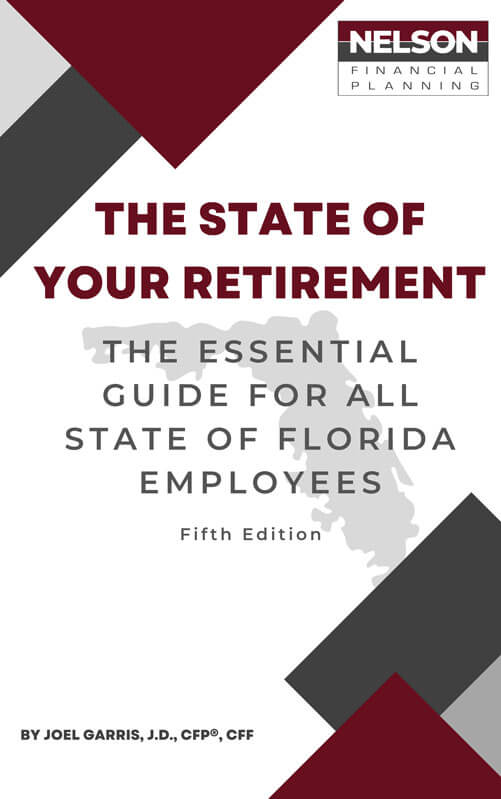
The State of Your Retirement - The Essential Guide for All State of Florida Employees

Decisions You Only Get to Make Once
The Florida Retirement System is generous — and unforgiving. Most of its biggest decisions are irrevocable:
- The plan election. Every FRS member gets one second election to switch between the Pension Plan and the Investment Plan during their career. Use it at the wrong time — or lose it by entering DROP — and there's no third chance.
- DROP entry. Entering DROP locks the pension benefit at that day's calculation, permanently closes the second election, and commits the member to a termination date.
- The survivor option. The payout option selected at retirement determines what a spouse receives for the rest of their life. It cannot be revisited later.
- Rollover timing. Moving deferred comp or a DROP payout to the wrong account at the wrong age can forfeit penalty-free access or trigger avoidable withholding.
And none of these decisions lives in isolation. Each one interacts with Social Security timing, Medicare premiums, and the household tax picture. That's why the right answer for a 52-year-old teacher with 22 years of service is genuinely different from the right answer for a 48-year-old deputy with 18 — and why generic advice fails FRS members so consistently.
Bad Advice Costs FRS Members Real Money
Nelson Financial Planning reviews FRS situations every week, and the same avoidable mistakes keep showing up — usually planted by advisors who don't know the system or are paid to recommend around it:
- The deferred comp rollover mistake. 457 deferred compensation plans carry a benefit almost nothing else has: penalty-free withdrawals after separation, at any age. Rolling that money into an IRA before 59½ — as members are routinely advised to do — throws that benefit away.
- The “guaranteed” annuity pitch. FRS employees are a favorite audience for steak-dinner seminars selling annuities with “guaranteed 7% growth.” The fine print: that rate applies to an income base, not money you can walk away with, and the product usually pays the salesperson a substantial commission while locking the member into years of surrender charges.
- The age-55 exception nobody mentions. The FRS Investment Plan lets members who retire in the year they turn 55 or older withdraw penalty-free before 59½ — and direct DROP withdrawals go a step further, recognizing an age-50 exception for special risk public safety officers. Advisors who reflexively roll everything into an IRA erase those options — often without ever mentioning they existed.
None of these mistakes feels like a mistake in the moment. Each one costs real money, and most are discovered only when it's too late to undo them.
Properly Plan Your Retirement Income
First, do not rollover your deferred compensation account to an IRA if you are under age 59½.
Once this money is placed in an IRA, you have to pay an extra 10% tax penalty to use the money if you are under age 59½. If the funds are left alone in the deferred compensation plan, you have completely flexible access to the funds with no tax penalty. Bottom line, if you are under age 59½, leave your deferred compensation alone.Second, the guarantees and promises that come with these “new” income approaches that use annuities are simply not as they are described.
These guaranteed income streams and returns are filled with caveats, fine print, and high costs. These promises don’t actually guarantee any real return on your money as they only apply to internal insurance company values. In addition, their income guarantee offers of 8% include the return of your actual investment in this calculation. Despite what annuity advertisements assert, that should never be considered a part of your profit. Your real rate of return (i.e., the actual profit on the investment you made initially) is typically only 2 to 3 percent. Bottom line, if it sounds too good to be true, it is.Third, if you are over age 55 and under age 59½ when you retire, you need to leave the amount of money you will need to spend before age 59½ in the FRS Investment Plan.
The FRS Investment Plan provides you an exception to draw money out in any amount or frequency without having to incur a 10% tax penalty for early withdrawal if you retire in the year you turn age 55 or older. This is a very valuable option for those who qualify. If all the money is rolled out of the FRS Investment Plan and into an IRA, you lose the flexibility of this option. Bottom line, if you are retiring in the year you turn age 55 or older, you have more flexibility by actually leaving some money behind in the FRS Investment Plan.What the FRS Planning Review Covers
This is a working session, not a sales call. FRS members leave here with specific answers on:
- Pension vs. Investment Plan analysis — modeled for your actual years of service, membership class, and second-election status.
- DROP timing math — the frozen-benefit-plus-lump-sum path versus continuing to accrue, under the current 4% rate and 96-month rules.
- Rollover and tax treatment — the 457, 403(b), and DROP payout decisions, including how to avoid the mandatory 20% withholding trap and a one-year tax spike.
- Social Security coordination — how the pension interacts with claiming timing, spousal benefits, and Medicare premium thresholds.
- Survivor option and beneficiary analysis — what each option actually pays a surviving spouse, and how it fits the household's full picture.
- Health Insurance Subsidy check — the forgotten benefit worth up to $225 per month from the state, plus a county portion where offered (Orange County pays one). The state only pays six months in arrears, so retirees who never file the forms lose the rest permanently. Nelson has found this unclaimed money for numerous retirees.
What to bring: a recent FRS statement or MyFRS estimate, deferred comp/403(b) balances, and questions. That's it.
The Fiduciary Difference - and Why It Matters Most Here
Every advisor guiding FRS decisions at Nelson Financial Planning is a Certified Financial Fiduciary™. That is not a marketing phrase — it means they have completed specific fiduciary training and are legally and ethically bound to act in clients' best interests at all times.
For irrevocable decisions, that distinction is everything. A commissioned salesperson profits when an FRS member rolls a pension into a product. Nelson doesn't charge for its conversations — so the DROP analysis, the rollover recommendation, and the plan election guidance carry no hidden incentive.
And unlike firms that charge FRS members annual consulting fees for guidance, these conversations have always been a free service to state employees — a commitment the firm has kept since 1984. Our advisors work with each FRS retiree to building the right retirement income plan.
Schedule Your Free Conversation Today

No account minimums. No obligation.
Planning your retirement savings as a member of FRS is a very intricate process. Depending on your age, years of service, FRS choices, and your deferred compensation account, the composition of your retirement benefits will be different.
During this 30-45 minute conversation, we can:
- Clarify your FRS options - how your pension, DROP, or investmnent plan works for your situation, and what your estimated retirement income could look like under each path
- Look at the "big" picture - how your FRS benefits work alongside IRAs, 403(b)s, and other savings; whether a Roth or Traditional IRA m ight make sense as a supplement to FRS
- Talk timing and next steps - simple concrete steps you can take now no matter where you are it - just starting out or close to the finish line
The Team that Wrote the Book on FRS
Literally. Nelson Financial Planning's booklet The State of Your Retirement: The Essential Guide for All State of Florida Employees — now in its 5th edition — covers the Pension Plan, the Investment Plan, DROP, and every major legislative change since 2008. It's the guide Florida government employees across the state have used to understand what their benefits are actually worth.
Joel Garris, J.D., CFP®, Certified Financial Fiduciary™

Christina Lamb, IRS Enrolled Agent, CF2
Tax planning built into every FRS recommendation, from DROP payout timing to rollover withholding. Most firms outsource tax; Nelson has it in-house.

Rob Field, NSSA, IRMAA Certified Planning, CF2
The only advisor within 50 miles of Winter Park holding both certifications; leads the Social Security and Medicare coordination that pension decisions depend on.

Kristin Kalley, CPA, CFP®, Certified Financial Fiduciary®
A rare credential combination, bringing CPA-level tax depth to rollover, DROP payout, and retirement income decisions.

Zach Keister, CF2, CRPC™
Chartered Retirement Planning Counselor and regular Dollars & Sense co-host; every advisor on the team is a Certified Financial Fiduciary, and every plan is a team effort.

Chet Cowart, Certified Financial Fiduciary™, CRPC™
A regular co-host of the Dollars & Sense podcast with a focus on disciplined rebalancing and keeping clients out of products built to pay the salesperson.

Get the FRS Decision Guide - FREE
The State of Your Retirement - The Essential Guide for All State of Florida Employees
The complete guide to the Pension vs. Investment Plan election, DROP eligibility and timing, and what the legislative changes mean for your benefits. The FRS audience has the most to lose from a wrong decision — this guide exists so members don't make one uninformed.
Should I Roll Over My Balance Into an IRA?
Expenses: The Whole Story
Expenses are only one factor in comparing investment options. The MyFRS Article compares the expenses of their proprietary FRS funds with other fund companies and draws the conclusion that they are cheaper. However, the MyFRS article is completely silent on the actual performance of these FRS funds. When comparing investment options, the most important factor is not expenses but what you earn after expenses.Income Tax Limitations
The MyFRS article does not mention the rigid tax planning limitations of the FRS Investment Plan. The FRS Investment Plan requires a mandatory tax withholding of 20% on any distribution made payable to a retiree irrespective of what you actually owe. For example, if you take $10,000, $2,000 will be sent to the IRS and you will only get $8,000 to spend.
When we help you retire, we start with how much you want to spend and then determine not only your tax liability but also when you should pay your taxes. Most of the time, the tax liability amounts to 10-12% of distribution for a retiree. In some cases, the proper timing of these tax payments may occur as late as April 15 of the year after you retire.
If your tax liability is only $1,000, why withhold $2,000? The IRS does not pay interest on the difference between what you had withheld and the amount you actually owe. Why should you be required to withhold more taxes than what you owe? This tax withholding is perhaps the most important reason to roll your money out of the Investment Plan and into an IRA when you retire.
Service (or Lack Thereof)
Recently, we called FRS to request a systematic withdrawal from the FRS Investment Plan for a recent retiree. We were told that we needed to call back the next day as they would not process that request right then because the timing did not fall within their parameters. The next day we called back only to have to wait on hold for NEARLY THREE HOURS! The FRS Investment Plan's rigidity and lack of service for FRS retirees are quite troubling. In the era of budget shortfalls and projected cuts, we expect this service will only get worse.Exceptions
As with any advice, there are always exceptions. In particular, if you retire and are over age 55, you should keep an amount in the FRS Investment Plan sufficient to cover your living expenses until 59½. Otherwise, you could face a 10% penalty on these withdrawals unless you choose to use a 72(t) distribution from an IRA.Frequently Asked Questions
Does Nelson Financial Planning charge for the FRS planning review?
No. The FRS planning review is free, with no obligation and no account minimums. It covers the Pension vs. Investment Plan analysis, DROP timing, rollover and tax treatment, Social Security coordination, and survivor option selection for your specific situation.
What are the biggest mistakes FRS employees make?
The five most common — and most costly — mistakes are:
(1) Starting too late — the FRS pension is a strong foundation, but for most retirees it isn't enough alone, and a small monthly investment early in a career makes a massive difference later.
(2) Not using 457, 403(b), or IRA options to build flexible savings alongside the pension — 457 deferred compensation is especially valuable because it carries no 10% early-withdrawal penalty at any age after separation.
(3) Skipping Roth options — paying taxes now, often in a lower bracket, so the money comes out tax-free later alongside a fully taxable pension check.
(4) Avoiding investing out of fear — market headlines are real, but doing nothing is the most expensive option.
(5) Messing up the DROP rollover — the most preventable mistake of all, with mandatory 20% withholding and penalty traps that careful planning avoids entirely. Nelson Financial Planning reviews all five in every free FRS planning conversation.
Do you work with both FRS Pension Plan and Investment Plan members?
Yes. Nelson Financial Planning works with FRS Pension Plan members, Investment Plan members, and employees who are unsure which plan they're in or are weighing their one-time second election. The right answer depends on years of service, membership class, age, and family situation — the review analyzes all of it.
Can Nelson Financial Planning help if I'm already in DROP?
Yes. For members already in DROP, planning focuses on the exit: coordinating the DROP payout with taxes to avoid the mandatory 20% withholding trap, deciding between a rollover and other options, timing Social Security, and structuring retirement income once employment ends.
Is there a minimum account size to work with Nelson Financial Planning?
No. Nelson Financial Planning has no account minimums. Whether an FRS member has $20,000 in deferred comp or $2 million across accounts, the guidance and the fiduciary standard are the same.
Are Nelson Financial Planning's advisors fiduciaries?
Yes. Nelson's advisors are Certified Financial Fiduciaries™ — they have completed specific fiduciary training and are legally and ethically bound to act in clients' best interests at all times. Meeting with the firm does not cost anything, which matters most for irrevocable decisions like the FRS election and DROP entry.
Do you only work with FRS members near Orlando?
Nelson Financial Planning is based in Central Florida and has served the region for more than 40 years, but works with FRS members across the state through virtual meetings. The Florida Retirement System rules are the same statewide — and so is the planning.