




Dollars & Sense Episode Summary
Kick off 2026 with Joel Garris, CFP® on Dollars & Sense as he tackles two questions every investor asks at the start of a new year: Where are the markets headed – and how do I actually stick to my financial goals this time?
This episode opens with Joel’s annual Fearless Forecast, including an honest look back at last year’s predictions. While deregulation and tax reform played out largely as expected, one major force reshaped the markets far more than anticipated: artificial intelligence. Hear why 2025 became a transformative year for investors, how a nearly 20% market drop turned into a third straight year of double-digit gains, and what those lessons reveal about the Dow’s outlook for 2026.
Looking ahead, Joel breaks down the forces likely to shape this year’s investment landscape – from AI-driven earnings growth and the real impact of recent tax legislation to growing concerns around market concentration, inflation, and labor pressures. He explains why 2026 may be a “pause year” for the major indexes – and why diversification could be the difference between simply riding the market and outperforming it.
The episode wraps with a practical shift from markets to mindset. Drawing on behavioral finance principles and insights highlighted by The Wall Street Journal, Joel shares actionable strategies for setting financial resolutions that don’t disappear by February. Learn how automation, clear targets, and regular check-ins can turn good intentions into lasting habits.
If you want to know whether your portfolio is positioned for what comes next – or whether this will finally be the year your financial resolutions stick – this episode delivers thoughtful analysis and real-world guidance to help make 2026 your strongest financial year yet.
Episode Chapters & Highlights
PODCAST CHAPTERS
- 00:00 – Welcome to 2026 & The Fearless Forecast
- 01:30 – Lessons from 2025: Consistency Beats Headlines
- 04:30 – What Last Year’s Market Forecast Got Right and Wrong
- 07:10 – How AI Became the Biggest Market Driver
- 13:30 – 2025 Market Performance: Dow, S&P 500, Nasdaq
- 16:50 – Key Trends for 2026: AI, Taxes, and Fed Policy
- 23:45 – The Biggest Risk: Market Concentration and Valuations
- 26:30 – Why Diversification Is the Core Theme for 2026
- 28:30 – Fearless Forecast: Dow Target for 2026
- 32:20 – Financial Resolutions That Actually Stick
HIGHLIGHTS
- Review of 2025 market performance and forecasting lessons
- AI’s role in driving corporate earnings growth
- Why fewer Fed rate cuts may be healthier for the economy
- Risks of market concentration inside major indexes
- 2026 Dow “Fearless Forecast” and what it represents
- Financial resolutions that focus on habits, not perfection
Podcast Transcript
Speaker: Joel Garris, CFP®
Welcome to 2026 & The Fearless Forecast
[00:00:00] Welcome to 2026. My goodness. These years just roll by, don’t they on this show, our first show of 2020. Six. We’re gonna be making our fearless forecast, that annual tongue in cheek exercise that’s been going on in this program for quite some time. And then we’re gonna talk about how we did last year. [00:00:28] Of course, we’re gonna make a forecast for the coming year. We gotta know how we did last year to see whether we have any idea what it is that we’re actually talking about. So stay tuned for that. We’re gonna talk about the trends that we, expect to drive the markets for this year and what we got what we got wrong for the past year. [00:00:48] And then as usual, at the start of of the year, people like to make New Year’s resolution. So we thought we would give you a couple of suggestions out as to how to maybe achieve a little bit more success on those resolutions. Then what the average. Individual does. Did you make any resolutions this year? [00:01:11] Are you still. We’re a few days into the year. So are you still on track for them or have you already fallen off? We’ll talk about how you might be able to get back on track with that. Here on this week’s edition, the first of 2026 of dollars and cents, [00:01:30] where we help you make sense out of all of life’s decisions involving your dollars. [00:01:33] One of Central Florida’s longest running radio programs. Also a top 25 financial planning podcast. On the big Wide World Web to find our channel’s. Either search for us on your favorite platform using Dollars and Sense with Joel Garris of Nelson Financial Planning, or go to our website at Nelson Financial Planning to find how you can directly link in to our channel. [00:01:59] Once you’re there, make sure you hit that subscribe button, and then that way you don’t have to do that exercise Again, my name is Joel Garris, certified Financial Planner, Certified Financial Fiduciary at Nelson. Financial Planning where we got a team of great folks who also happen to be certified financial fiduciaries as well. [00:02:16] They stand ready to help you improve your life in the new year with a successful and cost-effective financial plan. Basically, our goal at Nelson Financial Planning is to help you make better decisions with your money.Lessons from 2025: Consistency Beats Headlines
So here we are, 2026. We certainly wanna take a moment and wish you a happy and healthy new year.
[00:02:41] The other thing that strikes me now that it’s 2026 is the first quarter of the century is. Actually now in the books and looking ahead to this year, it’ll mark our 250th birthday of a country here in the us. So obviously gonna hear a lot about that during the course of this year. Then as usual, it’s not like the change of the calendar is a hard stop in terms of the headlines and the trends that were occurring last year. [00:03:15] We think some of those trends will obviously continue to be some dominant. Themes in the year ahead, but also be interspersed with some newer themes for the year that we think are gonna be crucially important for your investment performance this year.What Last Year’s Market Forecast Got Right and Wrong
Let’s begin, shall we? Last week on the program, we recapped the headlines of 2025.
[00:03:38] Certainly a lot of them, and one where, as we were talking about consistency, was certainly a chief ingredient to achieving investment results during the course of 2025. If you recall the year, and if you don’t listen to last week’s podcast the reality is that the year started off with nearly a 20% decline in the markets. [00:04:03] If you had focused solely on that, then you might’ve missed what happened in the rest of the year, which was a pretty strong recovery in the markets. And ultimately the markets wound up. Generating double digit returns for the third year in a row. Certainly a, an important reminder, as you said last week on the program, about being consistent and ultimately not. [00:04:29] Trying to not pay too much attention to the headlines one way or the other. So thinking about last year and this program from a year ago, we obviously talked about some themes and some things that we thought might happen. So we thought we would start this program recapping how we did a year ago in terms of our expectations, what we got right. [00:04:53] What we got wrong. Certainly a change of administration produced what we expected in terms of less regulation and pretty significant tax reform that happened during the course of the summer months, we. Did get that part right And certainly deregulation, tax cuts, all of that wind up adding to overall economic growth. [00:05:19] We also, a year ago, expected the Fed to start to cut interest rates, although they kinda waited a little bit longer than we thought they might did not get around to cutting rates last year until September, and then did one in September, October and then in December. So a total of three for the year, expected a little bit more than that out of the Fed. [00:05:40] I think probably the biggest thing that we got wrong, if you will, along with of course many others, is how much uncertainty was created by the stop and start tariff approach that we saw. That obviously contributed to that big decline. Nearly 20% decline in the [00:06:00] first few months of the year. And certainly a drag on businesses making decisions as well. [00:06:07] I think the lasting impact, I think we said this a little bit on the program last week, I think the lasting impact on that throughout the course of the year. Was more on smaller companies. Let’s face it, smaller companies don’t have the ability or the resources or the size to be able to pivot like a larger multinational company. [00:06:29] So I think that. Dichotomy or that difference in terms of who was impacted or who was able to navigate around versus who was a little bit more restricted in terms of how they could navigate was a big part of the underlying theme and the underlying current sort of in consumer sentiment and, and economic perspective. The reality is that the large companies, which obviously dominate a lot of the market indexes, found ways around that tariff uncertainty. And as we said on the program last week certainly the theme. For 2025 in terms of AI and how transformative it was. Not exactly something new.AI’s Expanding Impact on Corporate Earnings
[00:07:12] Ai artificial intelligence is certainly something that has been around for some time in various forms we’ve certainly been using at the office for several years now, particularly with our tax preparation software that kind of takes the documents and reads the numbers and then puts ’em into the software. [00:07:28] It’s pretty cool when you see it happen. [00:07:30] The reality is though, that I think it hit mainstream. Last year and and it seemed to jump to the front of the pages and seemed to gain critical mass, if you will.So it, it really became a big part of the conversation last year. One could certainly argue maybe to the.
[00:07:47] Detriment of the labor market because that weakness in the labor market and the tariff uncertainty and the continued inflation certainly did cause the fed reserve to, to lower rates. Maybe not. Exactly as much or as many times as the expectation was. But it certainly caused those rates to get lowered. [00:08:09] And we think, just as AI was a big theme for 2025, obviously we think that’s a big one that carries forward to 2026, so too will the fed and interest rates and what they will do as well. On that end, I think the general mainstream medias probably expect. Too many rate cuts outta the Fed. [00:08:29] I’ve seen some sort of prevailing estimates that say that the Fed’s gonna cut five different times. I don’t see it happening to that number. I would say maybe three. A repeat of this past year, 2025, but certainly not five. I think that’s a little bit. A high. So at the end of the day, as we reflect on a year ago and what the expectations were for 2025, I would say we got the deregulation and the tax cuts right? [00:08:59] And the positive [00:09:00] impact on that sort of right on the rate cuts, maybe not as many or as quickly as we as we expected, but the impact of AI and how big of a transformation and how much that hit the mainstream during the course of last year I think is what was the big surprise. [00:09:16] And probably the biggest reason why we undercut what our feelers forecast was a year ago. So we’re gonna take a break. We come back, we’re gonna recap what exactly our ERs forecast was from a year ago. And give you our thoughts for the Euro Road ahead here on dollars and Cents with Joel Garris of Nelson Financial Planning. [00:09:41] Welcome back to Dollars and Sense where we help you make sense out of all of life’s decisions involving your dollars, one of Central Florida’s longest running radio programs. Also a top financial planning podcast out there on the worldwide web. So make sure you check us out. In particular, check out our website@nelsonfinancialplanning.com to learn how you can connect to us on your favorite platform. [00:10:04] Once you’re there, make sure you subscribe, and then you don’t have to do that all over again. Plus you get notified when we upload new content, which of course we do each and every week on all of those various platforms. My name is Joel Garris, certified Financial Planner, certified financial fiduciary at Nelson Financial Planning, where we got a team of great folks who also happen to be. [00:10:26] Certified financial fiduciaries as well as long along with a [00:10:30] host of various expertise. We get to have the benefit of that expertise on the next couple of radio programs. Actually, you’re gonna be joined by Christina Lamb, our IRS enrolled agent, and Kristen. Costello on on the next couple of shows as we talk about taxes and tax changes and those kinds of things as well. [00:10:52] My name of course is Joel Garris, certified financial Planner and certified Financial fiduciary Nelson. Financial planning. So talking a little bit about the fearless forecast that we did a year ago. Always good to recap how we did last year, particularly since we’re about ready to go out on the proverbial limb and make our fearless forecast for the year 2026. [00:11:14] So as we were saying at the be at the. Close of the last segment. We got the deregulation right under the new administration. We got the tax cuts right on the rate cuts. Maybe a not quite as many as we might’ve thought as particularly a year ago. Certainly slower than anticipated in terms of when those rate cuts actually happened. [00:11:33] That didn’t happen until the fall. I would say probably the biggest underestimate was. AI coming into the mainstream. Always been around in various forms over the course of the years. It’s not like it’s all of a sudden just came out of complete nowhere. It was always lurking and building, and companies were using it. [00:11:54] But it became, I guess mainstream or mainstream media very much driven. And so that I think is a big part of what drove a lot of corporate profitability. Ultimately, why our fuelers forecast a year ago did not quite get as accurate as we would love it to be. And certainly our fuelers forecast a year ago was perhaps more muted than the markets wound up for the year. [00:12:22] So if you recall the show a year ago, and if you don’t, you can go into the archives on any of those podcast platforms and make sure we’re telling the truth ’cause it’s. The whole episode is on out there, on the internet, so you can’t get away with saying, oh, I said this when the reality is that there’s, something out there that said something, what you actually said. [00:12:40] Anyway the Fearless Forecast is our annual. Tongue in cheek exercise, and we’ve been doing this for well over 30 years. Or should I say my late father-in-law, Jack Nelson, started this exercise pH probably more like 35 years ago. He and I used to do it together when we were co-hosting the program. [00:12:59] And then for the past 15 years or so, I’ve been doing it on a solo basis. The caveat and the reason we say, of course, it’s tongue and treat. Cheek in, in case you didn’t know. The reality is that we can’t predict the future. And there you have it. So understand that this is just an interesting exercise. [00:13:18] Certainly a tradition on the radio show to to do it at the beginning of the year. But I wouldn’t basically kinda. Hold our feet to the fire on it. ’cause we’re basically trying to predict the future anyway.2025 Market Perforamnce: Dow, S&P 500, Nasdaq
So the impact of AI on productivity gains and the tendency of that.
[00:13:37] To lower costs for corporate America led to some pretty solid earnings growth for the year. Corporate earnings grew about 12% among larger companies. That’s pretty significant, which obviously propels the markets pretty well. Our prediction underestimated that, and I think that was the core thing that happened that maybe we didn’t necessarily see. [00:13:58] The reality is we still expected 2025 to be a decent year, but maybe not as strong as it turned out if you’re keeping score. Our feelers forecast for the Dow was for it to close at about 45,000 for the end of the year, 2025. Keeping in mind that started out the year at about. 42,500. So we were certainly expecting a positive year, but perhaps one not quite as strong because at the end of the day while we were predicting maybe a five or 6% type of return, the reality is the Dow wound up closing above 48,000 at the end of the year, which was actually up about 13%. [00:14:36] Broader markets also did even stronger with the s and p 500, up about 16%. The NASDAQ up about 20%. So I like to think that we under promised and the markets then over delivered for us. I guess that’s how gonna be how. We spin it because we thought the year would be positive, but at the end of the day, it wound up being much more positive than we thought. [00:15:00] Interestingly it was the second year in a row where we under promised, if you will on it for 2024. I think our fuelers forecast on the Dow was for the Dow to close out about 41,500. And it in fact closed out about 42,500. So we missed that one by a thousand last year. We actually probably a little bit more off since we missed it by 3000 points on the dao. [00:15:26] And why do we focus on the DAO when the reality is the s and p 500 is probably a little bit better broader index? It’s just tradition. It’s what we always have done here on the program is that we have limited our fuelers forecast to just that. Number on the Dow Chris, back when we, this all started 35 years ago. [00:15:45] The Dow was the index that everybody knew and many people didn’t know about the s and p 500. So it’s funny how things change over a third of a century. So that’s the recap for last year. We thought it would be 45,000 under promised it, if you will. Dow wound up closing at 48,000, so about 3000 points higher than what we had originally thought. [00:16:09] So that leads us to the question, what does 2026 have to offer? What are the trends that are gonna dominate? And most importantly, what. Our fuelers forecast is going to be as a result of not just the trends, but also the risks that we see, right? Any year. Okay. There’s gonna be some positives, but there’s also gonna be some risks as well, particularly as we start out the year.Key Trends for 2026: AI, Taxes, and Fed Policy
[00:16:32] So let’s get into that a little bit. We’re gonna start with the trends that we think will be important from a positive impact in terms of the market. And as we said the first one has gotta be, we’ll start with ai, artificial intelligence, and its ability, particularly as we saw this year, to drive corporate earnings, corporate profits. [00:16:52] We think that’s gonna continue next year. Obviously, the annual earnings growth expected for this year, 2026, is expected to be about 14% versus last year where corporate earnings growth came in at about 12%. So still that drive or the impact of AI on corporate profitability will continue to be a big driver in terms of earnings. [00:17:18] And obviously if companies are making money. Then that’s good for the market. We do think that those earnings will show up in, across a broader cross section of companies. It’s still a pretty concentrated market with what we refer to as that group of eight tech, very high ai focused businesses. [00:17:40] Tesla, Microsoft, Google, Amazon, Facebook, you know the names. But there’s a group of eight that ultimately made up. Over 40% of the entire market performance during the course of last year. So yes, AI will continue to drive corporate profits, but maybe see that on a little bit broader scale.Fed Rate Cuts: Expectations vs Reality
Second is that the full implications of the tax bill are gonna be felt, although that may not be as dramatic as people may think, because the biggest part of that tax bill that passed last year.
[00:18:18] Was that. It had to continue the lower tax rates from the prior several years, and so a lot of the dollars that were spent in that tax bill went just for that issue. So there wasn’t a whole lot of new stuff. There was some new stuff, but not a lot of new stuff. So we’ll get into that a little bit more about kind of the impact that’s going to have on the year 2026 when we continue after these messages here on dollars and cents with Joel Garris of Nelson Financial Planning. [00:18:59] First show of the new year 2026. We’re working through some of the trends that we think will have major impact in 2026, and then we’re gonna finish it up with our Fearless forecast. So welcome on into Dollars and Sense where we help you make sense out of all of life’s decisions involving your dollars. [00:19:17] One Central Florida’s longest running radio programs. Also a top financial planning podcast out there on the worldwide web to learn more about us and what we do on a daily basis by helping people to make better decisions with their money. Check out our website nelsonfinancialplanning.com. My name is Joel Garris, certified financial planner, certified financial fiduciary at Nelson. [00:19:43] Financial planning. So trends for 2026. We talked about the continuation of the AI trend from last year. We think that’s gonna continue to be a major player in driving corporate earnings. Corporate earnings, in fact, expected to grow by 14% this year, 2026 versus 12% last year, 2025. We do think that you’re gonna see that in a much broader range of companies rather than just the concentration that has been occurring. [00:20:10] Among those predominantly AI names like Nvidia and Microsoft and Amazon and Google, we do think that you’re gonna see that much more broadly in the markets. Number two that we were talking about is the tax cut. Obviously here a lot of that tax bill went to continuing the lower tax rates. But there will certainly be an impact, particularly if you’re below certain income levels where you could certainly see some extra money in your pocket as a result of the additional standard deduction from say, social security things, the increased child tax credit, things like that. [00:20:48] The reality is the next couple weeks on this program, we’re gonna be joined by. Kristin Costello of who is a CPA with us here at Nelson Financial Planning. And and then the following week it’s Christina Lamb, who’s an IRS enrolled agent here at Nelson Financial Planning. We’re gonna have them on the show in the next couple weeks to really talk through kind of these tax changes ’cause guess. [00:21:11] Tax season around the corner, gearing up for that. The other impact on the tax side is that don’t forget the bill had a lot of depreciation benefits or depreciation. Provisions in there that are going to allow companies to expense things at a much more accelerated rate, which could lead to increased spending. [00:21:31] Increased spending, obviously good for the economy. So theme one for 26, AI theme two tax cuts, theme three. Again, a little bit of a continuation of a theme from last year, and that is the Federal Reserve and what it’s gonna do for cutting rates. Obviously some of the weakness that you’re seeing in the labor market, some of the higher inflation that’s impacting the consumers. [00:21:57] There’s still a pretty good amount of consumer spending happening. Corporate America is still making pretty good money, so I think it, it becomes a little bit of a difficult proposition for the Federal Reserve to really cut rates. As regularly and aggressively as I think some folks would like. [00:22:14] Lower rates obviously stimulative to the economy, but you don’t wanna lower ’em too much too quick. ’cause ultimately that generates other economic issues that can spike inflation. So we think we’ll see some fed rate cuts, but maybe not as many as what is predicted. I would say you could see as few as two or three fed rate cuts during the course of the year. [00:22:35] I don’t think five or six or some of these other predictions are accurate based on what the landscape looks like. Fourth the cloud of the tariff uncertainty that sort of overhung the markets last year, I think that continues to. Dissipate perhaps remains subdued. I’m sure it will raise its head from time to time but certainly not have the, quite the same dramatic impact that it did during the course of 2025. [00:23:01] Of course, the real uncertainty on the political side of things is that, let’s not forget, 2026 is a midterm election year. That’s certainly gonna dominate Washington and lead. Probably a little progress on anything that’s that is substantive. So those are the, the factors or the trends that we see that could be a little bit more on the positive side to 2026. [00:23:22] If we take the flip side and talk about the risks I think the biggest risk is just the reality of what’s happened over the course of the past three years. You’ve had three years in a row where the markets have basically generated double digit growth. And while we would love a fourth year I have to temper your expectations on that, that markets don’t go up like this all the time on a nice, regular, smooth pattern.The Biggest Risk: Market Concentration & Valuation Risks
[00:23:46] So I, I would say. I would be a little concerned about the staying power of double digit returns for the year 2026. And certainly last year wasn’t exactly a smooth year with a 20, nearly 20% decline to start the year, but it led to a vi very, quick recovery. Again, as we said earlier, highlighting the notion the importance of consistency. [00:24:10] In 2025. Certainly by some measures you could argue that stocks are expensive and particularly when we think about, price relative to earnings, things like that. And that expense or expense concern is also correlated to the concentration issue whereby. Overall market concentration is really focused on a very small group of companies that basically are all in the same kind of industry. [00:24:37] That concentration among those group of eight companies is much higher than even in the late nineties. That those eight companies today drive over 40% of the performance of the s and p 500. So think of it this way, s and p five hundred’s supposed to be an average of 500 companies, right? But because it’s market weighted, the bigger larger companies will dominate. [00:24:56] You’ve got eight names basically dominating and generating 40% of the performance in that index. That’s pretty narrow. And so here’s the thing, I think to watch out for in 2026, because of the narrowness of that. You could certainly see a bit of a sell off that shows itself well or much more strongly in the market indexes. [00:25:18] And so here’s where we wanna make the distinction between the markets as a whole, measured by benchmarks like the s and p 500, things like that. And a diversified portfolio. Look, as we were saying last year, the key to getting good investment results for the year was to be consistent.Why Diversification is the Core Theme for 2026
We believe that the key to getting in good investment results for the year 2026 is going to be diversification.
[00:25:44] Because if you see any kind of weakness in this group of eight, that’s all in ai. That’s all in technology. You’re gonna see ma major declines in the. Indexes or much more significant decline in the indexes, then what may very well may be happening in the broader market among a broader cross section of companies. [00:26:06] So you could really see where having a diversified portfolio. Significantly outperforms the overall market indexes. Again, that’s the theme for 2026. Diversification last year was consistency. If you were inconsistent and jumped out in response to a 20% decline in the market, that started to start the year you missed out on the full recovery and then some, and what ultimately created a double digit. [00:26:35] Return for the markets in the year 2025, we think 2026. It’s not gonna be the market indexes that lead the way, but rather a much more diversified portfolio that really helps to balance things out as best as possible. So we think that’s gonna be the big theme. The risks of sticky inflation, labor market, all of that. [00:26:57] And midterms and mounting government debt, all of that is a big part of that. Interestingly if you’re elected as a senator here in the midterms, then your term is going to include the year 2032. Which is the year that social security is projected to be running a shortfall. [00:27:16] So I would expect to see some movement more on these bigger picture issues that have to deal with government debt. And in dealing with that, you may find that creates a little bit of a drag on the economy. ’cause the money’s gotta come from somewhere, folks. So with that. That backdrop, if you will, if we think about the positive trends that we expect in the coming year, we balance them out against the negative trends that we think we will see in 2026. [00:27:44] It could be, in a way, a little bit of a pause year for the markets. We think three years in a row, a double digit growth. It becomes hard to do that on a fourth year. And along with the concept that I think diversification is gonna be key and crucial to helping investors through generate overall returns for the year. [00:28:04] Certainly be a very different story if you’re focusing solely on the market. So with that backdrop, we’re gonna take a break and finish up with our fearless forecast, along with some tips to successfully com. Satisfy your New Year’s resolutions coming up here on dollars and sense with Joel Garris of Nelson Financial Planning.Fearless Forecast: Dow Target for 2026
[00:28:29] So here we go. Fearless forecast time for the year 2026. The reality is that in the prior segment we were talking about some of the trends that we see that will be positive. Things like tax reform, things like additional deregulation, things like ai. All of that. And then of course the headwinds that you would typically expect to. [00:28:50] Encounter, biggest of which is that there has been a period of time where the markets have generated double digit returns three years in a row now. So the longer that happens, the more you have to think about at some point the market’s going to pause. And in particular, I think that pause will be most seen in the market indexes because the market indexes are super, super concentrated in a very small handful of names that are all operating in the same economic space.Why Diversification is the 2026 Theme
[00:29:20] Technology, ai, things like that. So with that being said we think the key to next year in terms of, or 2026 or this year is is going to be a diversification. The thought is that you would see your portfolio, assuming it’s a well diversified one, actually perform. Quite a bit better than the overall markets, given that how concentrated the overall markets are. [00:29:47] So here we go with those thoughts. We do think that it’s gonna be a bit more muted year. The markets started out at 48,000 for the year. There was actually, there has been one trading. Day already here in 2026 and that was on Friday. We’re gonna project. So I guess with a drum roll, please. [00:30:08] We’re gonna project that the Dow closes out the year 2026 at 51,000. So a bit more muted. But the thoughts of why that will happen and in particular, the impact on the market indexes, causes us to think that the Dow is gonna close out around 51,000. So not a whole lot higher than where it. [00:30:28] Starts the year out. But again, I think 2026 is gonna be a crucially important year to make sure you have a diversified portfolio. ’cause we would expect you’re gonna see better returns in that diversified portfolio than you are in the overall markets. Because that concentration, we suspect is going to get less. [00:30:47] Concentrated and the impact is going to be much greater on that small handful of companies. I guess if you take our miss from, for this year where we underestimated where the Dow would end at about by about 3000 points. We thought it would be 45,000 a year ago, and instead it ended at 48,000. [00:31:04] Unscientifically, I’m basically taking that miss and adding it to the current level of 48 and that ultimately is shaping our. Fielders forecast of 51,000 on the Doud and the year. So mark it down, lock it in. As we said, it’s not an overly scientific process if I’m taking my miss from last year and just adding it on or my underestimate of last year and just adding it on to the current [00:31:30] level but certainly a stab on it. [00:31:32] And at least you have our thoughts as to what. The trends and the risks that are gonna be vitally important during the course of next year. So guess what? A year from now, you’ll get to see how close or how far off we are. That’s what this whole exercise is all about. The fearless forecast, our annual tongue in cheek exercise that we’ve been doing on this program for over 35 years now. [00:31:56] So lock it in. There you go. 51,000. Hopefully the explanation of why we think it’s gonna wind up there all make sense and if it doesn’t, then guess what? You can call the office. At 4 0 7 6 2 9 6 4 7 7 and give us your perspective or send us an email courtesy of our website@nelsonfinancialplanning.com.Financial Resolutions that Actually Stick
[00:32:18] We’re gonna end this last segment. Obviously, it’s it’s a new year, so people like to go ahead and try and make some New Year’s resolution as we step into the new year. Those resolutions have a tendency unfortunately to, fail pretty quickly. Something like the 80% of people who make resolutions give up by the second week of January, that’s not exactly a staying power Apparently. [00:32:42] The second Friday in January is affectionately known as quitters day because that’s. Of the day when when people generally give up on their, I guess by the time you get to the second weekend of the year, you’re like, ah, the heck with it. I’m just gonna go out and have fun. And that is understandable. [00:32:57] Oftentimes resolutions are just that they’re vague, they’re unrealistic, they don’t really have a clear plan versus setting a specific goal which ultimately I think is a big part of how you manage to get through. A particular resolution or ultimately make a resolution that that sticks Because something that isn’t really definite is easily positioned to not exactly be successful or not exactly be achievable. [00:33:28] At the end of the day if we think about financial resolutions, and then it’s certainly good to make them at the beginning of any year or. Really at the beginning of any day during the course of the year. The reality is the sooner you address and improve your finances, the better off you’re going to be. [00:33:46] The reality is that money touches every part of life, whether it’s security or freedom or wellbeing. And we think about financial discipline. It’s not just about budgeting it’s aligning your spending and your savings, and you’re investing with the values and the goals that you want to achieve. [00:34:03] So the reality is that without discipline it’s gonna be very difficult to create the habits to help you. Those bigger goals. So a lot of people make the same mistakes EE every year when it comes to resolutions. They don’t really necessarily define why they are doing it. They can sometimes overcomplicate the process. [00:34:25] And then, good old social media that allows you to compare yourself to anybody and everybody on a regular basis is a good way to undermine your resolution. Look, the reality is that everybody’s financial journey is unique. We talk about that all the time at the office and here on the program. [00:34:43] And it’s also why we don’t ever have account minimums at Nelson Financial Planning, something that we’re very proud of that we’ve been able to maintain now this year as we approach our 42nd year as a financial planning firm here in central Florida, we’ve never had account minimums and have no intention of ever having account minimums because we believe it’s more important. [00:35:04] To meet people where they are in their financial journey. So whether you’re just starting out or whether you’re at the finish line and finishing strong we’re here ultimately to help you make better decisions with your money.Dow Forecast: Where Markets May End 2026
And the reality is that if you’re focusing on social media, making those comparisons.
[00:35:22] It’s just easy to get off track and develop that kind of all or nothing mindset. Look, if your goal is to get healthier and you miss one gym session, that doesn’t mean that, it’s not an achievable goal. If if you’re trying to spend less and you go on a little bit of an overspending binge for a day or two, again, it’s not. [00:35:41] About perfection. It’s more about making progress. There’s a great acronym when it comes to goals. It’s smart. You may have heard it. SMART stands for specific, measurable, achievable, relevant. Time base, that’s the acronym that you want to think about as you set goals for [00:36:00] the new year. So start with that. [00:36:02] Why? What is the goal that you’re trying to accomplish? Set it up so that you automate that savings and investing so that it’s automatically goes into that corporate that employer retirement plan, or it automatically goes into. A savings account or an investment account. The more you automate stuff, the more you take the guesswork out of it and make it much more attainable in terms of a goal that you’re trying to achieve. [00:36:29] Obviously, you wanna set realistic goals if you’re trying to. Save a hundred thousand dollars and you only make $50,000, then you’ve gotta work a little bit more with the numbers in terms of setting those specific measurable goals and break it down into steps, right? If the goal is to save $12,000 in emergency savings, that’s a thousand dollars a month. [00:36:50] Focus on that rather than the big number. The goal here when it comes to New Year’s resolutions, and particularly those that are financial in nature. You want to try and develop good habits. This is not a pass fail test. It’s not if you mess up once, that’s it. The reality is that it’s about developing good financial habits. [00:37:12] So we think, we hope that those are some things that you can take away here in the new year to help you improve your overall. Financial help with that we’re gonna get on out here and wrap it up for our first show of 2026. My name is Joel Garris of Nelson Financial Planning. To learn more about how we can help you visit our website@nelsonfinancialplanning.com. [00:37:36] Hope you have a great 2026. Happy New Year.Next Steps
If you’d like help reviewing your financial plan, investment strategy, or retirement readiness, explore the resources available through Nelson Financial Planning or schedule a consultation to discuss your goals.
Get a free copy of our book and workbook Next Gen Dollars & Sense
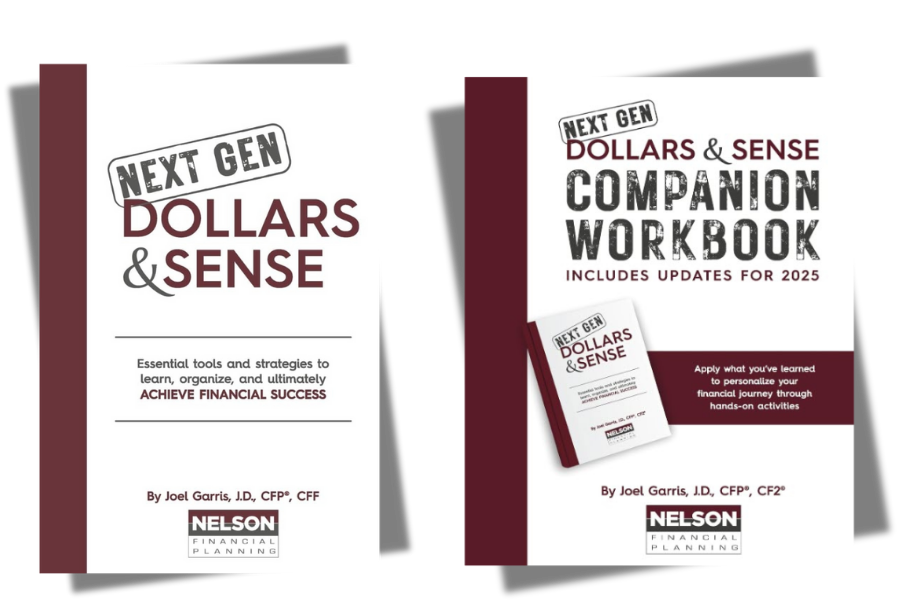
Unlock the secrets to financial success with Joel J. Garris’ insightful book, designed to equip you with the essential tools and strategies needed to take control of your financial future. Whether you’re just beginning your financial journey or approaching retirement, this book offers a comprehensive guide to help you build a solid financial plan that aligns with your goals.
- 8 Wonders1
- Bank Investments3
- Beating Inflation1
- Budget for Retirement5
- Corporate Transparency Act2
- Digital Currency1
- Energy Tax Credits1
- ESG Funds1
- Featured Blog0
- Financial Planning14
- Financial Success5
- Importance of Dividends1
- Investment Diversification1
- Investment Portfolio6
- Investment Strategy4
- IRA1
- Joel Garris1
- Nelson Financial Planning7
- Net Worth Improvement1
- Next Gen Dollars and Sense1
- One Big Beautiful Bill Act (OBBBA)1
- Pension Plans1
- Podcast Transcripts17
- Retirement “Secure” Act2
- Retirement Income Planning3
- Retirement Planning7
- Retirement Regrets5
- Social Security4
- Tax Liability3
- Tax Planning7
- Year-End Tax Changes3