




How Ultra-Long Car Loans, Loss of Purpose in Retirement, and Poor Spousal Planning Quietly Undermine Financial Security

Dollars & Sense Episode Summary
In this wide-ranging episode of Dollars & Sense, Joel Garris tackles three financial issues that are quietly reshaping the lives of families, retirees, and surviving spouses across the country – often without them realizing it until real damage has already been done.
The episode begins with a disturbing trend in the auto industry: the rise of the 100-month car loan. With the average new car price now exceeding $50,000 and monthly payments topping $750, many households are stretching loan terms to make payments “affordable.” But as Joel explains, these ultra-long loans dramatically increase interest costs, delay equity buildup, and leave families financially vulnerable if income changes or the economy slows. What looks manageable on a monthly basis can quietly erode savings, retirement contributions, and emergency reserves for years.
“A car is a tool, not a wealth builder. If the payment only works with an eight-year loan, the car is probably too expensive.”
From there, the conversation shifts to a completely different, but equally critical, retirement issue: the loss of “mattering.” While most retirement planning focuses on investments, income, and healthcare, research increasingly shows that lifestyle – not money – is the strongest predictor of retirement satisfaction. Retirement doesn’t just end a job; it often ends a role, a routine, and a sense of being needed. Joel explores why retirees who fail to plan for purpose, contribution, and connection often struggle emotionally and physically, even when their finances are solid.
“Retirement doesn’t just end a job = it often ends a role, a routine, and a sense of being needed.”
Finally, the episode addresses one of the most emotionally charged and financially dangerous transitions many families face: the death of a spouse. Joel outlines the financial blind spots that frequently overwhelm surviving spouses – surprise debt, inaccessible accounts, missing passwords, unexpected tax increases, and the loss of one Social Security benefit. Compounding the stress is the so-called “widow’s penalty,” where tax brackets shrink just as income becomes more fragile. Without proper planning, grief is often paired with confusion, delayed access to assets, and avoidable financial mistakes.
“The greatest risk in retirement isn’t outliving your money – it’s outliving your sense that you matter.”
Throughout the episode, Joel emphasizes a consistent theme: smart financial planning is about more than numbers. Whether it’s avoiding debt traps, designing a meaningful retirement, or protecting a surviving spouse from unnecessary hardship, clarity and preparation create resilience. This episode offers practical insights, real-world examples, and actionable guidance for anyone who wants to make better decisions with their money – and their life.
10 Key Takeaways
- Ultra-long car loans reduce monthly payments but dramatically increase total interest and financial risk
- Focusing only on the payment hides the true cost of owning a vehicle
- Retirement satisfaction depends more on purpose and connection than portfolio size
- Many retirees underestimate the emotional transition away from work
- Feeling valued and useful is critical to long-term emotional and physical health
- Surviving spouses often face surprise debts, frozen accounts, and lost income
- The loss of one Social Security benefit can significantly alter household cash flow
- Tax brackets narrow after a spouse’s death, often increasing taxes despite a lower income
- Proper account titling and beneficiary designations can help avoid probate delays
- Planning ahead creates clarity during emotionally overwhelming moments
Episode Chapters
- 00:00 – The Hidden Crises Facing Today’s Families
- 02:00 – Car Payments Over $750 and the Rise of 100-Month Loans
- 05:40 – Why Focusing on Monthly Payments Is a Financial Trap
- 09:00 – Negative Equity and the Auto-Loan Debt Snowball
- 13:45 – Smarter Alternatives: Shorter Loans and Better Planning
- 17:40 – Retirement’s Overlooked Challenge: The Need to Matter
- 22:00 – Why Lifestyle Predicts Retirement Happiness More Than Money
- 26:10 – Planning for Purpose, Connection, and Contribution
- 31:00 – Financial Blind Spots That Burden Grieving Spouses
- 34:45 – Social Security Losses and the Widow’s Tax Penalty
- 38:00 – How to Prepare Now to Protect the Surviving Spouse
Podcast Transcript
Podcast: Dollars & Sense
Episode Date: January 25, 2026
Speakers: Joel Garris, Certified Financial Planner® Professional and Certified Financial Fiduciary™
00:00 – Opening: What This Episode Covers
00:00:05 — Joel Garris, CFP:
Loaded show today, folks. So we’re going to be talking about the hidden crisis that impacts every single retiree. And the crazy thing about this particular crisis is it actually doesn’t have anything to do with your money. So we’re going to talk about what that is and things that you need to be aware of to make sure that you are dealing with that appropriately. And then we’re going to try and tackle a tough subject.
00:00:33 — Joel Garris, CFP:
And that is some of the financial blind spots that we see that create significant burdens when a spouse passes away. So welcome on into the program. This, of course, is Dollars & Sense, where we help you make cents.
00:00:50 — Joel Garris, CFP:
Out of all of life’s decisions involving your dollars—one of Central Florida’s longest-running radio programs. Also coming to you on a host of podcast channels. So make sure you check us out on your favorite platform of choice. Any trouble finding us? Visit our website at nelsonfinancialplanning.com. There you’ll see the icons, including our YouTube channel as well.
00:01:15 — Joel Garris, CFP:
And then just click on the icon. Once you’re redirected, make sure you subscribe. That way you’ll get alerted to when we post new material, which, as you know, is every week here on Dollars & Sense. My name is Joel Garris, Certified Financial Planner, Certified Financial Fiduciary at Nelson Financial Planning, where we’ve got a team of Certified Financial Fiduciaries who join us regularly on the program. This week we’re flying solo, so hopefully we’re—
00:01:45 — Joel Garris, CFP:
—going to keep the plane on the right track in terms of our topics. The folks at Nelson Financial Planning stand ready to help you improve your life with a successful and cost-effective financial plan. Speaking of cost-effectiveness, I don’t know if you saw this article. This was an article in The Wall Street Journal recently about—
02:00 – Car Loans: $750+ Payments and 100-Month Terms
00:02:09 — Joel Garris, CFP:
—a disturbing statistic about car loans. And it really grabbed my attention. We wanted to take a moment here at the beginning of the show and talk it through with you because it does have some pretty significant impact on pretty much every family out there today. The headline of the article kind of says it all: that car payments now average—
00:02:36 — Joel Garris, CFP:
—more than $750 a month. Enter the 100-month car loan. Now, those of you who have issues dividing by 12—I know I had to use a calculator a couple of times on this one—that means that’s over an eight-year—eight years and a third, to be exact—car loan that you would have if you have a 100-month car loan. That’s—
00:03:05 — Joel Garris, CFP:
—an incredibly long period of time. And obviously, I think the background of all of this is what’s been going on, particularly when it comes to the auto market—new cars. New car prices have skyrocketed. The average price of a new car over the past several years has jumped—
00:03:26 — Joel Garris, CFP:
—33%. So by about one-third since 2020. So here in just a little over five years, you’ve seen an increase significantly above inflation of a 33% increase in the average price of a new car. Many cars now cost more than $50,000. And so because of that—
00:03:50 — Joel Garris, CFP:
—folks are stretching out payments longer, paying more interest, all of which is not good from a financial point of view. And I guess the selling point when you go into the auto dealer is, “We can make that payment more affordable by changing the term of the loan.” So maybe instead of a five-year loan, maybe we can do a seven-year loan. Maybe even an eight-year loan. And now you can do these 100-month car loans—
00:04:20 — Joel Garris, CFP:
—which are over eight years. And in late 2025—so about a month or so ago—the average new car payment hit about $762 a month. So that’s a particularly big drain on the budget. And what you’re finding is that people are getting more attracted to these longer loan terms, which ultimately reduces the monthly payment.
00:04:45 — Joel Garris, CFP:
But that’s been the issue now, right? So it’s not just that the cars are getting more expensive, but families are taking on more debt. That debt is costing them more money because they’re stretching out the payments over a longer period of time, at a time when interest rates aren’t exactly rock bottom. And that really has the potential to put a lot of pressure on your household finances.
00:05:12 — Joel Garris, CFP:
It squeezes room for savings, squeezes room for emergency savings, retirement contributions—all of that. And heaven forbid if your income changes, the economy slows, then you’ve got a pretty long car loan to navigate. So we thought we would talk about some of the pitfalls that cause people to fall into this car loan trap, and then some of the ways you can try to avoid it. Among the pitfalls is focusing on that monthly—
00:05:42 — Joel Garris, CFP:
—monthly payment, right? You’ve certainly heard the car dealer always ask, “How much can you afford? What can you afford per month? Let me figure out what you can afford per month, and then we’ll figure out how we get that car in your hands today.” Obviously, that’s not exactly how a car salesman would say it, but you get the deal. And so focusing on that monthly payment, there’s a little shift—
00:06:10 — Joel Garris, CFP:
—in terms of how long that car loan will be. And ultimately, that increases your overall cost of owning that car. Here’s an example. If you’ve got a $50,000 loan at, say, 5%, and you do that over five years, you’re going to have a $950 a month payment and pay over the five-year period roughly about $6,600 in interest.
00:06:32 — Joel Garris, CFP:
If you then take that same $50,000 and borrow it over 100 months—that eight-plus-year period of time—your payment’s going to drop down to $600. You may say, “My goodness, that makes that car so much more affordable. I can do $600. I can’t really do $950, but I can do $600. So I’m going to go with that.”
00:06:52 — Joel Garris, CFP:
The problem is because it’s eight-plus years of a loan versus the traditional five years, the amount of interest you pay nearly doubles. So on that example of that $50,000 loan over five years, you paid about $6,600 in interest. On the 100-month loan—same amount of money that you borrow, the $50,000—you’re going to pay over $11,000 of interest. So just about double—
00:07:21 — Joel Garris, CFP:
—and that means that’s money out of your pocket that you’re never going to see again. So that’s kind of the first mistake that people make. Another thing is taking a longer loan to justify a more expensive vehicle, right? Maybe you can afford a little bit more of a payment. And by stretching out the loan payment over an extended period of time, voilà—you get a better car.
00:07:48 — Joel Garris, CFP:
And that’s kind of what the automotive industry is banking on, right? They’ll put you in the higher-price trims and features and benefits to fit them into your budget. And the disturbing thing when you think about an eight-year car loan is—
00:08:08 — Joel Garris, CFP:
—cars break down. I don’t even know if, when you’ve got an eight-year car loan, the car is really going to last as long as the car loan. And then when the car starts to break down, it starts to get old, your habits change, technology changes—whatever the case may be—far too often we hear where people are rolling that negative equity into the next car loan.
00:08:35 — Joel Garris, CFP:
Because if you try and get rid of your car and you owe more on it than what it’s worth, that’s a negative equity situation. And a lot of car dealers will advertise, “Don’t worry about that. We’ll take care of that.” Well, how that gets taken care of is by rolling that into the new loan. And obviously, now with that next car payment—
00:08:58 — Joel Garris, CFP:
—you’re paying on the car you just got and you’re still paying on the car you had before. So it’s the very definition, folks, of a debt snowball.
00:09:08 — Joel Garris, CFP:
And then lastly, another mistake that people make is ignoring that there’s more to the cost of a car than just the cost of a car. There’s insurance, which is a big cost. There are ongoing taxes. There are maintenance costs, gas costs—all of those kinds of things, which have a tendency to trend higher. So those are some of the traps that people fall into when we think about cars. When we get back from the break, we’re going to talk about maybe some better—
00:09:38 — Joel Garris, CFP:
—alternatives, the benefits of better planning to help people combat this issue—a significant issue that affects most families when you start to talk about the increasing price of cars over the past few years, and then the silliness with the loan to try and make the payment fit your budget. We’ll have more on this when we return here on Dollars & Sense with Joel Garris of Nelson Financial Planning.
10:10 – Better Planning: Shorter Terms, Better Financing, and Saving Ahead
00:10:10 — Joel Garris, CFP:
Talking about one of the harsh realities here on this week’s episode of Dollars & Sense involving cars and car loans. Welcome on back into the program. This is Dollars & Sense, where we help you make cents out of all of life’s decisions involving your dollars. One of Central Florida’s longest-running radio programs, also a top 25 financial planning podcast. So make sure you check us out on your favorite podcast platform along with our YouTube channel as well. Visit our website at Nelson Financial—
00:10:39 — Joel Garris, CFP:
—Planning for more information on how you can connect. My name is Joel Garris, Certified Financial Planner, Certified Financial Fiduciary at Nelson Financial Planning, where we’ve got a team of folks who stand ready to help you make better decisions with your money. This week we’re talking about some of the disturbing trends happening in the car market these days. Average monthly payment for a car loan in America at the turn of the year averaged above $750. Average price of a new car in America now exceeds $50,000. And my goodness, that makes a situation that is ripe for—
00:11:04 — Joel Garris, CFP:
—running into financial difficulties for pretty much every family in America. And you hear it all the time: “Let me see if I can figure out a monthly payment that’s going to work,” or “How much monthly payment can you afford?” That’s under the guise of trying to get you into your “dream car.” The problem is that the cost of that dream is going to accelerate pretty dramatically because in order to get you the payment that you need, what they’re doing is extending—
00:12:00 — Joel Garris, CFP:
—out the term of the loan that you’ve got for that car loan. So now you’re seeing some of these car loans go out 100 months. That’s over eight years in terms of that payment. And ultimately, it becomes a question of whether the car is going to be worth as much as what you owe on the loan at the end of the day, which can create a tremendous snowball when you want to buy the next car and your current car is worth less than what you owe on the loan—
00:12:10 — Joel Garris, CFP:
—because you spread the loan out over such a long period of time that you were paying more interest, less principal. So the principal didn’t go down. And now you want another car, and the car dealer is only too happy to say, “Let’s take that negative equity—the amount you’re upside down—and roll it into the new car loan.” So now—
00:13:05 — Joel Garris, CFP:
—when you’re paying that car loan, you’re not just paying for the current car, but you’re paying for the prior car. It can snowball dramatically. This notion of using longer loan terms to justify a change in vehicle—or a more expensive vehicle—is a real problem that ultimately is a major detriment to a lot of people’s finances.
So now we’re going to shift gears and talk about what you can do. First, understand the numbers. Look at the total cost of the loan, not just the payment. Much like when you’re in the market for a car, you should research total cost of ownership: insurance, tags, sales tax, maintenance, the cost—
00:13:29 — Joel Garris, CFP:
—of gas. All of that is part of understanding what that car is truly going to cost you. And if that means you’re going to buy a less expensive car or explore the used car market, maybe that’s not a bad idea. You don’t want your car loan payment to be something you can’t afford. Shorter loans reduce the overall cost, especially the interest.
When you have a shorter loan, more of that payment goes to principal. That means you build equity faster and reduce your risk of being underwater.
It’s also important to shop around for different places that can lend you money. Credit unions are typically better on rates and terms than what you’ll get at the dealership. And then save money ahead of time before you go car shopping. Set up a car—
00:15:11 — Joel Garris, CFP:
—fund that helps you save for that car.
So a couple of action steps. Calculate the total cost of the loan—not just the monthly payment. Longer loans will always cost you far more than shorter loans. Aim for the shortest loan term you can afford—maybe it’s four years, maybe it’s five. If the payment you can afford doesn’t fit the term, you need a cheaper car. That’s really what it comes down to.
Shop around—both the dealership and the financing. And don’t rush. This is a big decision.
And we talk a lot about this in the book, Next Gen Dollars & Sense, and its companion workbook. A car is a tool. It’s not a wealth builder. It doesn’t typically appreciate. It’s not a status symbol, even though many people think it is. The goal of a car is to get you from point A to point B reliably. That’s a point we make in chapter 14 of the companion workbook—
00:16:34 — Joel Garris, CFP:
—where there’s an exercise on car payments and how much the car actually costs.
For those of you who don’t have a copy yet of that companion workbook, we continue to offer it absolutely free of charge as a courtesy to our radio show and podcast listeners. Visit nelsonfinancialplanning.com where you can request your free copy. If you don’t have the book itself, you can ask for a free copy of that as well.
And while you’re asking, if you listened to the past couple of shows, we had a lot of conversation—thanks to Christina Lam and Kristen Costello joining us in the prior two weeks—about taxes and some big tax changes. We’ve also got that top 10 tax changes that you can request on the website as well. So let’s—
00:17:28 — Joel Garris, CFP:
—shift gears and set the stage for this next topic.
17:40 – Retirement’s Hidden Crisis: Mattering
00:17:40 — Joel Garris, CFP:
This is an intriguing topic that doesn’t get a lot of conversation because it’s not really financially related. It’s not really investment related. And yet it’s an aspect of retirement that impacts every single person who retires. The concept is: are you feeling like you don’t matter? Are you feeling like you don’t matter when it comes to retirement?
That concept of mattering is something a lot of people don’t talk about. But more and more research is suggesting that mattering in retirement can have a much greater impact physically, mentally, emotionally, psychologically than not having money, health, or longevity. It comes down to the feeling that you’re seen, valued, and contributing to something meaningful.
We often see it turn into one of the biggest unspoken retirement challenges of our time. One of the first questions I ask when people come in to talk about retirement, before any of the financial questions, is: what are you going to do with the rest of your life? Because answering that can be more important than where your income is coming from.
When people plan for retirement, they almost always think about finances and healthcare. That’s crucial. But research is starting to show that the need to feel valued, useful, and connected is equally important. We’ll have more on this when we return—
00:19:55 — Joel Garris, CFP:
—after these messages here on Dollars & Sense with Joel Garris of Nelson Financial Planning.
00:20:14 — Joel Garris, CFP:
Talking about what we’re describing as a concept that isn’t talked about very much, but is perhaps one of the most unspoken, misunderstood retirement challenges of our time. And that’s this notion of feeling like you matter—feeling like you matter when you retire. That notion of being seen, being valued, contributing to something. These are basic instincts of all human beings. So anybody retiring is going to feel this in some way.
And the reality is that it’s crucially important. Studies are coming out saying it’s not just about how much money you have. It’s not just about how much you’ve set aside for finances or healthcare. The need to feel valued, useful, and connected is just as important as those financial questions.
One of the reasons we ask, when people come to us to start talking about retirement, is: what are you going to do with your life? Answering that can be just as important as where your income is coming from and how much money you need.
And while most people plan carefully for what retirement looks like financially, a recent study concluded that less than half of people spend any time trying to figure out what their lives will look like after they stop working. And here’s the kicker: lifestyle, not finances, turned out to be the strongest predictor of satisfaction in retirement.
If you want to retire and be satisfied—would you really want to be retired and dissatisfied?—you’ve got to have a game plan for how you’ll spend your time. Because when you retire, it doesn’t just end a job. It often ends a role. It ends a routine. It ends a sense of being needed. It ends that sense of community you had going into the office.
This is basic human wiring. And today, it determines how well we cope, connect, and engage. So the question isn’t how long do I think I’m going to live. It’s really how long will I continue to matter along the way.
23:00 – Common Mistakes Retirees Make
00:23:00 — Joel Garris, CFP:
A lot of common mistakes pop up here. We see them all too regularly. It starts with believing money alone determines retirement success. Money doesn’t buy happiness—that’s true in retirement too. Just because you have money doesn’t guarantee meaning, connection, or purpose.
When the paychecks stop, there can be a huge emotional gap that money alone can’t fill. You lose some of those anchors that work provides: built-in sources of validation—colleagues, responsibilities, recognition. People underestimate the psychological impact of that because retirement is a significant emotional transition.
Even if you’re looking forward to leaving work, you can feel disoriented if you don’t have a plan for how you’re going to spend your free time. And when people don’t feel as validated or seen, they tend to withdraw. That’s the natural instinct.
But research suggests the opposite is what helps: contribute, engage, reach out, prepare for a third act where retirement isn’t an end, but the beginning of a new chapter.
That sense of usefulness helps reduce anxiety, depression, isolation. Having a role leads to greater life satisfaction. It creates structure and deeper social connection.
So establish a plan for staying engaged—friends, neighbors, communities—to replace collegial connections from work and renew purpose. Instead of retirement becoming “what now,” it becomes “where can I contribute and make a difference?”
Planning how you’ll matter in retirement is just as important as planning how you’ll spend your money.
26:21 – How to Build a Plan for Mattering
00:26:21 — Joel Garris, CFP:
At the end of the day, it requires planning. Think about going to places where you feel seen. Look for roles where you can contribute and have your contributions valued. Cultivate relationships with mutual support.
One key thing people suggest is to say yes to invitations—especially at the beginning of retirement. And extend your own invitations for others.
There’s a need in the community for mentoring, volunteering, helping people. There’s plenty of need where you can find something to do where you still matter—especially if you make yourself useful.
As you plan retirement, ask yourself: What am I going to do? Who am I going to see regularly? When am I going to contribute? Where am I going to matter? How am I going to stay connected? Who’s going to depend on me? These are equally important because they contribute to emotional and physical well-being.
When you step away from work, you’re going for a new identity. Just like you plan your finances, prepare for life itself. Because perhaps the greatest risk isn’t outliving your money—it’s outliving your sense that people value you and you matter to others.
Yes, retirement planning is about numbers, but it’s also about thoughtful conversations about what you’re going to do with your free time. That’s an important question we ask everyone at Nelson Financial Planning, because that answer can contribute directly to improving your emotional and physical well-being.
And money can’t buy that.
00:29:09 — Joel Garris, CFP:
So with that, we’re going to wrap up this segment and continue after these messages here on Dollars & Sense with Joel Garris of Nelson Financial Planning.
29:30 – Segment Recap: Cars, Mattering, and the Next Topic
00:29:30 — Joel Garris, CFP:
So on this week’s program, we’ve tackled a couple of major financial issues that really impact pretty much everybody. When you’re in the new car market, understand how much the cost of vehicles has gone up over the past few years. And understand the game that’s played to get you into a payment you can afford per month.
Be careful, because that can mean ending up with a longer loan. That longer loan will cost you much more money than a shorter loan.
And then in the prior segment, we were talking about a rising challenge that studies have concluded is crucially important in retirement: mattering. What are you going to do to make sure you’re still valued, seen, and a vital part of your surrounding community? Ask those questions before retirement, because otherwise you may withdraw, which compounds the problem.
To achieve the best emotional and physical health, it’s hard to do that in isolation. More important to be out there in the community. That’s a basic human need—needing others around you.
We’ll finish this week’s program with a third crucially important topic: issues that surviving spouses find themselves facing when their spouse passes away, and what you can do now to be in better shape when that time comes.
31:01 – Financial Blind Spots That Burden Surviving Spouses
00:31:01 — Joel Garris, CFP:
Because the reality is there are often surprises—there are always surprises—when one spouse passes away. The surviving partner often discovers bills they didn’t know existed, accounts they didn’t know about, or accounts they can’t access because they don’t have the right password.
Tax changes they don’t anticipate. Income changes they don’t anticipate. Chief among those is the fact that if both of you are collecting Social Security and one passes away, one Social Security benefit ends. You get the higher one, but the lower one goes away.
Then there can be various legal or credit issues when trying to claim assets owned by the decedent. And all of this happens during a time when people are emotionally vulnerable.
So like planning ahead for buying a car, and planning ahead for what you’ll do in retirement, this requires planning ahead while both spouses are healthy. Understand the picture: where things are, what bills exist, what accounts exist.
Mistakes often include discovering debt you didn’t know about, or accounts you can’t access—especially since so much is digital.
And the notion of an asset being solely in one spouse’s name is a big issue. That can make the asset subject to probate. That may mean you have to wait six or twelve months to access that asset while it goes through probate.
Your budget changes because income goes down. And even though income may go down, taxes can go up due to what people often call a widow’s penalty. When you’re married you file married filing jointly, and the tax brackets are wider. When your spouse passes away, the following year you’re forced into single brackets, which are much narrower.
So often we see taxes go up when people pass away because income brackets get cut in half.
All of that requires planning ahead.
Chief among the steps is making sure assets are jointly titled or have payable-on-death or transfer-on-death designations so that if something happens, the assets move automatically to the surviving spouse. That bypasses probate and allows immediate access.
Your tax strategy and income strategy may change. You may need to take more income from after-tax accounts or Roth accounts to offset the tax burden when moving from married filing jointly to single filing status.
And you need a record—logins, passwords, accounts—so you can access what’s out there.
Many people suggest holding monthly money meetings as a couple so both spouses understand the complete picture. Create a physical document that tracks every account: account numbers, addresses, logins, passwords.
The last thing you want is to be unable to access your money in the middle of a highly emotional time.
So take steps to avoid probate: name beneficiaries, use transfer-on-death or payable-on-death designations, and review your tax strategy regularly.
The greatest gift you can give your spouse during an emotionally charged time is clarity: what’s going on, how things are set up, and how to access everything—especially in today’s digital world.
38:14 – Show Wrap-Up & Next Steps
00:38:14 — Joel Garris, CFP:
So certainly a full show this week talking about major financial issues that folks can face: buying a new car, making sure you matter in retirement, and preparing for the blind spots that can burden surviving spouses.
To help you work through these exercises, we have our companion workbook. It has specific exercises about deciding between different car loans. It also has exercises about making sure your accounts have named beneficiaries and how those accounts pass, and how to avoid probate.
So if you’re interested in your absolutely free copy of our companion workbook that goes hand in hand with our book, Next Gen Dollars & Sense, visit our website at Nelson Financial Planning. There, you can request your free copy.
And while you’re there, if you’d like to sit down and have a conversation with us about how we can help you make better decisions with your money, fill out that Contact Us form on our website. We’ll look forward to having that conversation.
With that, we’re going to wrap it up and get on out of here. This is Joel Garris of Nelson Financial Planning. You’re listening to Dollars & Sense.
00:39:39 — Joel Garris, CFP:
You’re listening to Dollars & Sense.
Next Steps
If you’d like help reviewing your financial plan, investment strategy, or retirement readiness, explore the resources available through Nelson Financial Planning or schedule a consultation to discuss your goals.
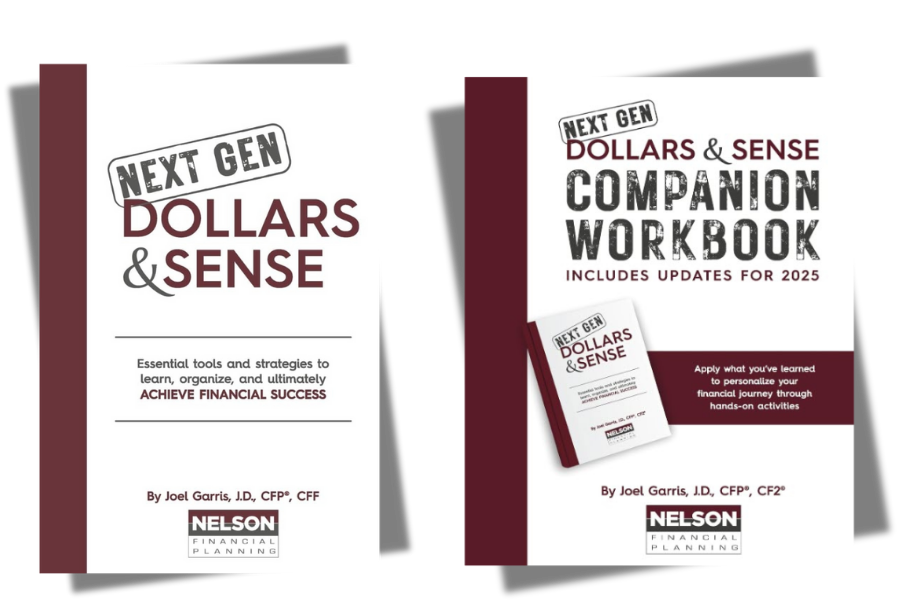
Unlock the secrets to financial success with Joel J. Garris’ insightful book, designed to equip you with the essential tools and strategies needed to take control of your financial future. Whether you’re just beginning your financial journey or approaching retirement, this book offers a comprehensive guide to help you build a solid financial plan that aligns with your goals.
- 8 Wonders1
- Bank Investments3
- Beating Inflation1
- Budget for Retirement5
- Corporate Transparency Act2
- Digital Currency1
- Energy Tax Credits1
- ESG Funds1
- Featured Blog0
- Financial Planning14
- Financial Success5
- Importance of Dividends1
- Investment Diversification1
- Investment Portfolio6
- Investment Strategy4
- IRA1
- Joel Garris1
- Nelson Financial Planning7
- Net Worth Improvement1
- Next Gen Dollars and Sense1
- One Big Beautiful Bill Act (OBBBA)1
- Pension Plans1
- Podcast Transcripts17
- Retirement “Secure” Act2
- Retirement Income Planning3
- Retirement Planning7
- Retirement Regrets5
- Social Security4
- Tax Liability3
- Tax Planning7
- Year-End Tax Changes3