




2026 Financial Reality Check: Market Leadership Changes, Money Myths & the $4.6 Trillion Real Estate Shift

Dollars & Sense Episode Summary
The first few weeks of 2026 have already delivered a powerful reminder: financial success this year will require clarity, discipline, and perspective. In this episode of Dollars & Sense, hosts Joel Garris, CFP®, and Zach Keister, CF2™, take listeners inside the trends shaping markets, money habits, and real estate decisions right now – and explain why these shifts matter for long-term financial planning.
The conversation begins with the evolving investment landscape. After years of market performance dominated by a small group of mega-cap technology stocks, early data in 2026 suggests leadership may be broadening. Joel and Zach explore what it could mean if the “Magnificent Seven” narrows into a smaller group of true leaders — and why improved market breadth may create a healthier environment for diversified investors. They also unpack the latest Federal Reserve decision to hold interest rates steady, how falling mortgage rates are impacting buyers, and why policy uncertainty continues to inject short-term volatility into markets.
“Diversification may be the single most important ingredient for investment success in 2026.”
From there, the discussion moves beyond headlines and into everyday financial behavior. A central theme of the episode focuses on the five financial lies people commonly tell themselves – often without realizing it. These include believing you have a budget when expenses are not tracked, assuming leftover checking-account cash is an emergency fund, relying on credit cards to manage spending, underestimating how much you spend dining out, and wondering why money always seems to disappear. Joel and Zach explain how these myths quietly undermine financial stability and why honest awareness is the foundation of any successful financial plan.
“Most people aren’t bad with money – they’re just operating on financial autopilot.”
The episode closes with a look at one of the most significant wealth shifts of our time: the massive transfer of real-estate wealth from Baby Boomers to Gen X and Millennials. With an estimated $4.6 trillion in global property expected to change hands over the next decade, housing decisions are becoming deeply intertwined with estate planning, tax strategy, and family dynamics. The hosts discuss common scenarios they see every day—from parents helping adult children buy homes to downsizing and multi-generational living—and outline practical planning considerations such as cash-flow analysis, ownership structure, gifting strategies, and family communication.
“Real estate is becoming a multi-generational planning decision, not just a housing choice.”
Together, these topics paint a clear picture of 2026: a year where smart diversification, honest money habits, and thoughtful financial planning around real assets can make a meaningful difference. This episode offers both perspective and actionable guidance for anyone focused on personal finance, investing, and retirement planning.
9 Key Takeaways
- Market leadership appears to be broadening beyond a small group of mega-cap stocks, reinforcing the importance of diversification.
- The Federal Reserve’s rate pause and falling mortgage rates are creating new opportunities for buyers.
- Auto loan terms and monthly payments continue to rise, making the total purchase price more important than the monthly payment.
- Many people believe they have a budget without tracking expenses – written tracking is essential.
- A true emergency fund must be separate, liquid, and cover three to six months of expenses.
- Credit cards often increase spending due to behavioral psychology.
- Dining out and convenience spending are frequently underestimated and can derail cash flow.
- A $4.6 trillion real-estate wealth transfer is reshaping housing and family financial planning.
- Ownership structure, tax treatment, and family communication are critical in real estate decisions.
Episode Chapters
- 00:00 – Opening & What’s Driving Early 2026 Market Changes
- 02:20 – Market Breadth and the Shift from Mag 7 to Fab 4
- 03:00 – Policy Uncertainty, Tariffs, and Market Volatility
- 04:40 – Federal Reserve Update and Falling Mortgage Rates
- 05:40 – Auto Loans, Rising Payments, and Consumer Debt
- 07:20 – Tax Withholding Changes and Bigger Refunds
- 10:00 – The Five Financial Lies We Tell Ourselves
- 20:00 – The $4.6 Trillion Real-Estate Wealth Transfer
- 30:00 – Planning Strategies, Pitfalls, and Final Takeaways
Podcast Transcript
Podcast: Dollars & Sense
Episode Date: February 1, 2026
Speakers: Joel Garris, Certified Financial Planner® Professional and Certified Financial Fiduciary™ & Zach Keister, Certified Financial Fiduciary®, Certified Fund Specialist
Opening & What’s Driving Early 2026 Market Changes (00:00)
Joel Garris:
So we all kind of tell ourselves lies from time to time, and I guess that makes life easier. Certainly, we do that as humans on a regular basis. On the program this week, we’re going to talk about some of the financial lies that you may be telling yourself, why you shouldn’t do that, and how you might be able to overcome that.
And then we’re going to be talking about the massive shift that is occurring right now in the real estate market. You certainly don’t want to miss that conversation here on Dollars & Sense, where we help you make sense out of all of life’s decisions involving your dollars.
One of Central Florida’s longest-running radio programs, and also a top 25 financial planning podcast on the worldwide web. To learn more about us and how we can help you make better decisions with your money, visit our website at nelsonfinancialplanning.com.
My name is Joel Garris. I’m a Certified Financial Planner® Professional and Certified Financial Fiduciary™ at Nelson Financial Planning. I get the pleasure of some company in the studio today – Zach Keister, also a Certified Financial Fiduciary®. Welcome to the program.
Zach Keister:
Thank you. It’s always a joy. It’s always a fun time on the radio program.
Joel Garris:
That is for sure. And February already.
Zach Keister:
February already. I’m starting to understand, as I’m getting a little bit older, that time really moves very quickly. The years start flashing by. Next thing you know, it’s the end of a month again somehow, and I feel like we just started. So here we are at the start of February.
Market Leadership, Diversification & the “Mag 7” Question (02:20)
Joel Garris:
Last weekend is always what marks, in my mind, the start of the year from our perspective at Nelson Financial Planning, because that’s when we begin our educational events for clients. We do those regularly, one per quarter, and we had our first one for 2026 this past week.
Zach Keister:
We certainly enjoyed it. We were very happy to see the crowd attendance—even though, for us Floridians, it was cold. Maybe not cold for everyone else, but cold for us. We were really happy to see the turnout.
Joel Garris:
It was a huge group—somewhere around 200-plus people easily. I had the opportunity to share some key themes for 2026. One of those themes kept circling back during the conversation, including a discussion I had with an investment specialist we brought in from Boston.
Zach Keister:
He was certainly happy to come to Orlando from Boston in January. I’m surprised he didn’t show up in flip-flops and shorts, considering where he came from.
Joel Garris:
We kept circling back to this notion that diversification is going to be a key theme—if not the most significant ingredient—for achieving investment results in 2026. We talked about that during our Fearless Forecast show at the start of the year.
Zach Keister:
Absolutely. And a big question for this year is whether we’re still looking at the Magnificent Seven, or if it has come down to more of a Fab Four.
Joel Garris:
You’re already starting to see some split in terms of that group of companies that contribute such a significant portion of overall market performance. That group of seven companies still makes up about 36% of the S&P 500.
But interestingly, only two of them – Google and NVIDIA – actually beat the performance of the index last year.
Zach Keister:
That’s very interesting. And the thing that really caught our eye is that only 31% of S&P 500 companies outperformed the index last year.
Joel Garris:
Getting thinner. But what’s interesting is that so far this year, that number has expanded pretty dramatically. Obviously, we’re only a month into the year, so it’s too early to call long-term patterns.
But for January, we saw that number increase from 31% to 64%. So we went from one-third to two-thirds of companies potentially producing better returns than the overall market.
Zach Keister:
It’s a short sample size, but to see that kind of turn this early is definitely something to watch.
Joel Garris:
And that’s where diversification comes back into focus. Philosophically, when more companies across different industries are doing well, that generally speaks better for the economy because performance isn’t so concentrated.
Federal Reserve Update & Mortgage Rate Trends (04:40)
Joel Garris:
Last week, the Federal Reserve met, and it was fairly quiet. The decision was to pause interest rates, with the vote being ten to two.
Zach Keister:
Right—and it’s important to remember that this isn’t just one person making decisions. It’s a committee of twelve voting members.
Joel Garris:
Exactly. Another headline was the nomination of a new Federal Reserve Chair, but again, policy decisions require consensus across the entire group.
We’re already seeing shifts in interest rates reflected in mortgage rates, which are about 1.2 percentage points lower than they were a year ago. That’s good for homebuyers and for the real estate market.
Zach Keister:
The average 30-year mortgage is just slightly above 6%. And when you look at historical averages over the past 60 or 70 years, that’s actually pretty close to normal.
Joel Garris:
Not abnormal by any stretch of the imagination.
Auto Loans, Consumer Debt & Spending Caution (05:40)
Joel Garris:
We wanted to follow up on a topic we discussed earlier this year—auto loans.
Zach Keister:
Auto loans in America are now stretching past eight years, with an average payment of over $750 per month.
Joel Garris:
And here’s a stat that really stood out: for one in five new car buyers, that payment is over $1,000 a month. That’s like a mortgage payment—for a car.
Zach Keister:
That certainly is.
Joel Garris:
The bottom line is to be careful. Shop around. Consider used vehicles. And remember what we talk about in our book, Next Gen Dollars & Sense: a car is a mode of transportation. It’s not intended to be a status symbol.
Most importantly, don’t buy based on the monthly payment.
Tax Withholding Changes & Bigger Refunds (07:20)
Joel Garris:
Before the break, we were following up on some tax conversations we’ve had earlier this year. Specifically, one piece of legislation we didn’t fully address.
Zach Keister:
This has to do with tax withholding.
Joel Garris:
Correct. The bill passed in July, and the withholding schedules were intentionally not updated at that time. The idea was that taxpayers would receive the benefit later—right about now.
Zach Keister:
Early estimates suggest refunds could be 15 to 20 percent higher this year.
Joel Garris:
That amounts to about $100 billion of cash infusion into the economy, with the average refund being roughly $1,000 higher than last year.
Zach Keister:
Any time you put dollars into consumers’ hands, a lot of that money tends to flow right back into the economy through spending.
Joel Garris:
That impact is very real, and it’s something we discussed at length during our client educational event.
The Five Financial Lies We Tell Ourselves (10:00)
Joel Garris:
Zach Keister, as we mentioned earlier in the program, we’re talking about some of the lies that, as human beings, we tell ourselves—but with a financial spin on this one.
Zach Keister:
Absolutely. Tell me lies, tell me sweet little lies. Great song—even if it was before my time. But this topic applies to everyone. We’re going to cover five things people commonly lie to themselves about when it comes to money.
Joel Garris:
These money myths sneak up on people. Whether you’re 25 or 65, these are rooted in basic human behavior. You get busy, life happens, and before you know it, you’re wondering where the money went.
Zach Keister:
Exactly. People look at their bank account and think, “How did that happen?” That’s when we realize we’ve been operating on what I like to call financial autopilot.
Why This Topic Matters (10:40)
Joel Garris:
A lot of these misperceptions come down to not understanding true spending habits and not establishing proper structure. Your budget is meant to guide the choices you make with your money.
When we talk about emergency savings, we’re talking about having three to six months of living expenses in a separate account. These are concepts we’ve covered extensively in Next Gen Dollars & Sense and in our companion workbook.
Zach Keister:
Without that clarity, people drift. They assume things are fine without ever verifying it, and that’s how financial stress builds.
Lie #1: “I Have a Budget” (20:30)
Zach Keister:
Let’s start with number one: “I have a budget.”
Joel Garris:
This is one of the biggest lies people tell themselves. Many believe that having a number in their head counts as a budget.
Zach Keister:
Or they say, “I put everything on my credit card so I can track it.”
Joel Garris:
But unless you’re actually writing down and tracking your income and expenses, you don’t have a budget. Saying you have a budget without tracking is like saying you’re counting calories without ever stepping on a scale.
Zach Keister:
There are all kinds of ways to do it. You can use spreadsheets, apps, or even pen and paper. The method doesn’t matter as much as the act of writing it down and reviewing it.
Lie #2: “I Have an Emergency Fund” (22:00) v
Zach Keister:
The second big lie is, “I have an emergency fund.”
Joel Garris:
Emergencies happen more often than people like to admit, and they usually don’t give you any warning.
Zach Keister:
That’s why they’re called emergencies.
Joel Garris:
A true emergency fund must be separate, dedicated, and untouched except for real emergencies. It’s not a few extra dollars sitting in your checking account.
Zach Keister:
And it needs to be liquid. You don’t want it invested or tied up somewhere. When something happens, you need to be able to access that money immediately.
Lie #3: “I Manage My Spending Better with a Credit Card” (23:10)
Zach Keister:
Lie number three is, “I manage my spending better with a credit card.”
Joel Garris:
That generally doesn’t work. Behavioral studies consistently show that people spend more when using credit cards.
Zach Keister:
It’s basic psychology. You swipe a piece of plastic and move on. There’s no pain associated with it.
Joel Garris:
There was a well-known study—often referenced by Dave Ramsey—that showed using cash creates a physical awareness that helps control spending.
Zach Keister:
Here’s a challenge for listeners: take $500 out in cash and put it in your wallet. See whether that $500 lasts longer than spending the same amount on a credit card.
Joel Garris:
Survey after survey supports that idea.
Lie #4: “I Don’t Eat Out That Much” (24:45)
Zach Keister:
Lie number four is, “I don’t eat out that much.”
Joel Garris:
This one is extremely common. Dining out, delivery apps, and convenience spending add up quickly.
Zach Keister:
You can easily turn an $8 sandwich into a $30 meal once delivery fees and tips are added.
Joel Garris:
And the volume of advertising for food delivery services makes it even harder to avoid.
Zach Keister:
A lot of people don’t realize how much they’re spending until they track it monthly.
Lie #5: “I Don’t Know Why I’m Always Broke” (26:30)
Zach Keister:
The final lie is, “I don’t know why I’m always broke.”
Joel Garris:
This usually ties back to everything we’ve discussed. When you create a written budget and track expenses, the answer becomes obvious.
Zach Keister:
Your money isn’t disappearing mysteriously. It’s going somewhere—you’re just not watching closely enough.
Action Steps to Break Financial Autopilot (27:30)
Zach Keister:
Here are some practical steps people can take:
Track every dollar for the next month. Create a written budget. Start or build a true emergency fund. Automate your savings. Review your expenses quarterly.
Joel Garris:
The goal isn’t drastic, unsustainable change. Slow, consistent progress beats big dramatic moves every time.
The $4.6 Trillion Real Estate Wealth Transfer (28:00)
Joel Garris:
As we wrap up the program today, we want to talk about something that we are already seeing play out in real time with many of the families we work with, and that is the massive real estate wealth transfer that is underway.
Zach Keister:
This is a big one. Estimates suggest roughly $4.6 trillion in global real estate wealth is expected to transfer from Baby Boomers to Gen X and Millennials over the next decade, with about half of that occurring in the United States.
Joel Garris:
And this isn’t something that’s happening far off in the future. It’s already happening. We see parents helping adult children purchase homes. We see families discussing downsizing. We see multi-generational living becoming more common.
Zach Keister:
Housing decisions are no longer just about shelter. They’re becoming integrated financial planning decisions that affect taxes, estate planning, and family relationships.
Buying Homes for Adult Children vs. Inheriting Later (29:20)
Joel Garris:
One of the most common questions we get is whether it makes sense for parents to help buy a home for their children now or allow that wealth to transfer later through inheritance.
Zach Keister:
There’s no one-size-fits-all answer. It depends on cash flow, tax considerations, and family dynamics.
Joel Garris:
Some families choose to gift funds. Others structure loans. Sometimes the parents retain ownership and allow the child to live in the home. Each option comes with very different tax and estate planning implications.
Zach Keister:
And those decisions should never be made in isolation. You need to understand how they affect retirement income, long-term care planning, and your broader financial plan.
Ownership Structure, Taxes & Family Communication (31:00)
Joel Garris:
Ownership structure is critical. Are both parents on the title? Is the child on the title? Is the property held in a trust? These details matter.
Zach Keister:
They matter for capital gains taxes, estate taxes, and creditor protection.
Joel Garris:
But beyond the technical details, family communication is just as important. Misunderstandings around money and property can cause long-term conflict if expectations aren’t clearly set.
Zach Keister:
We encourage families to talk through these decisions openly, ideally with professional guidance, so everyone understands the intent and structure.
Downsizing, Multi-Generational Living & Planning Pitfalls (33:00)
Joel Garris:
Another trend we’re seeing is downsizing. Some people want to simplify. Others are moving closer to family or into shared living arrangements.
Zach Keister:
Multi-generational housing can be a great solution, but it requires planning. Zoning laws, tax considerations, and household expectations all come into play.
Joel Garris:
We also caution people against making real estate decisions solely based on emotions. You want to balance lifestyle goals with financial sustainability.
How Real Estate Fits Into a Broader Financial Plan (35:00)
Zach Keister:
Real estate often represents the largest asset on a household balance sheet. That means decisions around property can have a significant impact on long-term financial success.
Joel Garris:
Whether you’re buying, selling, gifting, or inheriting property, these decisions should be coordinated with your retirement plan, tax strategy, and estate plan.
Zach Keister:
That coordination is where many people get tripped up.
Final Thoughts & Call to Action (37:00)
Joel Garris:
We covered a lot of ground today—from market shifts and interest rates to personal finance habits and one of the largest real estate wealth transfers in modern history.
Zach Keister:
The common theme across all of it is intentionality. When you plan proactively, these changes can create opportunity instead of stress.
Joel Garris:
If you have questions or want to talk through your own situation, we invite you to reach out. We don’t charge for conversations, and we don’t have account minimums. That’s what being a fiduciary is all about.
Zach Keister:
Thanks for spending part of your day with us.
Joel Garris:
You’ve been listening to Dollars & Sense. We look forward to talking with you again next week.
Next Steps
If you’d like help reviewing your financial plan, investment strategy, or retirement readiness, explore the resources available through Nelson Financial Planning or schedule a consultation to discuss your goals.
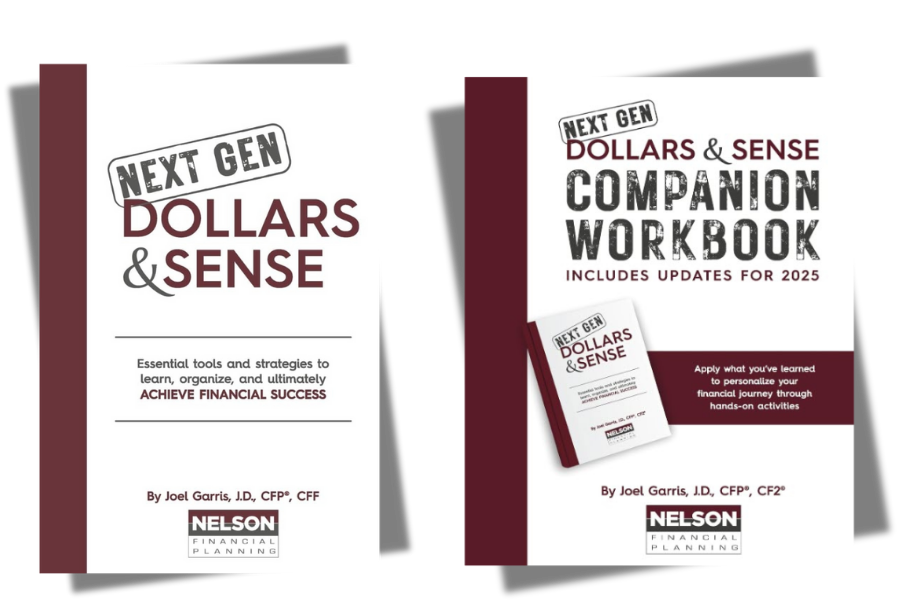
Unlock the secrets to financial success with Joel J. Garris’ insightful book, designed to equip you with the essential tools and strategies needed to take control of your financial future. Whether you’re just beginning your financial journey or approaching retirement, this book offers a comprehensive guide to help you build a solid financial plan that aligns with your goals.
REQUEST YOUR FREE COPY OF OUR BOOK & WORKBOOK!
- 8 Wonders1
- Bank Investments3
- Beating Inflation1
- Budget for Retirement5
- Corporate Transparency Act2
- Digital Currency1
- Energy Tax Credits1
- ESG Funds1
- Featured Blog0
- Financial Planning14
- Financial Success5
- Importance of Dividends1
- Investment Diversification1
- Investment Portfolio6
- Investment Strategy4
- IRA1
- Joel Garris1
- Nelson Financial Planning7
- Net Worth Improvement1
- Next Gen Dollars and Sense1
- One Big Beautiful Bill Act (OBBBA)1
- Pension Plans1
- Podcast Transcripts17
- Retirement “Secure” Act2
- Retirement Income Planning3
- Retirement Planning7
- Retirement Regrets5
- Social Security4
- Tax Liability3
- Tax Planning7
- Year-End Tax Changes3