




Avoid Costly Scams and Plan Your Retirement Move the Right Way | Dollars & Sense with Joel Garris
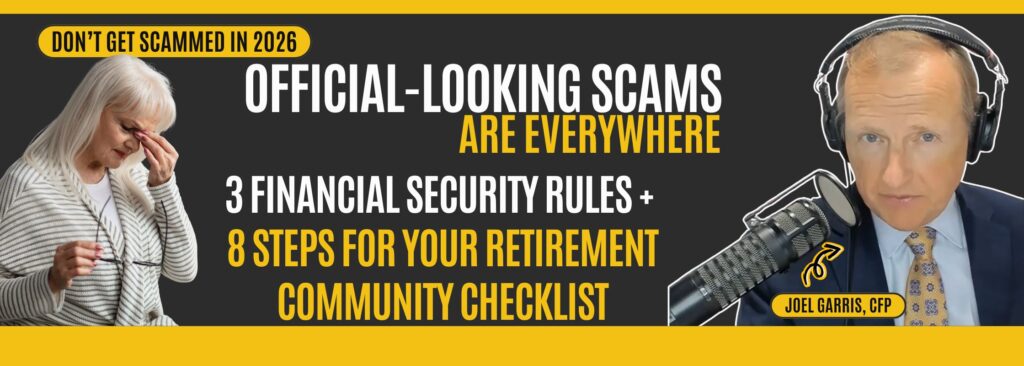
How to protect your identity, avoid expensive scams, and confidently plan a move to a retirement care community.
Dollars & Sense Episode Summary
In this episode of Dollars & Sense, Joel Garris, CFP®, tackles two critical financial topics that impact nearly every household in 2026: protecting yourself from increasingly sophisticated scams and preparing financially for a transition to a retirement care community.
As digital fraud evolves — with AI voice cloning, official-looking government letters, phishing texts, and business formation scams — financial security is no longer just about investment performance. It’s about protecting your identity, your accounts, and your long-term financial plan from being derailed by bad actors. Joel shares real-world examples, including the flood of deceptive letters he received after forming a new Florida business entity, and breaks down how scammers exploit urgency, confusion, and “official-looking” communication to separate people from their money.
“Don’t rely on clicking the link in the email. Independently initiate the interaction yourself. If it sounds too good to be true, it is. Don’t suspend your common sense.”
But this episode goes beyond fraud awareness.
Joel also outlines a comprehensive 8-step financial readiness checklist for moving to a retirement care community. Whether considering independent living, assisted living, or a continuing care retirement community (CCRC), this decision is far more than a housing choice. It’s a financial, tax, legal, and lifestyle transition.
“Moving into a retirement care community is not just a housing decision. It’s financial, emotional, practical—and it requires planning.”
You’ll learn how to:
- Assess your full financial picture before making a move
- Compare retirement community fee structures and services
- Build a realistic post-move budget
- Strategically sell your primary residence and understand capital gains exclusions
- Choose the right withdrawal order from retirement and taxable accounts
- Maximize medical expense deductions tied to entry fees
- Review legal documents and decision-makers
- Plan ahead for future levels of care
If you’re focused on retirement planning, fraud prevention, asset protection, or helping a loved one navigate later-life transitions, this episode delivers practical strategies grounded in fiduciary financial planning.
Financial confidence doesn’t just come from growth — it comes from protection, clarity, and preparation.
10 Key Takeaways
- Official-looking letters and emails are often solicitations—not government agencies.
- Business formation services like EIN registration are free directly through IRS.gov.
- Scammers thrive on urgency—pause before responding.
- Strong, unique passwords (12–16+ characters) reduce financial risk.
- Always independently verify financial requests before acting.
- Retirement community decisions should start with a full financial review.
- Selling a primary residence may offer significant tax exclusions.
- The order you withdraw assets can dramatically affect taxes.
- Entry fees for some retirement communities may qualify as medical deductions.
- Legal documents should be reviewed and updated before major life transitions.
Episode Chapters
- 00:00 – Welcome to Dollars & Sense: March 2026 Financial Security Focus
- 02:53 – Florida Business Formation Scams: Official-Looking Letters Explained
- 13:56 – The Growing Sophistication of AI-Driven Financial Scams
- 18:54 – Three Key Rules to Protect Yourself from Digital Fraud
- 24:55 – Considering a Retirement Care Community? Start With Your Financial Picture
- 29:28 – Comparing Retirement Community Costs, Fees & Services
- 31:42 – Budgeting for the Move: What Expenses Change?
- 32:56 – Selling Your Home: Tax Benefits & Liquidity Strategy
- 34:00 – Withdrawal Order & Tax Planning for Retirement Transitions
- 37:12 – Legal Documents & Planning for Future Care Needs
Podcast Transcript
Podcast: Dollars & Sense
Episode Date: March 1, 2026
Speakers: Joel Garris, CERTIFIED FINANCIAL PLANNER® Professional, Certified Financial Fiduciary™
00:00 – Welcome to Dollars & Sense: March 2026 Financial Security Focus
00:00:05 – Joel Garris, CFP
It is March already.
Hard to believe two months into the year 2026.
Off to the races indeed.
It certainly was a busy week at the office this past week for us at Nelson Financial Planning.
We did an educational webinar for our clients about
How do you protect yourself in today’s world from all of the scams that are out there, the texts about not paying your tolls, the emails from the IRS?
All of that stuff is unfortunately designed to separate you from your money.
So we wanted to provide an opportunity to talk about that.
Even though that might not be something that is specifically investment-related, it clearly is financially related.
And certainly, the notion of what you can do to protect yourself better is paramount.
So we’re going to share some of the things that we talked about in that webinar this past week with our clients, so that you can also adopt some of the best practices to help make sure that your data is as safe as it can be.
And then also in the program, we’re going to talk about some of the things that you might want to think about if you are considering making a transition to a retirement care community.
There’s all kinds of those with all kinds of different fees and expenses and things that they cover and all of that.
And so we thought it would be good to kind of share with you sort of a little bit of a checklist of what you need to be thinking about before you make that decision.
So all of that is coming up on this week’s edition of Dollars & Sense, where we help you make cents out of all of life’s decisions involving your dollars.
One of Central Florida’s longest running radio programs, also a top 25 financial planning podcasts.
Just search for us on your podcast platform of choice by looking for Dollars & Sense with Joel Garris of Nelson Financial Planning.
If you have problems finding us, go to our website at nelsonfinancialplanning.com.
There you will be able to see all the different icons, click on them, and they will immediately connect you over.
My name, of course, is Joel Garris, CERTIFIED FINANCIAL PLANNER®, Certified Financial Fiduciary™ at Nelson Financial Planning, where we got a team of great folks who also happen to be certified financial fiduciaries as well.
One of those, Rob Field, is going to join me next week on the program where we’re talking a little bit about IRMAA, what that is and how it impacts you and
I can maybe look to reduce that.
But on this week’s program, we’ve got a full slate of topics.
02:53 – Florida Business Formation Process & Junk Mail Solicitations
02:53 – Joel Garris, CFP
And, you know, as we shift gears and start to talk about the ways in which you can protect yourself, the reality is that, you know, I wanted to share a story here at the beginning of the program that just sort of a comment on the flood of texts and emails and letters that I have gotten since wound up setting up an additional new company here in Florida recently.
From a business perspective, anytime I sort of have a new endeavor, whether that’s a new sort of expanding the services that the firm offers or maybe something on a personal basis, I always like to create a new and separate entity legally for that.
And there’s some reasons for that in terms of liability.
There’s also some practical reasons of if you want to really track what’s going on in a business, you can’t really layer it into something else that’s already existing, just a cleaner way to kind of keep track of your numbers.
So I happened to do that for a particular endeavor that started earlier this year and it went online and filed the certificate of formation and all those kinds of things. And what happened in the subsequent weeks was just a tremendous amount of junk mail offering me services that I either didn’t really need or offering these services at a cost when said services were available for a nominal fee, or in many cases, in fact, free.
So… That’s kind of the kicker of all of this and why we wanted to share this with you as something to really kind of watch out for.
So let’s set the stage. Let’s say you open up a new business.
You wanted to form a company and to ultimately engage in creating a new business.
And obviously, you would have the ability to do that online. You go to sunbiz.org. That’s sunbiz.org. That’s the official website for the state of Florida when it comes to establishing a company. And you go through the process of, you know, putting the name of your business in, the address, registered agent, who are the officers or managers of the company.
And then once you do that, you obviously pay the fee. I think it’s like $125. You can toss in things like, oh, I’d like a certificate of status, that’s like another 5 bucks. But all that is a very online part of that process.
The caveat, I guess, is that if you want to get proof of that formation back right away, you’re not going to get it right away. It’s going to take about two weeks in terms of the processing time that the state has.
So just be aware of that kind of hold up and timing. But once you pay the fee, That’s 125 bucks, I think, for an LLC. A certificate of status for an LLC is 5 bucks.
If it’s a regular corporation, I think it’s a little bit more like 875 or whatever it is. And then once you do that, you know, the company is formed.
There’s obviously some other things that you need to do in order to sort of have a valid corporate structure. That’s things like making sure that you’ve got bylaws. If it’s a corporation, making sure that there’s an operating agreement if it’s an LLC. make sure you hold those regular annual meetings, all of those kinds of things that you’re supposed to do.
The biggest other thing is, of course, the IRS. They kind of like to know when you set up a new business.
So with the IRS, what you typically would do is you would apply for a taxpayer identification number, otherwise known as an EIN. That is a relatively easy process.
Those are usually issued instantaneously and are, in fact, free when you are using the IRS website.
So bottom line, that’s the process. You go through, you pay the normal fee, you set up the company through somebiz.org, you get the EIN number. That’s a free process through the United States Treasury, the Internal Revenue Service. So that’s what you do. That’s the background. So I did all of that in January.
And so now here comes the rest of the story.
13:56 – The Growing Sophistication of AI-Driven Financial Scams
13:56 – Joel Garris, CFP
I have been flooded over the past several weeks with texts, with emails, with all of that. And the point of all of those letters and emails is that they are designed to sort of trick you into thinking you need to pay for something that you don’t really need to pay for in some cases, or if you do have to pay for it, it’s a much lower fee than what is being offered to you.
But here’s the tricky thing is that, you know, these letters or these emails or these texts, they make it seem like they are official extensions of the state of Florida. And here’s where you got to be very, very tricky.
So I got three of these in my hands right now. These are the three that I got from the company that I just set up here back in January. And you’ve really got to look at the fine print on these that says this document is not a bill, it is a solicitation.
The company is not a government agency and is not affiliated with the Internal Revenue Service or any other federal or state organizations. That’s usually on there, but that’s in the really, really, really fine print.
And if you’re my age, unless you’ve got the fancy contacts in, then you have to put cheaters on in order to even find where the information is.
This other one, it says, you are not required to purchase anything from this company, and the company is not affiliated, endorsed, or approved by any government, but they look they’re official.
Like one of them is called the Florida Division of Business Administration. Like you would think, and it’s got like a little seal thing and it says Tallahassee, it’s got like a little courthouse.
You would think that these are legitimate services. And while they might be legitimate, the reality is that what they’re doing is they’re trying to convince you to pay for something that you really don’t have to pay for.
So for example, this one, says, let us send you your certificate of status fee.
Remember, I said that was 5 bucks. They want you to pay $97.25 to get the certificate status when you could order it directly off of sunbiz.org for 5 bucks.
That’s that one. Here’s another one. They’re going to offer you, this is the business certificate services.
Again, very official looking letter, but you got the fine print that’s, you know, I understand. This one, EIN registration service, $137.50. That, folks, is something you can get for free. Go to the IRS.gov website.
Don’t fall victim to these kinds of letters that make you think that you have to spend a bunch of money to do stuff that you can easily do on your own for a fraction of the cost. We’re going to take a break here on Dollars & Sense and continue. This is Joel Garris of Nelson Financial Planning.
18:54 – Three Key Rules to Protect Yourself from Digital Fraud
18:54 – Joel Garris, CFP
So before the break, we were talking a little bit about setting up a company and the flood of nonsense that you get from folks that are masquerading as official or trying to masquerade as official divisions of the state of Florida government.
And while they have the little fine print on the letters and the emails and all of that, you really got to look for that because at first blush, you would think that they need your, that you need their services to help you finish up the process of setting up a company here in Florida. The reality is that it’s a very simple process. You go to sunbiz.org, you go through, you
Put in all the information, the name of the business, the address, who the registered agent is, who the officers or managers are, and that’s it. Pay the fee. It’s 125 bucks for an LLC.
If you want a certificate of status, yes, that’s an extra cost. Five bucks if it’s an LLC, 875, it’s a regular corporation. So that’s it.
Then once you’ve got your business started and you want to do things with it, like open up a checking account, you’re going to need an EIN number. For the EIN number, you go to the IRS.gov website, you say, apply, fill in again, all of that information, business name, address, agent, responsible individual, all of that good stuff.
Couldn’t be more straightforward. And voila, almost instantaneously you get an EIN number, and that is a no-cost service. Along comes then these texts, these emails. these letters.
And as I was mentioning before the program, I have three in front of me. And you got to be careful with this stuff because it looks like it’s legit, but it’s really not. Florida Division of Business Administration with a little seal, it says Tallahassee, it looks legit. They are saying if you want a certificate of status, you can get one by sending them $97.25.
Remember, it’s only 5 bucks to get. So that seems like somebody’s kind of trying to pull a little bit of wool over the eyes on that one, right? These other two, EIN registration service, $137.50.
Well, you can get that for free. Last one, an EIN number, employer identification number. is issued by the IRS to identify your businesses in red.
So it must be important if it’s in red. All businesses are required to register with the federal government and obtain an EIN. The cost for that, $199.95. Folks, you can go online and do it for free.
So it is amazing the flood of mail that I have gotten since I created a new business here in Florida to address an expanding business concept that I was working in.
And I think that’s number, whatever it is, number of different businesses that I, companies that I own here in Florida. And, but these letters always bug me.
And it’s not the first time I’ve gotten them. Anytime you set up a new business here in Florida, you get a bunch of these silly letters that basically are them trying to charge you a bunch of money for stuff that you don’t really have to pay them for.
It’s free or minimal cost, but
They do a good job at making these letters look like they are legitimate.
Speaking of folks that also do a good job of making things look legitimate when they’re really not, is some of these scams that are out there.
And while the notion of protecting your data and protecting yourself from scammers doesn’t always get framed as a financial issue, the reality is it absolutely is. Protecting your personal data, protecting all of your finances from the evil parties out there that would be happy to separate you from your money.
And boy, there is a host of them. And it’s an ongoing issue. It’s an issue that obviously has been around a long time. But here’s the thing with AI, these scams are getting so much more sophisticated. They’re getting so much more individualized. And particularly when you think about some of the voice technology that’s out there that allows folks to be able to replicate somebody’s voice nearly instantaneously and certainly incredibly accurately.
And those are the kinds of things that are very much a part of the world in which we live in. So we need to be careful. So last week we decided to kind of tackle this topic with our clients in the form of a webinar where we had actually a lot of folks was participating so that was great to see.
And obviously, valuable educational opportunity, which is sort of a cornerstone of what we believe at Nelson Financial Planning, is that, look, education is so crucially important when it comes to not just your investments or your retirement or your taxes or any of those kinds of things, but just overall to be educated about things like this, to try and help you avoid falling victim to some of the very real scams about identity theft or cyber crime. Those aren’t just technology problems.
Those are at their core financial risks. And so our goal obviously is to help you reduce that risk across all of your finances.
24:55 – Considering a Retirement Care Community? Start With Your Financial Picture
24:55 – Joel Garris, CFP
So let’s shift some gears to talk about one of life’s major transitions. And some of the things that we would encourage you to be thinking about as you start to think about making this type of life transition.
And what we’re talking about is the notion of moving into a retirement care community. Now, that’s not just a housing decision. It’s a financial one. It’s an emotional one. It’s a practical one. And the right planning can certainly reduce stress and protect your assets and build some real confidence in that next chapter of of life.
So if you or someone you love is considering transitioning to sort of an independent living or assisted living or a continuing care type of community, this section of the program is certainly for you. And obviously the best time to prepare for that transition is before the final decisions are made.
So we’ve got like 8 key points that we’re going to talk through during the rest of the program as to things that you can do to make sure that you are financially ready for that type of transition.
And of course, the first one, we would say, well, before you can decide to make that transition, you have to take a look at what your current financial picture is, right? Because there all are costs involved when you make this transition to a retirement care community.
And so you got to know kind of, okay, where am I at? What’s my starting point? How much money do I have? How much money do I owe? So what do I own? What do I owe? How much money do I have coming in? What’s my Social Security? Do I have pension? All of those kinds of things. And then how much money do I have going out in terms of my expenses?
It’s important to sort of get that overall perspective in terms of your financials, not just when you’re facing a decision of moving into a retirement care community, but more importantly, pretty much any big decision. you certainly want to get a handle on where your overall investment financial picture is. And certainly that clarity really helps to reduce anxiety.
It helps to prevent surprises in terms of kind of how these numbers play out. A good income and expense gives you a good idea of your budget and then a statement of your assets and liabilities, also known as a net worth statement. Good to update that at least annually to sort of get an understanding of how that total financial picture is playing out.
So step one, obviously, or.1 is to make sure that you review your current financial situation when you’re looking at transitioning into any kind of a retirement care community.
29:28 – Comparing Retirement Community Costs, Fees & Services
29:28 – Joel Garris, CFP
The second item is each one of these retirement care communities, I mean, there’s a ton of them here throughout Central Florida, and they’re all different in terms of kind of how the pricing works out, how much you pay now versus later, what’s the entry fee if there is one, what’s the continuum of care look like, how much, what are you getting in exchange for that monthly service that you are paying for.
And it’s important to kind of make that comparison. Just like anything, make sure you do your comparison shopping and look at how ultimately all of these different types of expenses can compare. Because just because something may appear cheaper, at least on the service, it might not be over time.
And that’s the key piece to really be thinking about when you’re looking at how all of these different options is get a copy of the written fee schedule, and not just for the level of care that you’re going into now, but also for the other levels of care that maybe you don’t need right now, but at the end of the day. you could very well wind up needing.
So it’s important to sort of understand the full spectrum of the available costs and services that are available anytime you’re thinking about making this type of transition. So those are kind of the first couple of points. We’ve got a bunch more that we’re going to cover. in the next segment.
So stay tuned here on Dollars & Sense. This is Joel Garris of Nelson Financial Planning, and we will be back after the break to continue this conversation of the things that you need to be looking at or thinking about if you’re thinking about transitioning to a retirement care community – coming up next.
31:42 – Budgeting for the Move: What Expenses Change?
31:42 – Joel Garris, CFP
We’re talking about some of the things to be thinking about if you’re looking at making that transition over to a retirement care community. And a lot of the things that we’re talking about as we go through kind of these eight different things to be thinking about really do apply to any big financial decision as a whole.
So not just if you are sort of in the market to be making that kind of a transition, but in the market to be making any big life transition. We started out the list before the break.
The first one, obviously, is to get an understanding of what your current financial picture is, right? What you own, what you owe, how much money’s coming in, what the expenses are coming out.
And then we shifted over to making sure that you understand the costs, the services of that particular retirement care facility that you’re looking at doing, because they can vary, very, very widely in terms of what those costs cover. And in terms of how the cost structure is made up, whether there’s a big entry fee or a monthly fee or whatever the case may be, it’s important to get all of that in writing, much like any other big financial purchase.
This, at the end of the day, is a big financial purchase that you’re thinking about doing. And then to continue on with the conversation, obviously important to make sure that what the numbers are.
And effectively, that always involves sort of creating a new budget that will reflect what things are going to be once you make that transition over to a retirement care community. Because oftentimes, the monthly fee will include things like meals.
It’ll include things like your cable or your internet or those kinds of things. Some of them even include transportation. So maybe that means you don’t need a car like you used to. But those are some of the important things to be thinking about.
And then also on the flip side, if you’re moving out of your home, well, then you don’t have to worry about home maintenance anymore. You don’t have to worry about your insurance costs, your real estate taxes, all of those kinds of things. Those expenses go away.
So it’s important to kind of understand how much this is going to change in terms of what that overall budget looks like, because some of the costs are going to be new and be new costs to you in terms of their impact on you on a monthly basis.
But others are going to be costs that go away because, and this gets us kind of to the next point to think about when you’re thinking about moving into a retirement care community, more often than not, that means selling your house.
32:56 – Selling Your Home: Tax Benefits & Liquidity Strategy
32:56 – Joel Garris, CFP
And so that is a big change in what that overall financial picture looks like. First, because if you sell your house, then all of a sudden, the bricks turned into usable cash that you can have to meet expenses and the like going forward.
So that’s number one. Number 2 is that you no longer have the expenses of owning a home. And #3, which is even more important, is that for the most part, when you sell your home, assuming it was your primary residence, two of the last five years, then you can exclude pretty much the entire amount of the gain or up to $500,000 as a married couple, $250,000 as an individual.
But that’s a lot of the gain that you can exclude from the sale of a house that ultimately makes those proceeds, that money that you get by converting those bricks to cash, tax-free.
Well, if it’s tax-free, then now, okay, that’s a very different, much more valuable asset in terms of liquidity, in terms of being able to meet financial needs, that is crucially important. And so that, the notion of sort of using the home, particularly once you, know, assuming that you’re selling it, it can have a major impact on what the bottom line is going to be on how all of this plays out in terms of what you pay for, what the monthly expenses are, all of those kinds of things.
Because there really are some, much like when you sell your house, there’s some unique tax strategies that apply, particularly the one that says if it’s a primary residence, you can exclude up to 500,000 of gain if you’re a married couple. The reality is that there’s also some things to think about when it comes to funding this transition to a retirement care community.
And when we think about back to that first item, which is understanding your current financial picture, taking a look at the assets that you have, and the order in which you use those assets is going to be crucially important to make sure that you are doing things in as efficient of a manner as you possibly can, because the order in which you use those assets can certainly have a pretty big difference from a tax perspective.
So it’s not necessarily necessary to say, oh, I’ve got a bunch of money and I’m just going to use that as the entry fee. But there really may be some strategies that you want to look at in terms of which assets to use as you make this transaction, because it’s not necessarily, I mean, there’s two parts of the question, right?
There’s, do I have enough money to do this? And then but equally as important, the second part is what’s the wise way to kind of make this decision? And so to really think that through, because the reality is, and this kind of gets us to the next point, is that there’s some real tax planning opportunities here, because when we think about entry fees, for retirement care communities, some of that or a large chunk of that can in fact be a medical expense deduction.
Now, here’s the thing about medical expense deductions. First of all, you got to itemize.
Second of all, you got to get above a 7.5% threshold of adjusted gross income in order for those medical expenses to qualify. But if you’re paying a $150,000 entry fee or a $100,000 entry fee, then you can certainly get above that threshold. pretty quickly.
So it’s important to ask the question, how much of that entry fee is going to be, I’m going to be able to treat as a medical expense? And for that matter, how much of the monthly fee that I am going to pay is going to be able to be treated as a medical expense as well?
Because if you have medical expenses, the thing about medical expenses is that you don’t get to carry them over to the next year if you don’t get any tax benefit or tax write-off for having medical expenses.
Medical expenses, either write them off on your tax return in the year that you had them, or that’s it. There’s no carryover of those expenses.
So in that year where you’re going to potentially have a large deduction, particularly if you paid an entry fee or something like that, well, then that may be a good time to look at, well, maybe I’ll take some money out of my retirement account. Maybe I’ll take a little bit more out of my fully taxable retirement account, because yes, that does create extra income, but if I’ve got a larger medical expense to offset it, then you are achieving a very tax-efficient strategy when it comes to making that life transition over to a retirement care community.
So it’s crucially important that you kind of understand the tax implications and kind of how all of that ultimately plays out, because there’s more to it than might meet the eye initially.
37:12 – Legal Documents & Planning for Future Care Needs
37:12 – Joel Garris, CFP
Similarly, in terms of things that certainly have more to it, and that is your various legal documents.
So if you’re looking at sort of transitioning to a retirement care community, it’s a great time to review those legal documents.
And beyond just making sure that you have them and have them in place, it’s a great time to reflect on, are these the right people.
Maybe when you did those documents a decade or two ago, you named somebody that was a friend or a peer.
And the reality is that they’ve also gotten older, just like you. And so you might not want to continue to use them, because if their health is not as good as yours, then might not be around to make the health decision that you would like them to make.
So it’s really important as you go through this particular transition phase, not just to say, okay, I’ve got the documents, they’re in place, everything looks good in that respect, but to really think through who are the decision makers and what role are they going to serve or can they serve?
Because ultimately, that becomes crucially important when it comes to those decisions that need to be made as you get older.
And then of course, lastly, have an understanding of what those future cash needs might be as you get older.
And maybe that means you’ve got to transition into assisted living, or maybe that means you’ve got to transition into the nursing home side of things. Make sure you understand what those costs are all going to be.
So as with anything, a successful transition in life, whether it be to a retirement care community or not, requires you to really think through your finances, your financial plan, to develop a tax strategy that’s going to allow you to do that on a tax-efficient basis, and really to kind of look at your legal documents as well, to make sure that the decision that you’re making, the move that you’re making, is one that can be done with clarity, with confidence, and to put you in the best possible shape.
Those are certainly the kinds of things that we’re here to talk to individuals about on a daily basis at Nelson Financial Planning.
If you think we might be able to assist you make decisions like this and the host of other decisions that we all make in our financial lives on a regular basis, pick up the phone, give us a call at 407-629-6477 or visit our website at nelsonfinancialplanning.com to schedule an absolutely free conversation.
This is Joel Garris of Nelson Financial Planning.
Enjoy the rest of your day.
Next Steps
If you’d like help reviewing your financial plan, investment strategy, or retirement readiness, explore the resources available through Nelson Financial Planning or schedule a consultation to discuss your goals.
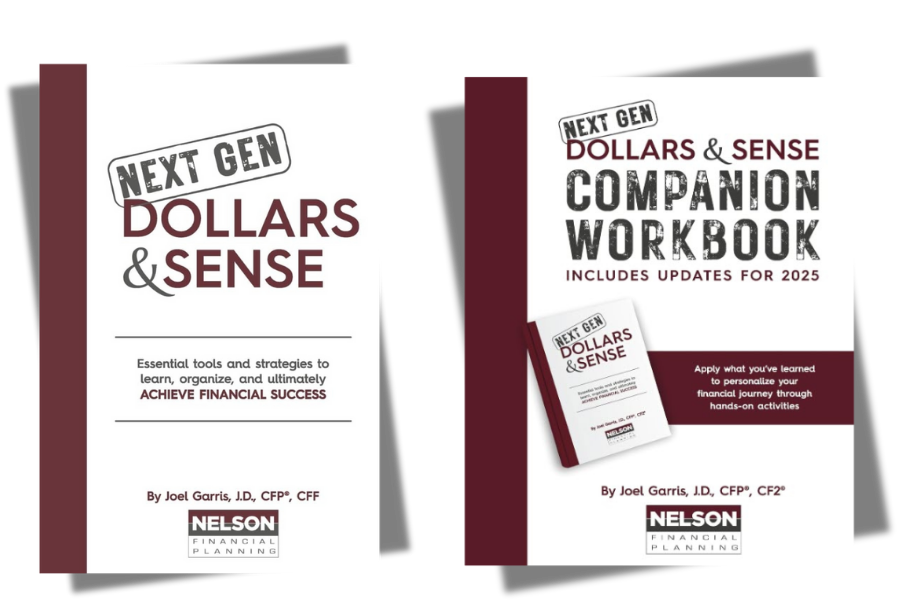
Unlock the secrets to financial success with Joel J. Garris’ insightful book, designed to equip you with the essential tools and strategies needed to take control of your financial future. Whether you’re just beginning your financial journey or approaching retirement, this book offers a comprehensive guide to help you build a solid financial plan that aligns with your goals.
REQUEST YOUR FREE COPY OF OUR BOOK & WORKBOOK!
- 8 Wonders1
- Bank Investments3
- Beating Inflation1
- Budget for Retirement5
- Corporate Transparency Act2
- Digital Currency1
- Energy Tax Credits1
- ESG Funds1
- Featured Blog0
- Financial Planning14
- Financial Success5
- Importance of Dividends1
- Investment Diversification1
- Investment Portfolio6
- Investment Strategy4
- IRA1
- Joel Garris1
- Nelson Financial Planning7
- Net Worth Improvement1
- Next Gen Dollars and Sense1
- One Big Beautiful Bill Act (OBBBA)1
- Pension Plans1
- Podcast Transcripts17
- Retirement “Secure” Act2
- Retirement Income Planning3
- Retirement Planning7
- Retirement Regrets5
- Social Security4
- Tax Liability3
- Tax Planning7
- Year-End Tax Changes3