




Tax Credits vs Scams: How to Keep More Money and Protect Your Refund in 2026

How smart tax planning can boost your refund — and protect you from costly scams.
Dollars & Sense Episode Summary
Tax season has a way of making even the most financially confident individuals feel uncertain—and that uncertainty often leads to missed opportunities and costly mistakes. In this episode of Dollars & Sense, Joel Garris, Certified Financial Planner® Professional and Certified Financial Fiduciary™, breaks down one of the most overlooked areas in personal finance: tax credits.
“A $1,000 tax credit saves you $1,000. A $1,000 deduction might only save you $200 or $300.”
The reality is simple but surprising — millions of Americans legally overpay their taxes every year. Not because they made errors, and not because they earn too much, but because they don’t realize certain tax credits even exist. And unlike deductions, which only reduce taxable income, tax credits directly reduce your tax bill dollar-for-dollar. That distinction alone can mean the difference between saving a few hundred dollars… or thousands.
“Most people don’t miss tax credits because they did something wrong — they miss them because they didn’t know they existed.”
Joel walks through five of the most commonly missed tax credits, including incentives tied to retirement savings, child and dependent care, continuing education, energy-efficient home upgrades, and the Earned Income Tax Credit (EITC). These are not obscure loopholes — they are tied to everyday financial decisions like saving for retirement, paying for childcare, improving your home, or investing in your education. Yet, without proactive planning, many taxpayers miss them entirely.
But maximizing your tax return is only half the battle.
As tax season approaches, scam activity surges — and it’s becoming more sophisticated than ever. Joel highlights the growing risks tied to IRS impersonation scams, fraudulent tax preparers, fake refund schemes, and identity theft. With the rise of AI-generated websites and communications, scammers are now able to mimic legitimate sources with alarming accuracy, making awareness more critical than ever.
This episode provides both sides of the equation: how to keep more of your money through smart tax strategy, and how to protect it from fraud. From understanding why software alone isn’t enough, to recognizing red flags like refund-based fees or unsigned tax returns, Joel delivers practical, real-world advice that applies whether you’re filing your own taxes or working with a professional.
If you want to reduce your tax bill, increase your refund, and avoid becoming a victim of tax fraud, this is an episode worth paying attention to — because when it comes to taxes, what you don’t know can cost you.
“Your investments should be geared for the rest of your life — not the rest of this month.”
10 Key Takeaways
- Tax credits reduce your tax bill dollar-for-dollar, making them far more valuable than deductions
- Many tax credits apply to everyday activities like childcare, education, and retirement savings
- Most people miss credits due to a lack of awareness, not income or eligibility
- Tax planning must happen throughout the year — not just during filing season
- Software is only as effective as the information you input
- Taxes are often the largest lifetime expense — planning can significantly reduce that burden
- The Saver’s Credit can provide up to 50% back on retirement contributions
- The Earned Income Tax Credit can exceed $8,000 for qualifying families
- Tax scams are increasing, especially during filing season
- IRS impersonation, ghost preparers, and fake charities are among the most common fraud risks
Episode Chapters
- 00:00 – Intro: 5 Overlooked Tax Credits and 5 Tax Scams to Watch
- 01:26 – Market Headlines: Iran, Oil Supply Disruption, and Investor Concerns
- 04:23 – Market Perspective: Why History Suggests Investors Should Stay Calm
- 10:15 – Why Millions of Americans Overpay on Their Taxes
- 11:31 – Tax Credits vs. Tax Deductions: Why the Difference Matters
- 13:12 – Why Tax Credits Get Missed So Often
- 16:16 – Why Taxes May Be Your Largest Lifetime Expense
- 19:35 – The 5 Most Overlooked Tax Credits
- 20:38 – Tax Credit #1: Retirement Savings Contribution Credit
- 22:49 – Tax Credit #2: Child and Dependent Care Tax Credit
- 24:41 – Tax Credit #3: Lifetime Learning Credit
- 26:43 – Tax Credit #4: Energy-Efficient Home Improvement Credit
- 27:36 – Tax Credit #5: Earned Income Tax Credit (EITC)
- 28:55 – Why Tax Scams Surge During Filing Season
- 29:35 – Real Client Story: Fraudulent Tax Return and Stolen Refund Attempt
- 33:07 – AI, Fake Websites, and Why Tax Scams Are Getting Harder to Spot
- 33:54 – IRS Impersonation Scams: What the IRS Will Never Do
- 35:19 – Tax Refund Mills and “Too Good to Be True” Credit Promises
- 37:17 – Ghost Tax Preparers and Unsigned Returns
- 37:48 – IRS Settlement and Tax Debt Forgiveness Scams
- 38:05 – Fake Charities, GoFundMe Donations, and Deduction Mistakes
- 38:52 – Final Thoughts and Wrap-Up
Podcast Transcript
Podcast: Dollars & Sense
Episode Date: March 15, 2026
Speakers: Joel Garris, CERTIFIED FINANCIAL PLANNER® Professional, Certified Financial Fiduciary™
Intro – 5 Overlooked Tax Credits and 5 Tax Scams to Watch
00:00 — Joel Garris, CFP
So we got the five most overlooked tax credits that we’re going to be talking about. And then, hand in hand with that, the five tax scams that you certainly need to watch out for in today’s world. So as you might well expect, a month out from tax filing deadline, our show this week has a very tax-oriented sort of focus.
So welcome in to Dollars & Sense, where we help you make cents out of all of life’s decisions involving your dollars. One of Central Florida’s longest-running radio programs, it is also a top 25 financial planning podcast as well. So make sure you subscribe to us on your favorite podcast platform or even check us out on the infamous YouTube as well, where you get to see us do the show in front of a camera and you can see how much I talk and use my hands at the same time, which obviously you don’t get that on radio or a podcast.
My name, of course, is Joel Garris, CERTIFIED FINANCIAL PLANNER®, Certified Financial Fiduciary™ at Nelson Financial Planning, where we have a team of great folks who also happen to be Certified Financial Fiduciaries™ as well.
Market Headlines: Iran, Oil Supply Disruption, and Investor Concerns
01:26 — Joel Garris, CFP
They stand ready to help you make better decisions with your money wherever you are on your financial journey. Speaking of journeys, we would be remiss to not engage in a little bit of conversation here in the opening segment about the latest and greatest headlines.
Obviously, the situation in Iran is certainly having an impact on the markets this past week. What is going on over there was described by a top sort of oil-related information, the international oil symposium or whatever it was, as the largest oil supply disruption in history. Obviously, you’ve got the Strait of Hormuz, which is the busiest oil tanker route that ultimately is creating a whole lot of concern about what’s going on in that part of the world and its spillover impact to everyone else beyond just the immediate or near immediate increase in the price at the pump that we’ve certainly all seen, but also whether there are longer-term implications as well. So we’re going to talk about that a little bit more.
I know last week, when Rob joined me on the program, we talked a little bit about it in the opening segment. Obviously, here we are. The headline still very much remains. And if anything, the situation has probably got a little bit more troubling than it was just a week ago, especially with this past week with the Iranian response, including laying some mines and things like that in that very narrow strip of water through which much of the world’s oil flows through.
So certainly an impact worth continuing the discussion beyond what we talked about last week. Clearly, there is some serious stuff going on here across the board. And no matter where the Iranians are in terms of their capabilities, and obviously because of the sheer volume of bombs that have been dropped on them, at the end of the day, they have lesser capabilities, but to the extent that they have any capability whatsoever, they can still create a lot of mess, particularly given the geography of that particular region.
And so, as we think about that, we think about now what the market’s reaction is to that. And certainly this past week, the market certainly had a tough week
Market Perspective: Why History Suggests Investors Should Stay Calm
04:23 — Joel Garris, CFP
But I guess, here’s where we always like to provide perspective. And it’s always curious just how much perspective gets lost within such a short period of time. Most of the people that I’ve been talking to this past week, they had already forgotten that a year ago, we were in the midst of a much more significant market decline. And that one was related to the conversation about tariffs.
Now, if you remember all the way back to 12 months ago, during the month of March of 2025, markets wound up going down about 20% within a very, very short period of time in response to kind of the tariff conversation that was all part of the front page news during that period of time. So I think when we look at the numbers, the broader-based market, S&P 500, or down about 5, maybe 6% since where it was sort of before the bomb started dropping.
So not necessarily some cataclysmic decline. And if you want to see what a much more significant decline looks like, well, then just go back 12 months. to the exact month of March of 2025, and you’ll see a much greater decline. But again, most people have kind of already forgotten that because the rest of the year there was a recovery. But always important to kind of maintain perspective and know that these types of events are very short-term in nature in terms of their impact on the market. And Maverick, to kind of boost that conversation, this was a piece that we were talking a little bit about last week.
It was an analysis that we saw of various military conflicts that have occurred over the course of the past 80-odd years. That included things like the Korean War, the Iranian hostage crisis, there’s a common theme there, to the Trade Center bombing, 9-11, and identified sort of over 20 such examples of kind of where military conflict had occurred. Here’s the statistical takeaway or what history tells us. 73% of the time, stocks generated positive returns.
So 3/4 of the time, positive returns one year after the act of aggression for the various armed conflicts that you’ve seen over the course of the past 80-odd years. Median return for that one year was up about 9.7%. So before you go about and change everything in your investment portfolio, consider how history has played out. That would be #1.
And #2, your portfolio should have been geared with the proper asset allocation to kind of handle the rest of your life, not the rest of the month of March. So make sure your investment allocation is designed to do just that. Frankly, you know, you could argue that the response in the markets has not been as dramatic as some might have thought, particularly in comparison to sort of prior types of actions like this. If you look at, for example, when Russia went into Ukraine back in 2022, that actually, on an inflation-adjusted basis, spiked oil prices up to about $130 a barrel. So we’re at about $100 a barrel, give or take what hour you’re checking it.
But the reality is that it wasn’t that long ago when we saw oil spike up in reaction to a military conflict as a result of what was going on. I think what’s different this time which I think is some of the reasons for optimism, is that there’s a lot more oil around. I think oil and storage hit a five-year high before all of this military action broke out. So a little bit more oil floating around out there. continues to be some sort of a belief that given the devastation, that the amount of these bombs have put on Iran, that there could certainly some expectation that it should be somewhat short-lived. And then let’s not forget some of the other things that happened this past week where you had a strategic release of over 400 million barrels of reserve. That’s the equivalent of almost like a month supply that goes through the Strait of Hormuz. So that in and of itself was certainly unique.
So I think there’s some reasons to not be quite so alarmed out there. particularly as it relates to these headlines, when we think about sort of the historical perspective of when this stuff happens. I mean, it wasn’t that long ago when Russia went into Ukraine, oil spiked above $130 a barrel on an inflation-adjusted basis. And then if we need a market decline, look no further than just a year ago, much more dramatic, much more significant, much more quickly, that decline in March of last year. And if you forgot what that was all about, that was all about the tariff conversation and the implications that would have.
So the world keeps spinning, whether we like it or not, maybe the headlines aren’t as favorable as they should be. and certainly very, very tragic given the massive loss of life that is happening as well. But history tells us that these things do, in fact, pass. So with that, we’re going to continue after these messages here on Dollars & Sense with Joel Garris of Nelson Financial Planning.
Why Millions of Americans Overpay on Their Taxes
10:15 — Joel Garris, CFP
We’re a month away from the actual tax filing deadline, and so that means that the show and probably the next few will have a little bit more of a tax focus as you sit there staring at your tax return, trying to figure out, okay, what’s going on with all of this stuff?
How do I ultimately file the best possible tax return that benefits me versus benefiting the IRS. So in this segment, we’re going to talk about something that is sometimes overlooked because it does have a lot typically to claim this on your tax return. There’s a variety of things that you need to sort of make sure that you are going through. And at the end of the day, what we’re talking about here is this concept of tax credits. And the reality is millions of Americans miss these types of tax credits and ultimately wind up overpaying on their taxes. And it’s not because they earn too much or because they did anything wrong, but it’s just not really knowing that these credits in fact exist.
Tax Credits vs. Tax Deductions: Why the Difference Matters
11:31 — Joel Garris, CFP
And these tax credits, with a little bit of planning and not really tax wizardry that we’re talking about, but with the tax credits, they have the real power to put money back into your pocket.
And the biggest reason for that is that tax credits are very different than deductions, right? So this is a critical, critical distinction because deductions will reduce your taxable income. Credits reduce your tax bill dollar for dollar.
So for example, if you have a $1,000 deduction, okay, that’s great. That reduced your taxable income. So you’re probably going to save anywhere from $200 or $300 depending upon your tax bracket. But if you have a $1,000 tax credit, that’s the entire $1000 that goes towards reducing your tax bill. So, as you can imagine, tax credits are much more powerful than tax deductions because ultimately those tax credits serve to directly reduce your total tax liability. And what’s interesting is some of these tax credits are refundable.
Why Tax Credits Get Missed So Often
13:12 — Joel Garris, CFP
And a lot of these credits actually relate to stuff that people are already doing. So things like saving for retirement, making some improvements in their home or continuing their education or paying for childcare.
Those are things that we, as humans, sort of do on a regular basis. But maybe people don’t realize that, hey, wait a minute, there’s some tax credits associated with those types of normal activities that are occurring for a lot of folks out there these days. And it’s easy to understand why a lot of people will sort of miss the credits, right? I mean, I think there’s an overriding sort of feeling of, well, I probably don’t qualify for it. And that’s understandable because oftentimes these tax credits, if you’re going to use them, there’s certain income limits that apply. There can be phase outs. You have to have certain types of expenses in order to claim these types of credits.
So there’s kind of that sort of assumption of maybe, maybe I don’t qualify for these in the 1st place. I think there’s confusion about credits over deductions. So do people underestimate or think that the value is the same as a deduction? It is most definitely not. Credits are much more powerful in the 1st place. And at the end of the day, what’s unfortunate as things play out is that in order to really make sure that you’re taking advantage of a particular credit that you might be eligible for, well, you can’t really be doing that in March, because the tax return you’re filing basically covers the prior calendar year. So if you’re saying, oh, wait, if I had done this, I could have gotten this particular tax credit, more often than not, if you’re doing it in March, well, then you missed it.
So at the end of the day, a little pre-planning on these tax credits is crucially important as well. And where they particularly sort of get missed is if there’s certain life changes, right? Like if you have a kid or there’s a career change or something like that, then you kind of have a tendency to maybe not revisit all of those life changes that could certainly be important and material when it comes to your taxes. And then kind of lastly, and this is something that we see a lot, is that
Perhaps maybe an over-reliance on software, because at the end of the day, software is great, and obviously you want to use software when you’re doing your tax return. But you got to make sure that you’re putting all of the information in, or thinking about some of the things that you could add into that tax return. At the end of the day, software works great, as it does all the time, if the inputs are correct.
So when the software, particularly tax planning or tax return software, is asking you a series of questions, you kind of got to make sure that they’re answered correctly in order to get the best effective use. And so beyond that, there’s a host of sort of strategic planning types of decisions that we would encourage people to sort of think through in terms of how all of this plays out, because the notion of trying to time those decisions intentionally, like when to contribute, when to spend, when to invest, really is going to determine your ability to capture these credits. And as we said, these credits can directly increase your refund or reduce your tax bill. And certainly an important topic given that taxes over the course of our lifetime, how much we pay in taxes, is probably going to be the single largest expense that we spend money on.
Why Taxes May Be Your Largest Lifetime Expense
16:16 — Joel Garris, CFP
Because like a mortgage, okay, fine. Maybe we’ll eventually have that all paid off within a 30-year period of time. There’s no age, despite some folks who think to the opposite, there’s no age in which you get to stop filing your income taxes.
So, whether you’re one or 101, just because of your age doesn’t mean that you get to skip filing taxes. Taxes are always required. If you have taxable income, then obviously you have to file a tax return. Hence, that’s why taxes is the largest expense during the course of our lifetime.
So make sure you’re really kind of thinking through these tax credits. They’re just way too valuable to sort of ignore. A lot of them do apply to sort of ordinary life decisions. And at the end of the day, though, that pre-planning in order to capture these is certainly the best way to get the maximum amount of… of advantage out of these credits. So take a minute and sort of make a checklist of kind of those life events that happen during the course of last year to make sure you’re not missing out on any of these credits.
Are there children in the household and was there care given? Was there any kind of education done, going back to school, any of those kinds of things, whether there’s some home upgrades or retirement contributions? Those are the things that you should be kind of making a checklist of. And then to make sure that you’re asking those questions. Are there credits that might apply? What income thresholds are there out there that apply to these credits? And then really to kind of review those on a regular basis.
You know, that’s one of the biggest reasons why at Nelson Financial Planning, our tax preparation service, which is an exclusive service to our clients, And that service is now in its 25th year. And we think it’s very important to make sure that rather than just saying, oh, your taxes are going to be this, or we estimate your taxes to be that, there’s nothing that beats the accuracy of the actual preparation of a tax return. And so when you’re using an actual tax return, then guess what? That means that you’re actually going to get to see the real result as it plays out on your tax return. tax return.
So that’s one of the biggest reasons why we actually do tax preparation with real 1040 tax software and then the tax return gets filed because that’s the best way to get the most important accurate result in terms of trying to plan ahead when it comes to not just getting, taking advantage of these tax credits, but things like Roth conversions and things like that. Because while the easy advice that you see out there all the time is make sure that you wind up having a tax-free retirement that at some point, in order to have a tax-free retirement, involves paying some taxes along the way to make that happen. Make sure you understand what the tax implications are when you do that.
So with that, in the next segment, we’re going to talk about some of the five most overlooked tax credits. credits when we return here on Dollars & Sense with Joel Garris of Nelson Financial Planning. We’re talking about in this segment that some of the five most overlooked tax credits and as we’re talking about in the previous segments.
The 5 Most Overlooked Tax Credits
19:35 — Joel Garris, CFP
Let’s be clear, tax credits versus tax deductions, which one do you want? You want a tax credit if you are eligible to get one.
Why? Because a tax deduction simply reduces your taxable income. So $1,000 of a tax deduction probably saves you $200 or $300 depending upon your income tax bracket.
But a tax credit is a dollar for dollar reduction in your tax bill. Some of these credits are in fact refundable as well. So they could even serve to boost up the amount of your refund. So we got a list of five, five of the ones that are most overlooked coming up here in this segment of the program.
Credit #1: Retirement Savings Contribution Credit
20:38 — Joel Garris, CFP
So the first one is… is what is known as the retirement savings contribution credits. And this really is one that I think a lot of people maybe don’t even realize that it exists.
And so what it is, it is a, in fact, a tax credit designed to encourage people to save money for retirement. And so whether it’s a contribution that you put into your 401k or your 403b at work, or whether you put money into an IRA or a Roth, it doesn’t matter where you put the money or what you put the money into so long as it is a retirement account, you have the potential to get a tax credit for that contribution.
Here’s the thing: this is a pretty valuable tax credit that can be worth up to 50% of the amount that you put into a retirement account. Obviously, all of this depends on income. This particular credit has a pretty low income requirements in order for you to claim it. But if you’re eligible to claim it, the reality is that for an individual, it is a tax credit of up to $1,000. So if you put $2,000 into an IRA or into a Roth or a 401k, you could then wind up getting a tax credit of $1,000 for that $2,000 contribution.
Married couple, you each get your own, so you have a tax credit that’s potentially up to $2,000 for a contribution that is $4,000, 2,000 for each of you. So pretty powerful stuff. Obviously, this one applies to sort of lower income, moderate income types of taxpayers. Rollover contributions obviously don’t apply, has to be new money kind of going in. And if you were claimed on someone else’s return as a dependent, then obviously you wind up having lesser eligibility. But this one we raise as the first one simply because a lot of people don’t realize that it even exists.
So if you made a retirement contribution, if you’ve got lower income showing on your tax return, Then double check this one, as you might be eligible. And this one’s pretty powerful.
Credit #2: Child and Dependent Care Tax Credit
22:49 — Joel Garris, CFP
The next one, and I think a lot of people know about, but if maybe, you have children for the first time and maybe didn’t realize that this was a credit out there, the child and dependent care tax credit is a tax credit that allows you to claim some of the expenses that you paid for childcare or dependent care while you were working while you were looking for work.
So things like childcare or after-school programs or summer day camps or even care for an elderly dependent who might be still living with you that is claimed on your tax return. All of those kinds of expenses can qualify for this particular credit. If it is a child, the childcare piece of it, the child must be under age 13. If it’s the dependent care, then obviously it has to be a dependent on your tax return. There are limits. up to $3,000 for one dependent, $6,000 for two dependent, two or more dependents. The tax credit that you get is then based on a percentage of those care expenses. That percentage can range from 20% on up to 50%. So if you spent 3,000, if your income qualifies for this credit, you spend $3,000 for after-school programs for your 10-year-old, you could potentially then wind up getting a tax credit of $1,500 for that that $3,000 that you expense.
So, pretty important credit. And again, rules here. You got to make sure you’re following the rules. Back to sort of our comment about using software. Certainly, you want to use software, but you need to make sure you’re answering the questions correctly in that software. Otherwise, you could find that you wind up losing a tax credit that you’re in fact eligible for.
Credit #3: Lifetime Learning Credit
24:41 — Joel Garris, CFP
So those are the first two. The third one is the lifetime learning credit. And this one often gets confused because there’s a lot of other tax credits that have to deal with education and learning and things like that. So the lifetime learning credit is a tax credit that applies when you spend money on educational expenses.
So, but it applies to whether it’s graduate school or trade school or just even continuing education to improve your job skills. So this credit is up to $2,000 or 20% of $10,000 in qualified expenses. So if it’s 20% and $10,000 of qualified expenses, the maximum you’re ever going to get out of this is $2,000. But again, as a tax credit, that is dollar for dollar money in your pocket. The thing about this particular lifetime learning credit that people kind of forget is that this one is available for an unlimited number of years.
And this is where the confusion often comes into play when you think about other tax credits, the American Opportunity Tax Credit, for example. That one only applies to your first four years in college. The lifetime learning credit, hence the name lifetime learning, could apply regardless of how many years you’ve been in school. school or how old you are or whatever that might be. So an important one to remember. So if you went back to graduate school or took some classes online or any of those kinds of things, you can use those expenses and then 20% of those expenses can potentially be a credit on your tax stamp.
Now obviously, as with all of these, there are some income limits to be aware of in order to claim. This one in particular, you can’t claim if you’re married filing separate. But again, the misconception here is that many people think that it only applies to undergraduate education. This one applies to lifetime learning, whether it’s graduate or continuing education classes as well.
Credit #4: Energy-Efficient Home Improvement Credit
26:43 — Joel Garris, CFP
The next one is a somewhat limited one. And that is because it pretty much is only good for your 2025 tax return that you’re in the process of filing. And that is your energy-efficient home improvement tax credits.
As many of if you’re a regular list of the program, when we, in prior shows, when we’ve broken down the one big, big, beautiful bill, all of that bill kind of did away with a lot of these energy-efficient home improvement credits, but they still are on the books for 2025. So things like energy-efficient windows and doors, heat pumps, insulation, central air conditioning, solar panels, all of those qualified energy-saving upgrades to your primary residence, key piece there,
You can get a credit of up to 30% of the qualifying expenses, maximum credit about 3,200. Understand that this credit is still available, but 2025 pretty much the last one.
Credit #5: Earned Income Tax Credit (EITC)
27:36 — Joel Garris, CFP
And then the last credit that a lot of people miss is the earned income tax credit. This is a refundable credit designed to help low and moderate-income workers and families and is available even if you owe no tax.
So it’s a fully refundable credit. The amount obviously depends upon your earned income, your filing status, the number of qualifying children, but some pretty significant credits. So if you’ve got three or more children, you could get over $8,000 in the form of this earned income tax credit. Again, this one also only available if your income is below certain IRS thresholds. So those are some of the most overlooked credits.
As you can tell, you know, that’s normal stuff that you might spend money on, whether it’s putting your kid in a summer camp or taking a continuing education class or any of those kinds of things, which is why these credits are some of the most missed credits out there. So make sure you take the time to see whether you have any type of expenses that might qualify you for these credits because they can make a real difference on your tax return. With that, we’re going to take a break here on Dollars & Sense with Joel Garris of Nelson Financial Planning.
Why Tax Scams Surge During Filing Season
28:55 — Joel Garris, CFP
So our next topic is a tough one and one that we see that increases very much around this time of year. And that is the notion of the proliferation of just a host of tax scams that are out there on a regular basis. So in this segment of the program, we’re going to spend a little bit of time talking about some of the some of the more popular ones and kind of what you can do if you find yourself falling either victim to them or more importantly, how to sort of prevent yourself from falling victim to them. Some of them, you can’t, you just can’t do a whole lot about it.
Real Client Story: Fraudulent Tax Return and Stolen Refund Attempt
29:35 — Joel Garris, CFP
We actually had one call about, not this past week, maybe the week before, but it was a client, a longtime client, someone that we had for years now been preparing their tax return as part of kind of the value-added services that we do for our clients at Nelson Financial Planning.
And so she said, oh, I got a letter from the IRS. They are holding on to my refund. I’m not really sure what that’s all about. And I said, oh, well, that’s weird. Go ahead and send it to me. And so, you know, looking at the letter and kind of reading it, read it again. I was like, well, this is weird. Doesn’t really say what’s, what, you know, what, the specific issue is because normally when you get those letters from the IRS, they sort of say, hey, here’s something that we saw on your tax return and it, you know, it looked weird and we’d like an explanation. That’s usually what these letters say, but this one wasn’t referencing that. So I had to read it a couple of times and then finally I realized, well, oopsie, this is a letter that is talking about the refund that you are requesting on your 2025 tax return. And client, you haven’t filed your 2025 tax return. Matter of fact, you haven’t even given us the documents for us to even start to get to work on the 2025 tax return.
So here’s, unfortunately, what this letter means. It means that somebody out there got a hold of your social, your date of birth, whatever the case may be. And let’s face it, pretty much everybody’s social and date of birth is floating out there on the web somewhere. And at the end of the day, they went ahead and filed a return and asked for a massive refund, which apparently the refund was so big that the IRS computer said, wait a minute, that seems weird, considering the prior tax returns that this client has been filing. And so ultimately they froze the refund going to what obviously was a fraudulent actor. And so to respond to the letter, just check the box that says, no, I did not file this return.
And what that means then is that the individual will need to get a taxpayer identification number directly from the IRS. That’s actually a suggestion that we make for clients as well. To help protect yourself, get a specific PIN number. It’s a six-digit PIN number. It’s only assigned by the IRS. And at the end of the day, they resend that every single year.
So you get a new one. I personally use that on my own personal tax return. Again, it’s a security feature and one that ultimately helps to prevent this kind of a fraud. Because otherwise, you can’t really prevent it if someone’s just taking your social security number and filing a tax return with totally made-up information. That’s one of the biggest things that happens out there.
And at the end of the day, it’s frustrating. It’s always nerve-wracking when you get a letter from the IRS. And ultimately, you can also lose dollars and increase your stress, and run into a host of other problems if you fall victim to these types of tax scams. So obviously, a little awareness goes a long ways, which is why we’re going to kind of run through these types of examples, because there’s some like the filing of a fake tax return that you’re not really going to be able to prevent. But there’s others where you just have to be really careful.
AI, Fake Websites, and Why Tax Scams Are Getting Harder to Spot
33:07 — Joel Garris, CFP
And along those same lines, I saw this statistic the other day, and it relates to AI. So here’s the number. And why this statistic is important is that there are more and more sites out there that are getting proliferated to made to make you think or look like it is the real website.
The ability for AI to easily write code has resulted in an explosion of new websites and smartphone apps. After years of flatline growth, website registrations have jumped 34% year over year, while Apple app releases are up 55%. The reality is that means that it’s easy for scammers to create an app or a website that looks exactly like the original.
IRS Impersonation Scams: What the IRS Will Never Do
33:54 — Joel Garris, CFP
So be careful and be aware because that’s probably the biggest scam that happens is this IRS impersonation scam. And, you know, maybe that’s an e-mail or a text or a website that looks like the IRS or even a phone call.
Look, folks, these phone calls that people can get that say you owe taxes or they’re going to come and arrest you or you must pay now. Folks, that’s not how the IRS operates. There is a process to when they audit you and when you wind up having to pay them money. The IRS is not going to initiate contact by e-mail or by text or through a message on your Facebook. It’s not going to work that way. They send letters. That’s how they operate. They also don’t demand that you immediately pay them or else they’re going to arrest you. They also don’t demand that you pay them in gift cards. They don’t demand that you send a wire transfer. They don’t demand that you pay them only in crypto.
All of those are intended to be IRS impersonators, be very careful with that. Any contact from them proactively on your phone or text or e-mail ain’t them. So ignore it. and move on with life and do not fall victim to that.
Tax Refund Mills and “Too Good to Be True” Credit Promises
35:19 — Joel Garris, CFP
Similarly, a lot of these days, a lot of kind of shops will spring up to say, oh, let us file your taxes because we’ll be able to find refunds or tax credits or those kinds of things that nobody else knows about. Let me assure you with the hundreds and probably thousands of different tax preparation and accounting firms out there, chances are tax credits probably already known.
So it’s not like somebody just came up with a brand new one and ultimately all of a sudden has the magic elixir. We actually saw this type of 1 play out a lot post-COVID. There was this employee retention tax credit, and there were these ERC, employee retention credit, ERC. There were these ERC tax preparation and filing mills, really, that the IRS wound up issuing out some specific guidance on to make sure to avoid these firms that were set up to establish, hey, we’ll get you this massive tax credit for keeping employees on your payroll during COVID, and we will do that all for, you know, just 20% of the refund that we’re able to get. Folks, that is a red, that should be a red stop sign.
Anytime you’re talking to someone about filing their taxes, they should not be saying to you, don’t worry about how much this is going to cost you. How much this is going to cost you is simply going to be a function of the amount of the refund that we are going to get you. That’s a problem because when they file the tax return, and they create a bunch of tax credits, refunds, whatnot, and then they collect their fee immediately, you’re very much left holding the bag. So be careful if you’re getting charged a percentage based on the refund that the tax preparer can actually do.
Ghost Tax Preparers and Unsigned Returns
37:17 — Joel Garris, CFP
And this is relatively common with ghost tax preparers as well, where it’s folks that will say, oh, we’ll go ahead and file your taxes and let us do all of that work. And then they won’t actually sign the return. That is another red alert that you should be aware of if someone has done your taxes, but you don’t see their name where they’ve signed the return, that’s a problem because then that means they’re not taking responsibility for what’s on the return.
IRS Settlement and Tax Debt Forgiveness Scams
37:48 — Joel Garris, CFP
Similarly, a lot of tax debt forgiveness and IRS settlement scams are around these days. So be aware of that. You know the IRS doesn’t just simply settle outstanding tax liabilities for pennies on the dollar for anybody and everybody.
Fake Charities, GoFundMe Donations, and Deduction Mistakes
38:05 — Joel Garris, CFP
Similarly, a lot of fake charity scams out there as well. To really double check if you’re contributing to a real charity, there are some IRS tax exempt organization search websites that will allow you to find out whether in fact that you are giving to a legitimate charity.
We often run into that, particularly some of these, so GoFundMes and things like that, where people say, oh, I made contributed money to a GoFundMe page. And at the end of the day, I gave $100, so I should get a tax credit or tax deduction for that. And the reality is, no, you won’t get that because it wasn’t a valid 501C3. So just some of the things that you need to be aware of to protect yourself this tax season.
Final Thoughts and Wrap-Up
38:52 — Joel Garris, CFP
With that, we’re going to wrap it on up and get on out of here. Thank you for listening to this week’s program. This has been Joel Garris of Nelson Financial Planning here on Dollars & Sense. Have a great rest of the day.
Next Steps
If you’d like help reviewing your financial plan, investment strategy, or retirement readiness, explore the resources available through Nelson Financial Planning or schedule a consultation to discuss your goals.
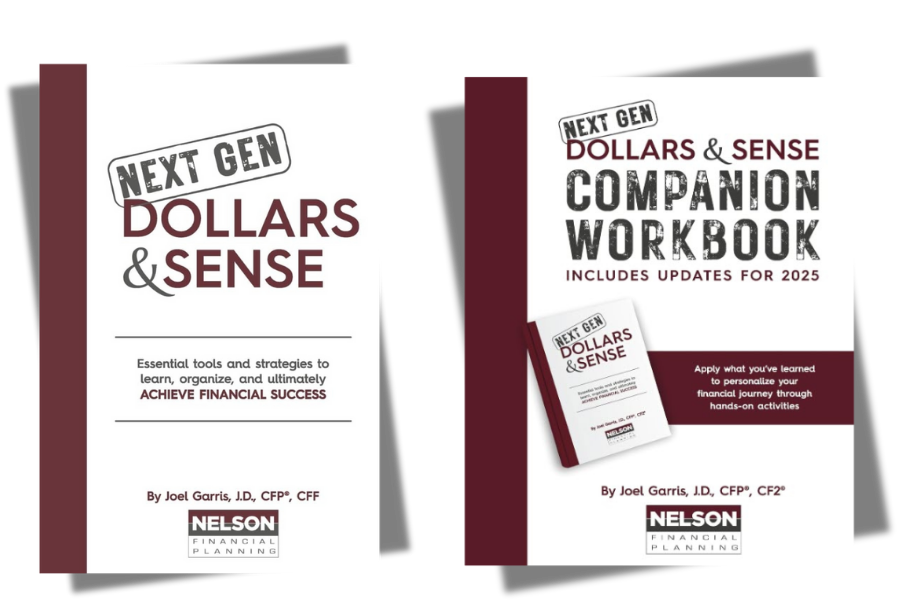
Unlock the secrets to financial success with Joel J. Garris’ insightful book, designed to equip you with the essential tools and strategies needed to take control of your financial future. Whether you’re just beginning your financial journey or approaching retirement, this book offers a comprehensive guide to help you build a solid financial plan that aligns with your goals.
REQUEST YOUR FREE COPY OF OUR BOOK & WORKBOOK!
- 8 Wonders1
- Bank Investments3
- Beating Inflation1
- Budget for Retirement5
- Corporate Transparency Act2
- Digital Currency1
- Energy Tax Credits1
- ESG Funds1
- Featured Blog0
- Financial Planning14
- Financial Success5
- Importance of Dividends1
- Investment Diversification1
- Investment Portfolio6
- Investment Strategy4
- IRA1
- Joel Garris1
- Nelson Financial Planning7
- Net Worth Improvement1
- Next Gen Dollars and Sense1
- One Big Beautiful Bill Act (OBBBA)1
- Pension Plans1
- Podcast Transcripts17
- Retirement “Secure” Act2
- Retirement Income Planning3
- Retirement Planning7
- Retirement Regrets5
- Social Security4
- Tax Liability3
- Tax Planning7
- Year-End Tax Changes3