




Why Betting Too Heavily on One Market Trend Can Create Long-Term Financial Risk
The Investment Strategy That Helps Investors Survive Uncertainty, Inflation, and Market Hype
Every market cycle has a story that makes investment diversification feel unnecessary.
In one era, it was dot-com stocks. In another, it was real estate. More recently, it has been artificial intelligence, mega-cap technology stocks, and the belief that a handful of companies can carry the entire market forever.
That belief can feel convincing when markets are rising. But long-term investors know something important: leadership changes.
The best-performing sector today may not lead tomorrow. The hottest stock may cool off. Interest rates shift. Inflation surprises people. Corporate earnings rotate from one industry to another. Headlines change faster than most investors can react.
That is why diversification remains one of the most important investment principles for people who want to build, protect, and eventually use their wealth.
Joel Garris recently explained it this way on the Dollars & Sense podcast:
“Diversification is going to be crucially important to our investment results this year.”
That statement may sound simple. The reality behind it is far more important than most people understand.
Because diversification is not merely about owning different investments. It’s about building a financial structure capable of surviving uncertainty.
Why Diversification Searches are Exploding Online
Search behavior around diversification has changed significantly over the past few years. People are no longer only searching for basic questions like:
- “What is diversification?”
- “Why diversify investments?”
Now investors are searching much deeper concerns, including:
- “Should I diversify beyond the S&P 500?”
- “Is the stock market too concentrated?”
- “Best diversified retirement portfolio”
- “How to protect investments from recession”
- “What happens if AI stocks crash?”
- “Can diversification reduce volatility?”
- “How much international exposure should I own?”
- “What investments perform during inflation?”
- “Diversification vs concentration investing”
- “How to build a recession-resistant portfolio”
Those searches reflect investors growing anxiety about market concentration, inflation, economic instability, and retirement preparedness. Investors increasingly recognize that simply owning a few popular stocks is not a comprehensive financial plan.
A diversified portfolio does not mean avoiding opportunity. It means not depending on one opportunity to carry your entire financial future.
The Hidden Risk Inside Today’s Market
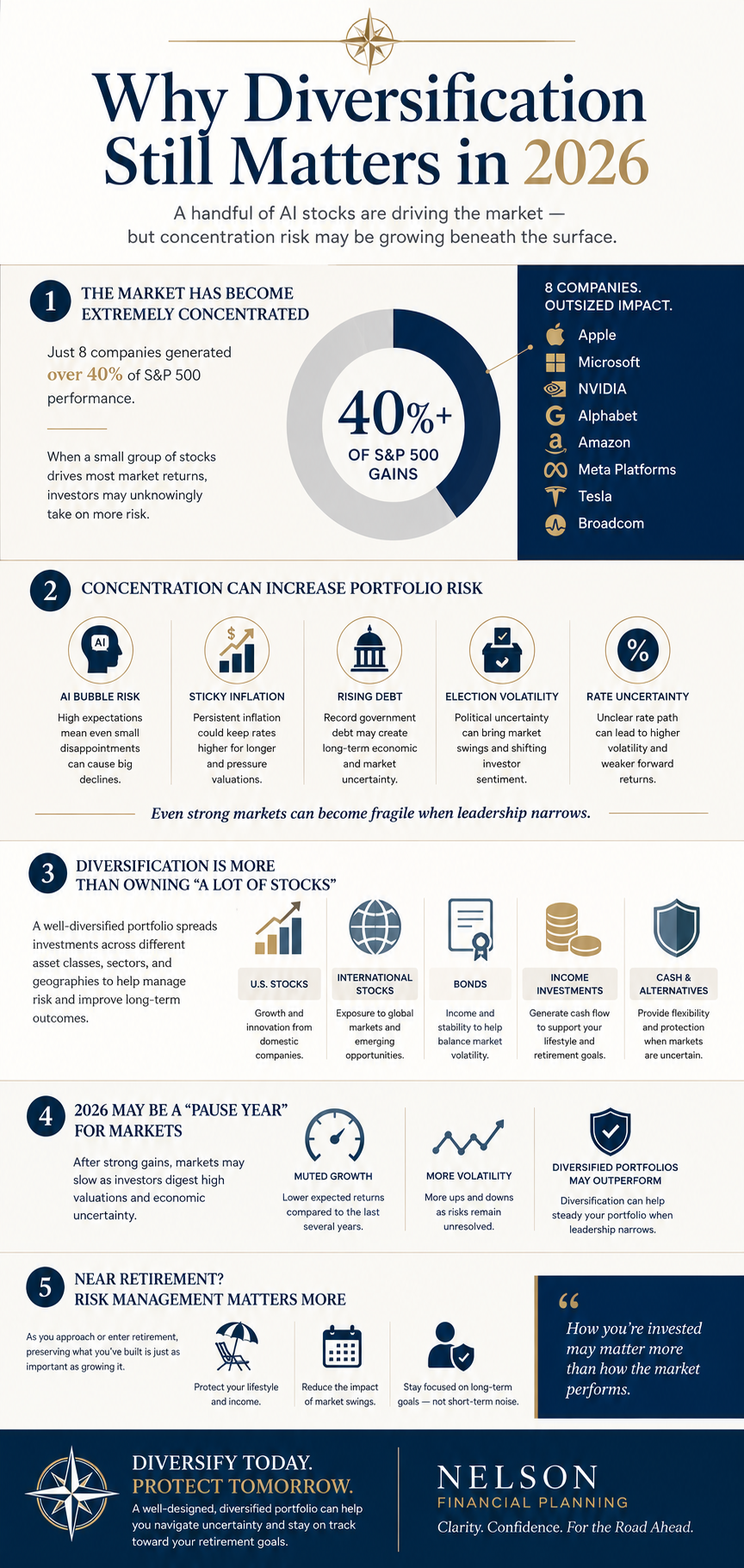
One of the biggest reasons diversification matters today is market concentration.
Many investors believe they are diversified because they own S&P 500 fund. That may be better than owning only one or two stocks, but it does not automatically mean their portfolio is balanced.
Morningstar has warned that the U.S. stock market has become highly concentrated in mega-cap technology stocks, and investors may need to look at areas like small caps and international markets to manage that risk.
Joel Garris made a similar point on Dollars & Sense when discussing how much influence a small group of companies had on market performance:
“That group of seven companies still makes up 36% of the performance of the index.”
That matters because concentration works both ways.
If a small group of companies pulls the market higher, weakness in that same group can pull it down quickly.
This is why investors should look “under the hood” of their portfolio. Owning a popular index fund may still leave someone heavily exposed to the same handful of companies, sectors, and economic assumptions.
Diversification is Not About Owning More. It is About Owning Differently.
A common mistake is thinking diversification means having more accounts, more funds, or more stocks. That is not always true. Owning 30 technology stocks is not the same as owning a diversified portfolio.
Real diversification means owning investments that may respond differently to different market conditions.
That can include:
- U.S. large-company stocks
- Small and mid-sized companies
- International investments
- Bonds
- Cash reserves
- Dividend-focused strategies
- Real estate exposure
- Taxable accounts
- Traditional retirement accounts
- Roth accounts
That is the heart of diversification. It does not remove risk. It spreads risk more intelligently.
The Emotional Problem Diversification Solves
Diversification is not just mathematical. It is behavioral.
Investors often want to move money toward whatever has recently performed best. That is human nature. Nobody likes seeing one part of a portfolio lag while another part is doing well.
Joel Garris described that exact investor temptation:
“I’ve got a bunch of different investments, but this one over here, that’s doing well. And maybe this one over here is not doing as well. And so we want everything to be in the one that is doing well.”
That feeling is understandable. It is also dangerous. The investment that looks obvious after it has already gone up may be the one carrying the most future downside risk.
Diversification helps investors avoid turning short-term emotion into long-term damage.
Christina Lamb explained the emotional side of money this way:
“People feel fear and guilt and shame and envy over money.”
Those emotions affect investment decisions. Fear makes people sell during downturns. Envy makes them chase hot trends. Anxiety makes them avoid reviewing their accounts. Overconfidence makes them take risks they do not fully understand.
A diversified plan creates guardrails.
Why Diversification Matters More Near Retirement
Diversification becomes even more important as retirement gets closer.
A younger investor may have decades to recover from a downturn. Someone five years from retirement does not have the same margin for error.
Retirement investors face multiple risks at once:
- Market volatility
- Healthcare costs
- Longevity risk
- Required minimum distributions
- Tax bracket changes
- Social Security timing
- Medicare IRMAA surcharges
- Withdrawal timing
That is why a retirement portfolio should not be built only around maximum growth.
Rob Field explained the difference between younger and older investors during a Dollars and Sense episode:
“What a young investor can handle volatility-wise, swing-wise, is a lot different than somebody nearing retirement.”
That is the crucial point. Diversification should match the investor’s stage of life. For someone still accumulating wealth, diversification may focus on growth across different markets and sectors.
For someone approaching retirement, it may also need to focus on income, stability, liquidity and tax efficiency.
Interest Rates Make Diversification Even More Important
Interest rates affect almost every part of a financial plan.
When rates rise, borrowing gets more expensive. Bonds may struggle. Cash may finally earn more. Growth stocks can face pressure.
When rates fall, borrowing may become cheaper. Certain stocks may rally. Bond values may improve. Savings yields may decline. Joel Garris explained the Federal Reserve’s role using a simple analogy:
“They’re using interest rates like an accelerator or a brake when it comes to the economy.”
That is exactly why investors should not build portfolios around one interest-rate prediction.
Even Federal Reserve policy is uncertain. Joel also noted that the Fed is not just one person making decisions; it includes voting members with differing views.
A diversified portfolio helps investors prepare for multiple outcomes instead of relying on one forecast.
AI is Powerful, But AI Hype Still Needs Risk Management
Artificial intelligence may be one of the most economically significant trends of this generation. That does not mean every AI-related investment will be a winner. During one episode, Christina Lamb noted that major technology companies were planning enormous AI infrastructure spending.
“Alphabet, Amazon, Microsoft, and Meta have guided a roughly 700 plus billion with a B of capital expenditures for 2026.”
That spending could create opportunity. It could also create disappointment if earnings do not justify expectations.
Investors should be able to participate in long-term innovation without becoming dangerously dependent on one theme. That is what diversification does. It allows room for growth while acknowledging that no trend moves in a straight line forever.
Tax Diversification is Part of Real Diversification
Many investors only think about diversification inside the portfolio. Nelson Financial Planning’s broader philosophy goes further. A strong financial plan should also consider tax diversification.
That means understanding where assets are held, not just what assets are owned. For example:
- Traditional IRAs and 401(k)s may provide tax-deferred growth, but withdrawals are generally taxable
- Roth accounts may offer tax-free qualified withdrawals
- Taxable accounts may provide flexibility and capital gains treatment
- Cash reserves can help avoid selling investments during downturns
- Charitable strategies may support tax planning and legacy goals
Joel Garris has repeatedly emphasized that financial planning should integrate investments, taxes, retirement, and estate considerations.
That is especially important because decisions in one area often affect another. For example, inherited retirement accounts now involve more complex distribution rules, and Joel warned that missing the required distribution can create penalties. Diversification is not only about market risk. It is also about tax risk, income risk, and planning risk.
Diversification Should Match Real Life
A portfolio is not separate from someone’s life. It should reflect real goals. That may include:
- Retiring by a certain age
- Creating a reliable retirement income
- Helping adult children
- Supporting aging parents
- Leaving money to heirs
- Giving to charity
- Managing healthcare expenses
- Avoiding unnecessary taxes
- Staying financially independent
In one Dollars & Sense discussion, Joel talked about how family support can quietly drain retirement savings.
A portfolio designed for a 35-year-old business owner should not look the same as a portfolio designed for a 67-year-old retiree helping an aging parent. The right mix depends on goals, income needs, risk tolerance, taxes, and time horizon.
The Best Diversified Portfolio is One Investors Can Actually Stick With
A theoretically perfect portfolio is useless if the investor abandons it during volatility. That is why Nelson’s emphasis on education matters. Investors need to understand what they own and why they own it.
“Investing is all about being consistent.” – Rob Field
Consistency is easier when the portfolio makes sense. If someone knows why they own bonds, they are less likely to get frustrated when stocks are soaring. If they understand why international exposure exists, they are less likely to abandon it after a weak year. If they understand why cash reserves matter, they may avoid selling investments at the wrong time.
Diversification works best when it is paired with education, discipline, and periodic review.
What Potential Investors Should Ask About Diversification
Before working with a financial advisor, investors should ask:
- How diversified am I really?
- Am I too concentrated in large-cap U.S. stocks?
- Do I have too much exposure to one company or sector?
- Does my portfolio match my retirement timeline?
- How will this portfolio create income later?
- What happens if the market drops 20%?
- How do taxes affect my investment strategy?
- Should I have Roth, traditional, and taxable accounts?
- How often should my portfolio be rebalanced?
- What role does each investment play?
These questions move the conversation beyond performance. That is important because performance alone does not define a good financial plan. A good plan should help people make better decisions with their money. That idea fits Nelson Financial Planning’s long-running message on Dollars & Sense.
Final Thoughts: Diversification is Really About Financial Confidence
Diversification may not sound exciting. It rarely creates viral headlines. Nobody brags at a dinner party about having a balanced asset allocation.
But diversification is one of the reasons long-term investors may sleep better during uncertain markets. It helps reduce dependence on one trend. It gives investors flexibility. It supports retirement income planning. It can improve tax strategy. Most importantly, it may help people stay invested when emotions are high.
“Don’t let that short-term volatility negate your long-term financial planning.” – Joel Garris
That is the real purpose of diversification. Not perfection. Not prediction. Preparation.
Take the Next Step
If you’re unsure whether your portfolio is positioned for a more concentrated, potentially volatile market – or whether your financial goals are aligned with today’s realities – professional guidance can help.
Schedule your complimentary consultation with one of our financial planners today!
Your retirement deserves more than guesswork. It deserves a strategy.
Request the Next Gen Dollars & Sense book and workbook, designed to help individuals build clarity, confidence, and discipline around money decisions.
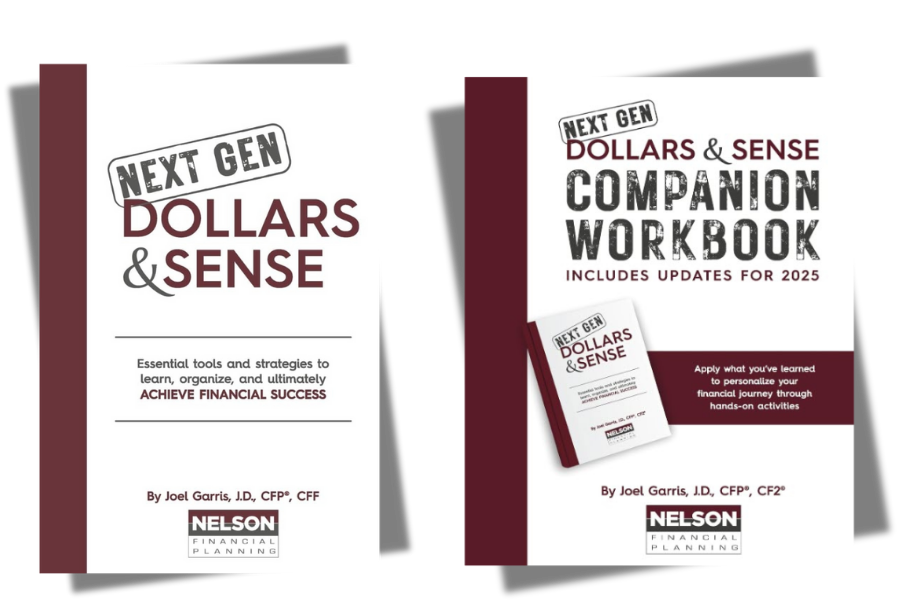
Unlock the secrets to financial success with Joel J. Garris’ insightful book, designed to equip you with the essential tools and strategies needed to take control of your financial future. Whether you’re just beginning your financial journey or approaching retirement, this book offers a comprehensive guide to help you build a solid financial plan that aligns with your goals.
Joel J. Garris, JD, CFP®, is the President and CEO of Nelson Financial Planning and the voice behind the Dollars & Sense podcast. A seasoned financial advisor with over 20 years of experience, Joel helps everyday investors make sense of complex markets with clarity and confidence. When he’s not simplifying retirement strategies or decoding economic trends, he’s probably on air delivering straight-talk financial advice – no fluff, just facts.

Resources
Fidelity: Portfolio Diversification
Vanguard: Diversifying Your Portfolio
SEC: Diversifying Risk
Morningstar: Stock Market Concentration and Diversification
U.S. Bank: Diversification in Investing May Reduce Risk
- 8 Wonders1
- Bank Investments3
- Beating Inflation1
- Budget for Retirement5
- Corporate Transparency Act2
- Digital Currency1
- Energy Tax Credits1
- ESG Funds1
- Featured Blog0
- Financial Planning14
- Financial Success5
- Importance of Dividends1
- Investment Diversification1
- Investment Portfolio6
- Investment Strategy4
- IRA1
- Joel Garris1
- Nelson Financial Planning7
- Net Worth Improvement1
- Next Gen Dollars and Sense1
- One Big Beautiful Bill Act (OBBBA)1
- Pension Plans1
- Podcast Transcripts17
- Retirement “Secure” Act2
- Retirement Income Planning3
- Retirement Planning7
- Retirement Regrets5
- Social Security4
- Tax Liability3
- Tax Planning7
- Year-End Tax Changes3