




Are you making this common retirement mistake?

The mistake isn’t how you save – it’s how you turn those savings into income.
Most people approaching retirement spend years obsessing over the same question: “Do I have enough saved?”
It’s the question that drives every calculator, every late-night worry, and every spreadsheet. And while that is an important part of preparing for life after work, it isn’t actually the biggest issue that sends retirees off course.
As Joel Garris, CFP®, explains on the Dollars & Sense podcast, the most overlooked retirement risk isn’t about whether your nest egg is big enough.
It’s about how you convert that nest egg into income.
“The biggest issue we see when we sit down and talk to folks . . . is not necessarily a failure of retirement planning, but a failure to really think through retirement income planning.” – Joel
This single distinction – between retirement planning and retirement income planning – is what separates people who feel confident and secure in retirement from those who run into avoidable financial stress.
Today, we’re breaking down why this mistake happens, what it really means, and how you can avoid it.
Retirement Planning vs Retirement Income Planning: What’s the Difference
Most people are familiar with traditional retirement planning. It’s the part that feels straightforward:
- how much do I have?
- how much do I owe?
- are my investments on track?
- what’s my portfolio balance today?
Joel compares this stage to a company’s balance sheet – a snapshot of assets and liabilities. Important? Yes. Sufficient? Not even close.
Traditional retirement planning doesn’t fully account for:
- market volatility
- inflation
- asset value fluctuations
- economic uncertainty
“You don’t necessarily have full control over the value of your assets at any given time . . . that’s a natural reflection of the underlying volatility of both the stock and bond market.” – Joel
This is why so many retirees feel unprepared. They’ve planned for the number but not the income.
Retirement Income Planning: The Missing Piece
Retirement income planning shifts the focus from what you have to how you use it.
Think of it as your retirement profit-and-loss statement – your P&L:
- where will your income come from?
- how should you time withdrawls?
- how do taxes change your take-home income?
- what’s the most efficient order to draw from different accounts?
- how does your strategy impact your beneficiaries?
You have far more control here than in traditional planning. But only if you intentionally build a retirement income plan.
“With retirement income planning, you can pick and choose exactly where your income comes from . . . but you have to do it properly.” – Joel
This is where most people make their biggest mistake. They retire without ever creating a real income plan.
Why This Mistake is So Common
Most retirement calculators look at “the number.”
Most investment apps focus on contributions and balances.
Most savers follow rules of thumb without understanding the tax implications.
The result?
People know how to save, but not how to spend strategically in retirement.
This leads to:
- unnecessary taxes
- poor social security timing
- drawing from the wrong accounts first
- increased medicare costs
- reduced long-term income
- faster depletion of savings
You can have a seven-figure portfolio and still undermine your retirement by choosing different income sources.
The 3 Core Elements of a Strong Retirement Income Plan
There are 3 key categories for retirement income planning.
#1. Social Security: The Cornerstone of Retirement Income
For most Americans, Social Security makes up a significant portion of their retirement income. Yet very few understand the nuances.
“You have to understand Social Security withdrawl strategies . . . because that is a large part of most people’s income in retirement.” – Joel
Timing
When you file – 62, full retirement age, or 70 – affects your income for the rest of your life.
Spousal & Survivor Benefits
Coordinating benefits between spouses can add tens of thousands more over a lifetime.
Income Taxation
This is the part that shocks nearly everyone.
“Social Security, in fact, is taxable . . . and those income levels haven’t changed in 40 years.”
Depending on your other income:
- up to 50% of your benefit may be taxable
- or up to 85% of it
The more taxable income you generate from other sources, the more your Social Security becomes taxable. This is why income planning – not just filing planning – is essential.
#2. Understanding the Tax Nature of Your Accounts
This is where retirees can make or lose the most money.
Your retirement accounts fall into different tax categories.
Traditional, Pre-Tax Accounts
401(k), 403(b), traditional IRAs – fully taxed as ordinary income when withdrawn
Roth Accounts
Roth IRA, Roth 401(k) – tax free withdrawls
After-Tax / Brokerage Accounts
Special tax treatment for long-term capital gains and qualified dividends.
“Dividends and capital gains are taxed at lower rates . . . and for many couples, those long-term capital gains rates can actually be zero.” – Joel
This creates incredible opportunities for strategic withdrawal sequencing, including:
- filling lower tax brackets intentionally
- using Roth conversions at opportune times
- reducing Social Security taxation
- lowering Required Minimum Distributions later
- managing Medicare IRMAA brackets
This is one of the most misunderstood and underutilized parts of retirement income planning.
#3. Inflation: The Risk that Never Retires
Inflation doesn’t feel dramatic from year to year . . . until you apply math.
Joel makes this clear with a simple example: “While 3% doesn’t sound like much . . . over 12 years something that costs $10 is now going to cost $15.”
That’s a 50% cost increase in just over a decade.
Why This Matters
If you retire at 65, your retirement may last 25-30 years.
That means two or even three rounds of 50% increases in expenses.
Why Bonds Alone Aren’t Enough
Many retirees mistakenly shift too aggressively into conservative investments.
Joel warns: “Far too many people . . . hear the message of ‘you’ve got to be 60% in bonds.’ No, no, no, no, no.”
A diversified portfolio with appropriate growth potential is essential to outpace inflation – especially when you’re drawing income.
What a Complete Retirement Income Plan Looks Like
A strong plan integrates:
- Social Security timing
- Tax-efficient withdrawals
- Investment allocation designed for longevity
- Inflation-adjusted projections
- Strategies to reduce taxation of benefits
- Sequencing rules for which accounts to tap first
- A beneficiary-friendly structure
The goal isn’t just to avoid running out of money.
The goal is to maximize lifetime after-tax income and minimize avoidable financial pressure.
“These are the key differences between retirement planning – which everyone talks about – and retirement income planning, which is far more nuanced . . . and ultimately something that you can control and make a real difference with.” – Joel
The Real #1 Retirement Mistake: Not Having an Income Plan
You can have:
- great savings habits
- a solid investment portfolio
- years of planning behind you
. . . and still fall short if you don’t convert that savings into a coordinated, tax-efficient income stream.
This is the mistake most retirees don’t even know they’re making.
The good news?
It’s completely avoidable – with the right help and a clear strategy.
Want to Build a Retirement Income Plan that Actually Works?
At Nelson Financial Planning, every client receives a fully customized retirement income plan:
- reduces taxes
- optimizes Social Security
- protects your portfolio
- coordinates your income sources
- adjusts for inflation and longevity
- supports your legacy goals
If you’re within 5-10 years of retirement – or already retired – it’s time to build the plan that will support the rest of your life.
Schedule your complimentary consultation with one of our financial planners today!
Your retirement deserves more than guesswork. It deserves a strategy.
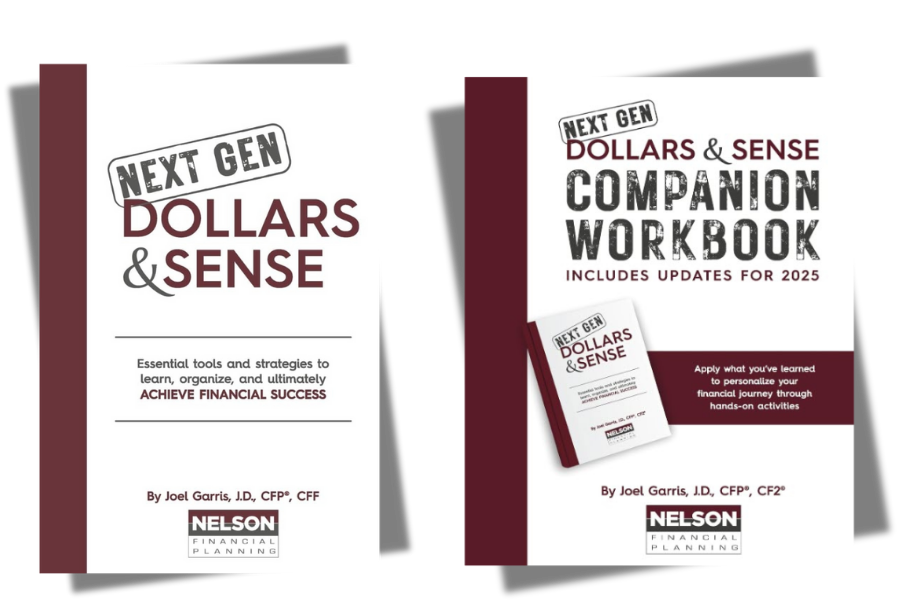
Get a free copy of our book and workbook Next Gen Dollars & Sense
Unlock the secrets to financial success with Joel J. Garris’ insightful book, designed to equip you with the essential tools and strategies needed to take control of your financial future. Whether you’re just beginning your financial journey or approaching retirement, this book offers a comprehensive guide to help you build a solid financial plan that aligns with your goals.
ABOUT THE AUTHOR

Joel J. Garris, JD, CFP®, is the President and CEO of Nelson Financial Planning and the voice behind the Dollars & Sense podcast. A seasoned financial advisor with over 20 years of experience, Joel helps everyday investors make sense of complex markets with clarity and confidence. When he’s not simplifying retirement strategies or decoding economic trends, he’s probably on air delivering straight-talk financial advice – no fluff, just facts.
- 8 Wonders1
- Bank Investments3
- Beating Inflation1
- Budget for Retirement5
- Corporate Transparency Act2
- Digital Currency1
- Energy Tax Credits1
- ESG Funds1
- Featured Blog0
- Financial Planning13
- Financial Success4
- Importance of Dividends2
- Investment Portfolio5
- Investment Strategy3
- IRA1
- Joel Garris1
- Nelson Financial Planning7
- Net Worth Improvement1
- Next Gen Dollars and Sense1
- One Big Beautiful Bill Act (OBBBA)1
- Pension Plans1
- Podcast Transcripts12
- Retirement “Secure” Act2
- Retirement Income Planning3
- Retirement Planning7
- Retirement Regrets5
- Social Security4
- Tax Liability3
- Tax Planning7
- Year-End Tax Changes3