




Dollars & Sense Episode Summary
Early in the year, headlines can feel overwhelming – and this episode of Dollars & Sense is a timely reminder of why reacting emotionally to the news can be costly. Joel Garris CFP Kristin Castello, CPA and CFP, walk listeners through two major forces shaping financial decisions right now: geopolitical instability tied to Venezuela and sweeping tax changes coming in 2026.
The episode opens with a discussion of the capture of Venezuela’s president and the uncertainty surrounding who controls the country moving forward. While the political implications are significant, Joel and Kristin focus on what matters most for investors: how global headlines influence markets, oil prices, and investor behavior. They explain why, despite dramatic news, markets did not experience the panic many expected – and why oil, energy supply, and global power dynamics don’t always translate into immediate market turmoil. The conversation highlights how fear-driven reactions often show up not in stock prices, but in investor decisions.
From there, the discussion shifts to a critical mindset lesson: volatility and uncertainty are part of investing. Periods like this test risk tolerance, diversification, and discipline. Joel and Kristin emphasize the importance of stepping back, reassessing portfolio balance, avoiding impulsive moves, and remembering that reacting too quickly to headlines can result in missing long-term opportunities.
The second half of the episode dives into the top tax changes taking effect in 2026 – many of which will directly affect retirees, pre-retirees, and working households. They break down the permanence of lower tax brackets and the higher standard deduction, helping reduce long-term planning uncertainty. They also explain new, time-limited deductions such as no income tax on tips and overtime, along with income phaseouts and filing-status rules that could trip people up if they’re not paying attention.
Joel and Kristin also cover increased contribution limits for retirement accounts, expanded HSA limits, and a new senior deduction for individuals age 65 and older. These changes open the door to meaningful planning opportunities, including strategic IRA withdrawals or Roth conversions in the right circumstances. The episode wraps up with a rapid-fire look at additional changes impacting homeowners, car buyers, charitable giving, gamblers, and families with young children.
Overall, this episode connects the dots between global events and everyday financial decisions – offering clarity, context, and practical guidance to help listeners stay focused on long-term financial success rather than short-term noise.
Episode Chapters, Highlights & Key Takeaways
PODCAST CHAPTERS
- 00:00 Headlines That Matter: Venezuela & Major Tax Changes Ahead
- 00:01 Meet the Hosts & Why This Episode Matters
- 00:01:50 Venezuela’s President Captured: What Happened?
- 00:02:31 U.S. Control, Global Backlash & Political Fallout
- 00:03:08 Oil Markets, Energy Prices & Why Markets Stayed Calm
- 00:03:30 Markets Rally Despite Crisis — Should Investors Be Surprised?
- 00:04:11 Geopolitical Risk, Oil Supply & Global Power Tensions
- 00:05:40 Gold, Fear Trades & Investor Psychology
- 00:06:21 What Headlines Reveal About Your Risk Tolerance
- 00:06:54 Rebalancing, Diversification & Staying Disciplined
- 00:07:13 Why Diversification Matters More in 2026
- 00:09:46 Transition: The Top 10 Tax Changes for 2026
- 00:11:22 Permanent Lower Tax Brackets Explained
- 00:13:29 Standard Deduction Made Permanent
- 00:15:33 No Income Tax on Tips: Who Qualifies
- 00:18:00 No Income Tax on Overtime Pay
- 00:20:17 Income Limits, Phaseouts & Filing Status Traps
- 00:22:29 Retirement Contribution Limits Increased (401k, IRA, Roth)
- 00:26:05 HSA Contribution Increases & Triple Tax Benefits
- 00:26:41 New Senior Deduction (Age 65+)
- 00:28:31 Roth Conversions & Strategic Withdrawals
- 00:30:19 SALT Deduction Raised to $40,000 (Temporarily)
- 00:31:46 New Car Loan Interest Deduction Explained
- 00:33:35 Charitable Giving Rule Changes (2026)
- 00:36:02 Gambling Loss Deduction Changes
- 00:37:43 New “Trump Accounts” for Children
- 00:39:00 Free Book & Workbook + Final Takeaways
- 00:39:44 Closing Thoughts & How to Get Help
HIGHLIGHTS
Global Shockwaves & Your Portfolio
- U.S. forces capture Venezuela’s president Nicolás Maduro
- Why oil markets stayed calm (for now)
- How headlines trigger fear — and bad investor decisions
- Why gold spikes during uncertainty
- What geopolitical volatility really means for long-term investors
Top 10 Tax Changes Coming in 2026 (Explained Simply)
- Permanent lower tax brackets (10%–37%)
- Bigger standard deductions (now permanent)
- No income tax on tips (for qualifying workers)
- No income tax on overtime (with limits)
- New senior deduction for those 65+
- SALT deduction cap raised to $40,000 (temporarily)
- New car loan interest deductions
- Expanded charitable giving rules
- Major changes to gambling loss deductions
- New government-funded “Trump Accounts” for children
Smart Takeaways for Retirement & Investing
- Why reacting emotionally to headlines hurts returns
- The role diversification plays in volatile years
- How new tax rules open planning opportunities
- When not to make big portfolio changes
- Why working with a fiduciary matters more than ever
KEY TAKEAWAYS
- Major geopolitical headlines can drive fear, but markets don’t always react the way investors expect.
- Oil supply, global power dynamics, and market sentiment are complex – and rarely move in straight lines.
- Gold and other “safe haven” assets often rise during uncertainty, signaling fear more than opportunity.
- Periods of volatility are a stress test for your risk tolerance, diversification, and discipline.
- Lower federal income brackets are now permanent (for the foreseeable future), reducing planning uncertainty.
- The higher standard deduction is permanent and indexed for inflation, simplifying tax filing for most households.
- New deductions for tips and overtime are temporary and come with income limits and filing restrictions.
- Retirement contribution limits increased across multiple accounts, creating long-term growth opportunities.
- A new senior deduction for those 65+ may allow for smarter IRA withdrawals or Roth conversion strategies.
- Several 2026 changes – SALT caps, charitable rules, and gambling deductions – require proactive planning to avoid surprises.
Podcast Transcript
Speakers: Joel Garris and Kristin Castello
Venezuela Crisis, Oil Market & 2026 Tax Changes
[00:00:00] Lots of headlines early in the year. we’re gonna talk a little bit about the developing situation in Venezuela, uh, starting with the events that happened last Saturday, and then we’re gonna immediately segue over to. Some of the top 10 tax changes that you’re gonna want to know for this year, so we get the pleasure of having a fellow certified financial fiduciary and certified financial planner. [00:00:34] Kristin Costello on the program, always a pleasure to have you on. [00:00:38] Yes, thanks for having me, Joel. So, not only are you a certified financial fiduciary, certified financial planner, but you’re also A CPA, which makes you, have a high level of expertise to talk about these tax changes and how they might affect people. [00:00:52] And we got a whole slew of new ones coming this year, so. So this is an important one to pay attention to. [00:00:57] We do, indeed. That is for sure. And, so welcome on in, to Dollars and Sense where we help sense out of all of life’s decisions involving your dollars. One of Central Florida’s longest running a radio program’s. [00:01:09] Also a top 25 financial planning podcasts out there on the big wide world web to learn more about us, including how you can get, connected to our particular channels on your. Favorite podcast platform or on YouTube as well, where you get to see us doing the show here in the Nelson Financial Planning [00:01:30] Studios. [00:01:30] Visit our website@nelsonfinancialplanning.com. My name of course is Joel Garris, certified financial Planner and certified financial. Planner, certified Financial fiduciary as well, and a few other acronyms we’ll throw in there. Kristin Castello, as we know, is joining me on the program.Venezuela’s Political Crisis and What Global Headlines Really Mean for Investors
So, a lot of, a, a lot of headlines, just early on, particularly this past week, the situation in Venezuela, and, sort of.
[00:01:54] Capture slash extradition depending upon, kind of your perspective of President Nicholas Maduro. And, last weekend obviously got the pleasure of appearing in court in New York this week, but it, it, it’s got a lot of implications in terms of, of not just for Venezuela and, and how that might happen, and what might happen there, but also sort of real implications for the financial markets, energy prices, and. [00:02:21] And your personal finances as well. [00:02:23] Yeah. Yeah. So kind of recap what we know so far. A lot of you have probably been reading the headlines that early Saturday morning, last Saturday, US forces captured Venezuelan President Nicholas Maduro and his wife. like Joel said, they are now sitting in US courts. [00:02:38] Um, so kind of where we’re at is that the US will quote unquote run Venezuela. I wonder what that means, right? For the, the time being. not really sure what that means. but we do know that the interim president Delcy Rodriguez, who was sworn in shortly after his capture, isn’t too happy with the situation. [00:02:57] No. Um, [00:02:58] so doesn’t kinda his right or [00:03:00] his right hand person. Mm-hmm. So it’s kind of odd that it was her rather than the other individual that won the Nobel Peace Prize. Right, right. So interesting kind of how all of that. Played out. And then just here in the US there’s a lot of division on what happened too. [00:03:16] Yeah, no question. And you know, the reality is oil, is a big part of the overall economy, and certainly has some, some major implications, for what may happen in, in the future. Now interestingly, the markets this past week were, very much, sort of unruffled, if you will, uh, by what was was going on, uh, as a result of that headline last weekend. [00:03:39] Yeah, didn’t really see much fluctuations at all. Yeah. And if anything, Monday, the DAO was up, uh, like 700 points. I mean, it is one of those things where I’m looking at how many points the Dao went up between Friday, last Friday, and Monday, and I’m already wondering if I need to revise my, my Fearless Forecast. [00:03:57] My fearless forecast might not be anywhere near accurate. Um. But I also suspect that there could be some volatility in the year ahead. Mm-hmm. That’s for sure. Mm-hmm. We’re only in the first week, Joel. Yeah. We’re only in the first week. Yeah. Only first week. Much, much to come. And I think that’s, I think that’s part of why we, we wanted to kind of talk a little bit about this is, this is the kind of headline thing that Ken and does create a lot of investor un uncertainty. [00:04:22] Now, o obviously, you know, their oil infrastructure down in Venezuela is, is aging, it’s it’s low [00:04:30] quality, sort of this called heavy oil, whatever that means. But it, it’s not as usable as it could be. Uh, they produce about a million barrels, uh, a day, um, which is about 1% of the world’s output. Uh, their, their, I guess, claim to fame is that they do have the world’s largest reserve, 300 billion, uh, barrels of oil. [00:04:49] Um, so certainly, um, an an an interesting, um. Kind of turn of events this week. Mm-hmm. Yeah. Yeah. And I think some of the bigger tailwinds from this are just gonna be political stability and just global tensions overall. We do know that China and Russia did not have the best reaction to, to the capture as well. [00:05:09] Um, so just kind of seeing how that plays out over the next couple of months or years. Yeah. No, no, no question. I mean, I think there’s, there’s some, a variety of issues in which to kind of really look at and, and to kind of talk through. Um, some of the, some of the global powers as you mentioned are, you know, having some serious concerns about the actions that were done. [00:05:30] Uh, obviously big energy, big part, and the price of oil, big part of sort of the global economy and certainly controlling, uh, Venezuelan oil supply could have. Direct impact on places like China and Russia, which were the primary buyers of that Venezuelan oil. Uh, and um, and then again, the, you know, kind of those headline impacts of, of kind of what can happen when you have a big, major headline event.Market Volatility, Gold & How Investors Should Respond to Uncertainty
[00:05:55] Like what we’ve seen with, with, with this particular, uh, headline. Mm-hmm. Yeah. Yeah. And I, I think one of the other sides that we’ve seen of this is that gold has kind of gone up again. Yeah. That whole fear tactic of when the markets are uncertain that gold is kind of the, the go-to asset. So we’ve kind of seen an uptick in that as well. [00:06:15] No, and I think that that and that, and that is typical, right? Mm-hmm. We see gold spike, you know, generally if there’s fear, uh, gold spikes, annuity sales spike. I mean, all of those kinds of things happen. Um, and I think though this headline is. Just serves as a good reminder here at the beginning of the year about, yeah, when you have these periods of uncertainty. [00:06:36] There’s certainly some things that every investor needs to make sure that they’re, you know, that they’re, that they’re doing, starting with kind of, you know, just kinda looking at their risk tolerance, right? Mm-hmm. Revisiting that. Um, but a few other key pieces as, as well beyond just kinda looking at the risk tolerance. [00:06:53] Um, ’cause we were talking about a bunch of different things that, you know, anytime you run into these headlines. It. It’s important to kind of keep some perspective. Yeah. Yeah. It’s a good way to kind of test your risk tolerance too. And then if it is something that makes you uncomfortable, that’s when you can do rebalances. [00:07:08] Get more diversified. Um, kind of maybe increase your cast position, if that makes you feel a little bit more at ease. So it’s a good way to kind of just reevaluate the portfolio. No, I think that’s true and I think it’s a good reminder of saying, Hey, you know, at the end of the day things like looking at your risk tolerance, reviewing that is, is always a good idea no matter what. [00:07:28] But I think these types of headlines help to kind of push us towards that. The notion of staying diversified. I mean that’s always important. And last week on the program with the Fearless Forecast, we were talking about that being a really big theme for this year, um, as opposed to last year, where I think it was important to be consistent. [00:07:51] This year is a year where that diversification is probably gonna pay off. Mm-hmm. I agree. I think so too indeed. And then all the other stuff that you’re supposed to remember as well, things like maintaining an emergency savings. Avoiding impulsive decisions. I mean, the reality is that you know, this, this certainly does have some, some, some major ripples, that’s for sure. [00:08:12] Mm-hmm. Anything that happens politically like this, we do see a lot of people wanting to make those impulsive decisions and maybe move all of their assets into cash or something more secure. So just kind of take a minute and. And let it settle before you make impulsive decisions or, you know, contact your financial advisor, give us a call. [00:08:31] We’re happy to, to kind of have those conversations. No, absolutely. Great, great suggestion. I mean, I think that, uh, you know, last year is a good reminder where it starts, started out with nearly a 20% decline in the markets and then ultimately, uh, you know, had you reacted to that. Uh, then, uh, you would’ve missed out on it what wound up being a, a decent year in terms of market performance. [00:08:54] Mm-hmm. Right, right. We actually did see that a couple times where unfortunately we had some clients miss out on that. Yep. Nope, that’s exactly the case. So, a good reminder. Of where diversification is certainly important, particularly when we think about kinda, uh, how all of this type of situation plays out. [00:09:14] You know, it’s funny, you know, a former Secretary of State, Colin Powell once cautioned, if you, if you break it, you own it. And certainly the US is I guess stepping right straight into the midst of this Venezuela situation with, with certainly some enormous implications. That is for sure. So, but anyway,that’s.Major 2026 Tax Changes and What They Mean for Long-Term Financial Planning
[00:09:40] Story obviously will continue. Our next segment will feature our top 10 tax changes. That’s gonna be a story that’s gonna hit your wallet in the next few months as you file your tax return. So stay tuned for that here on Dollars and Sense, [00:10:00] CPA. So Kristen, I am always excited. To have you join me for this show in January every year. Mm-hmm. Where we talk about these top 10 tax changes. Yep. It is a good one. It’s a good one for everybody to pay attention to as we go into tax season and kind of preparing for the year ahead as well. Lot more substance if you will, uh, to these top 10, uh, tax changes. [00:10:21] ’cause it was a major tax bill that passed last summer. Right, right. It’s every couple of years we have these major changes and this is one year where there’s gonna be. Significant changes that can impact your tax return. So every year, for several years now, and before that I used to do the top 10 right out the top 10 tax changes list. [00:10:41] But every year now you do that as, as would be expected given your level of expertise. hen we mailed that out to all of our clients. Mm-hmm. Okay. So a good resource document. So from now, sort of, sort of the rest of the show is gonna be dedicated to going through that. Top 10 list, share it with our listing audience. [00:11:03] But hey, if, if you’d like a copy of that top 10 tax list, feel free to go to our website@nelsonfinancialplanning.com. There, you can go ahead and just request it. We’re happy to send it out to you absolutely free of charge. It’s good solid information, a lot of which we’re going to cover in the rest of the program this week. [00:11:25] But you know, there’s always some. Some details that are easy to write out rather than to talk out. So, um, but so where do we want to get started on this thing? We’ll start with the biggest impacting change. Uh, so the reduced tax rates that we’ve seen for the past eight or so years, they are now made permanent. [00:11:47] Uh, so this is a big one. So the tax brackets that we have gotten used to, so that’s gonna be 10%, 12, 22, 24, 32, 35, and 37% are now permanent. So this is a big deal for long-term planning because we’ve had for years people asking, should I do Roth conversions before the rates go up? Should I do income planning, push more of my income when the income rates are lower, kind of wait to use my deductions when the income rates are higher. [00:12:13] So now. We don’t necessarily need to do that sort of planning anymore because those rates are permanent, at least for the foreseeable future. Yeah. Yes. We know that nothing is permanent when it comes to, you know, the, the government, but you never know when a new regime’s gonna come in and change those rates. [00:12:30] But for the time being. The foreseeable future, we can kind of rely on those, those lower tax rates. Yeah. Certainly an opportunity to kind of at least plan for the next few years. And I think that was one of the things that, uh, was so important. You know, all of those tax rates that you just kind of listed off, those were all going to expire at the end of last year. [00:12:52] Mm-hmm. And so that’s why so much of this bill. Had to focus on that. And obviously we got a lot of other changes that we’re gonna talk about that came through and, and they’re, and they’re, each one of them is certainly important, but maybe not as significant as what people were expecting. ’cause the biggest part of the, the dollars that were sort of set aside to help make this bill happen had to deal with continuing those lower tax rates and getting some. [00:13:23] Effective permanency, or at least temporary permanency on, uh, on, on those rates going forward. Yeah. Yeah. So those rates are staying the same. And then also capital gain rates, and for qualified dividends as well, they’re staying at zero, 15, and 20%. So that is good. That’s been around for a while, so nice to see that that is continuing as well. [00:13:44] And then the same thing with the whole notion of, of a higher standard deduction. Mm-hmm. Personal exemption’s gone away, so, so where are we now on that standard deduction? So that is also made permanent, so it’s not gonna go down to half of what it was before. So now it’s gonna be permanent at. 15,750 for single filers and 31,500 for joint filers, and it’s actually gonna be indexed for inflation every year. [00:14:07] So it’s gonna go up a little bit, kind of what we’ve seen in the past. Uh, so this is a big deal because it makes the tax return a little bit less complicated for those that ordinarily itemized their deductions before the standard deduction was larger. So now we’ve got about 90% of tax filers taking the standard deduction, which will just make processing you actually doing your tax return a little less time consuming. [00:14:31] It kinda makes it a little bit easier on everyone. Yeah, no, no question at all on that. I mean, know you got over 90% of the people that are now taking the standard deduction. Again, that’s an election that you get to take, right? You can either take the standard deduction or you can itemize your deductions. [00:14:45] Bottom line, you pick the one that is, that adds to the higher amount, so if the itemized deductions are less, then you would go with the standard. Those are some pretty high numbers. A standard deduction of almost $32,000 for a married couple. Mm-hmm. That, that’s a Pretty good deduction that you’ll find that most people will wind up going that route. [00:15:05] Right, right. And we actually have some deductions coming up that changed for the itemized deductions. Sure, sure. Yeah. So kinda stay tuned, we’re gonna talk to you about those two as well. Absolutely, absolutely. And certainly as you were sharing, you know, the, the, the permanency or the, you know, the kind of the, the removing. [00:15:22] The uncertainty about those tax rates really has helped in, in sort of some of the conversations we’ve had with clients. Mm-hmm. Yeah. So a lot of people were worried about the rates going up. Yeah. So now there’s not that huge push for Roth conversions immediately. We can kind of do them still over time. [00:15:39] There’s not the huge, you know, anxiety about the rates going up. You can kind of rest at ease that for the foreseeable future, those rates are kind of locked in. So we’ll shift gears and talk about one of the new ones, uh, which is this notion of not having to pay taxes on your tips or your overtime. [00:15:57] tell us about this one. This is kind of a little, this is different. We haven’t seen this one before, so this one’s brand new and, and certainly it’s gonna have some implications. Mm-hmm. So this is primarily focused on the service industry. So we’ll first talk about the no tax on tips. So this is only for 2025 to 2028. [00:16:17] So keep that in mind. It’s not a permanent thing, it’s just for four years. Uh, so it is a deduction up to 12,500 for single filers and 25,000 for joint filers, where you can essentially [00:16:30] not pay income taxes on tips up to that amount. Now you’re still liable for the FICA taxes, which is the Social Security and Medicare taxes, but income taxes will not be assessed on that. [00:16:41] So it’s pretty specific on what occupations qualify for this. So you need to be ordinarily tipped in your line of business. So financial planners, accountant, we don’t qualify for it. No, no professional type field, you know, lawyers, engineers, none of that would qualify. But the IRS does have a list of nearly about 70 occupations that qualify. [00:17:02] It’s gonna be your typical tipped occupations like food, servers, entertainers, hairdressers. Valet along those sorts of lines. Okay. All right. So that’s good. So they’ve started to kind of put some, put some parameters on it. Um, but, but it’s gonna be, this first year I think is gonna be a little tricky because they, they envision doing some changes to that standard form W2. [00:17:26] Mm-hmm. But a lot of those changes because the W2s, as an employer, you’ve gotta get those out within the first 30 days here in, in January. And I think, I think that’s, I think this year’s gonna be a little tricky mm-hmm. In, in, in, in, in terms of really trying to kind of get, get the right number on this stuff. [00:17:44] I think so too. It’s gonna kind of fall on to you as the taxpayer to kind of isolate what those tips are. So usually when you are in that industry, they kind of, uh, they, the tips that you get on credit cards, they can kind of isolate that pretty easily. But cash tips, that’s gonna be whole different ballgame. [00:18:01] Yeah. And, and the reality is that we’re only talking about the income tax side here. Right. Right. I mean, you still gotta pay the FICA tax, you gotta pay the Medicare and social security taxes and all that. Mm-hmm. So it’s not like it’s totally tax free, it’s just income tax free. Right. Exactly. And then the, the other big one is no tax on overtime pay. [00:18:20] So similar to the No Tax on Tips, it is for it’s up to $12,000 or 12,500 for single filers and $25,000 for joint filers. But keep in mind, this is just the incremental amount over your base pay. So if you’re getting paid, you know, $10 an hour, and then you get time and a half for working overtime, so you get $15 an hour, it’s just that $5 incremental increase for the overtime that would be tax free. [00:18:50] Yeah, so Nelson’s pretty excited about this one. I mean, obviously the supplies for last year, Nelson, being my oldest son, he works for the Osceola Magic. So during season, when they’re in, when the games are happening like now, uh, he, uh, you know, we’ll sometimes get overtime, you know, games are at night and things like that. [00:19:05] So, uh, so yeah, so he’s, uh, he’s particularly happy about, about this, uh, change. But again, the key piece is when you’re doing your 25 tax return, it’s not going to be as self-evident. As it might be. So you, you might have a little bit more work to do on your tax return if this, if you get tips or overtime to really kind of separate that stuff out. [00:19:27] Mm-hmm. At least for 2025. Right. You might [00:19:30] have it smoothed out next year, but that’s the hope Anyway, we’ll continue on with the top 10 tax changes for 2026, uh, on uh, dollars and Sense with Joel Garrison, Kristen Costello of Nelson Financial Planning. [00:19:48] We are talking about the top 10 tax changes for 2026. Right before the break, we were talking about the first one, which was that the lower tax rates are now permanent, uh, for the, at least the foreseeable future. And then we were also talking about the next big one about the no tax on tips and no tax on overtime. [00:20:07] So we were talking about how that is starting for 2025. So you will see it on the tax return that you are going to file this spring. So it is a deduction up to 12,500 for single filers and $25,000 for joint filers. Uh, and this is a income tax deduction. It’s your, your tips and your overtime will still be subject to the FICA taxes, which are the Medicare and social security taxes. [00:20:32] So something to keep in mind on these is both of these deductions do have an income threshold limit. So if you are single, the phase out starts at $75,000 and if you are married, then the phase out starts at $150,000. And another key thing about this deduction is you have to file married filing jointly. [00:20:51] It is not available for married filing separately. You know, that was kind of a unique thing that got thrown into a couple of these that we’re gonna obviously highlight, um, [00:21:00] where you really, you know, in, in the past it wasn’t, there wasn’t a significant penalty for married filing separate. But some of these provisions such as this one there, there definitely is that, that penalty if you’re choosing to file married, filing separate. [00:21:16] So if you’ve been filing, married, filing separate in the past, you really want to be thinking this one through a little bit more than, than maybe what you’ve done previously. Mm-hmm. Right, right. And I think it’s the iris as way of. We don’t want as many tax returns files, so we’re gonna limit what you can do if you file separately. [00:21:33] They have an ulterior motive. No. Why Washington doesn’t have an ulterior motive. Um, and, and, uh, the, the, the other part of that is that. Um, you know, the forms haven’t been updated, so look, if you’ve, if you’ve got tips, if you got overtime last year, you’re gonna have to really pay attention to making sure that your return is completed accurately and that you’re putting all of the information in the right space. [00:21:59] ’cause it won’t be as self-evident. As it should be in future years mm-hmm. Once they update these forms. But that’s a real issue for folks to, to, to want to be, um, paying attention to Right. At the end of the day. Right. You may need to have your pay stubs as well on top of your W twos. Yeah, yeah. Just kind of to look at what that overtime is, what that tip number is, just to make sure you’re putting it in Right. [00:22:20] No, absolutely. Absolutely. And speaking of, of kind of those, uh, you know, those, those things from, from work. Uh, the beauty of, of these [00:22:30] changes is that it also increased the retirement account limits, the HSA limits. I mean, you, you know, you’re talking about some nice increases in terms of the maximum contribution levels and things like that, that are available. [00:22:43] Mm-hmm. Yep. So the next big change is that all your 401k, 4 0 3 B 4 57, your normal, you know, employer contribution limits have increased. So they’re now up to 24,500. And then also the ketchup. It is now $8,000 for those that are age 50 to 59, or if you’re 64 and older, if you fall in that range of age 60 to 63, you actually get a higher catchup. [00:23:09] It’s 11,250. Yeah, so remember this is the year, I think it was last year as well, where there’s that, that kind of. Extra special catch up level if you’re for some reason just in that very narrow bracket. Mm-hmm. Of ages 60 to 63. So on the 401k level for 25 means you can do 11,250 versus the 8,000 numbers. [00:23:35] So again, you know. A lot of rules out there in terms of what you can and cannot do, thanks to the folks at the IRS. So, uh, but the IRA limit also changed mm-hmm. A bit as well for those that that fund their retirement accounts on an individual basis, whether that’s IRA or Roth. Yeah. So IRA limits don’t. [00:23:54] Typically increase every year, so this is a big one. So traditional and Roth IRAs are now up to [00:24:00] 7,500. It used to be 7,000, and the catch up that used to be a thousand dollars is actually now indexed for inflation. So this year, the year match ketchup, so if you’re age 50 and older is now 1,100. So if you’re over 50, you can put 8,600 into an IRA. [00:24:16] Yeah. So, uh, you know, as opposed to some of these changes in the past on the IRA contribution limit, you know, it’s usually like a clean whole number. I mean, this is kind of a weird number. But it’s, yeah, it’s 8,600 for the year. Similarly, within simples and, and and SEPs. Simple increase. Limit increase to 16,500, um, from 16,500 to 17,000, got a special catch up contribution limit of 4,000 if you’re 50 to 59 or over age 64 if you’re in that kind of. [00:24:50] Really small age range of 60 to 63. Your ketchup is 5,250. And, and, uh, and then the, the other thing, and, and this one is, is perhaps not new ’cause it’s was under the Secure Act, but it’s something that I, you know, you, you were the one who told me about this because I, I, I guess, you know, hadn’t necessarily kind of, kind of caught this one, but if you’re a smaller company, a company with less than 25,000, excuse me, 25 employees. [00:25:17] Then, um, you can contribute more of the, more than that basic limit that we’ve just talked about, up to a total of 18,000. 100. So nice little extra if you’re working [00:25:30] for a smaller employer. Mm-hmm. With a much higher contribution limit. Uh, of course, SEPs, uh, those limits increased, uh, from 70,000 in, uh, 25 up to 72,000, 2026. [00:25:43] So, um, some, some changes that, uh, are, are typical, uh, that, uh, at the end of the day, you need to know, because if you’re putting money in to an account. You wanna make sure that you’re maximizing it out. And obviously if there’s a higher limit, then you might need to adjust your contribution rate. Right? [00:26:01] Right. And particularly if you’re coming up on age 60, so you get that narrow three year gap where you can contribute more. Just take some extra time, some extra planning, make sure that you’re maxing that out if you want to. Well, and similarly, you know, we talk about these contribution limits increasing also increased for HSAs. [00:26:20] Mm-hmm. Which is a very popular vehicle for those that have a high deductible health insurance plan. But there, uh, you’re talking about 4,400 for individuals, 87, 50 for families. If you’re over 55, you get an extra a thousand dollars. HSA is a great option if you’ve got that high deductible plan. Mm-hmm. [00:26:38] Yeah, I mean, they’re triple tax advantage. We are big fans of them here in the office. Sure. You get the deductible contributions, tax free growth, and then tax free withdrawals as well.Retirement Planning Opportunities Created by New Tax Deductions and Contribution Limits
So what’s next on the list? This next one I think is probably one of the bigger ones. Yeah, this one was very popular. Um, so this is for seniors.
[00:26:56] Uh, so while we didn’t necessarily get no tax on Social Security, we did get a new senior deduction up to $6,000 per person. Uh, so if you’re married, it’s up to $12,000 and you really don’t need to be taking Social Security or, you know, you can still be working to take this deduction too. So the only limitation is that you’re over 65. [00:27:17] And that you fall within the income parameters, which are 75,000 for single and then 150 for, for married filers. Yeah. I think the key piece is look, the, the, the, the actual calculation for the taxation of social security has not changed. This did not change that in any way, shape, or form. It still calculated the same way. [00:27:37] It’s based on how much other income you have. If you hit certain thresholds, it’s 50% taxed. Still at higher thresholds, it’s 85% tax. None of that. Change. It wasn’t index to inflation, it wasn’t, it, it’s all the same as it has been for the past 40 years. Mm-hmm. What, what this looks at doing, and, and this is only available for a limited time, right? [00:27:58] 20 25, 20 28, that window, if you will. Um, but it, it, it. It simply is age based. Mm-hmm. It’s not social security based. No, it’s not. It, it still has that term, no tax on social Security, but it has nothing to do with social security. Just have to be over age 65 in order to qualify. So, key piece or key distinction on that one as well. [00:28:23] But some real, you know, uh, we’re already seeing some, some implications in terms of planning at the office as we’re having. Conversations with people. Yeah. Yeah. So particularly clients that the only income they report on their tax return is social security. There is a real opportunity to do things like maybe Roth conversions or pull money out of a traditional IRA and take advantage of that extra senior deduction. [00:28:46] To pull out more and not pay any taxes on it. No, and that’s, and that’s a big distinction. I mean, I know some of the tax projections, Kristen, that, that you’ve run and others in the office have run on certain client situations where Yeah, they can really take out more from that IRA and and have that not be taxable at all. [00:29:05] ’cause even though that might trigger a little bit more of that social security to be included because of the higher extra standard deduction, then you don’t have to pay any taxes on it. Mm-hmm. It’s got some value, that’s for sure. Right, right. Much like, uh, the next group on our list, uh, which we’re gonna get to here after the break again, we’re talking about the top 10 tax changes. [00:29:29] a document that, uh, Kristen Costello put together. And if you’d like a copy of it, just feel free to visit our website@nelsonfinancialplanning.com. There you can request your free copy and we’ll be happy to send it out to you. In the meantime, we’re gonna take a break here on Dollars and Sense with Joel Garris and Kristen Costello of Nelson Financial Planning. [00:29:56] So we’re gonna get through, uh, a little bit of a rapid fire here in this last segment. ’cause we’ve got I think we’ve got like six of our top 10 still to go in terms of the big tax changes for a next year or for this year. a couple of which are obviously, uh, have impact for 26, so we don’t need to worry about them for 25, but just know that a lot of these have some pretty. [00:30:16] Significant impact. And as we mentioned before the break, if you’re interested in getting a copy of our top 10 tax changes courtesy of uh, Kristen Costello’s perspective feel free to visit our website@nelsonfinancialplanning.com and you can get your free copy. So, uh, the salt cap, which is the state, state, and local income tax deduction as an itemized filer. [00:30:41] That increased as a result of the tax changes from 10,000 all the way up to 40,000. Tell us a little bit about that one. Mm-hmm. So that, again, is a limited time period. So this is only from, uh, 2025 through 2030. And then it’s gonna drop back down to that $10,000 cap. And this is a weird one because that’s a cap for married and single filers. [00:31:06] So before it was 10,000, regardless if you’re married or single, and now it’s gonna be 40,000 regardless of you’re married or single filing. So significant for folks in high tax state, like, like New York, California, but also to a certain extent here in Florida as well. Mm-hmm. Because of high real estate taxes. [00:31:22] So that category includes not just income, state income taxes, but it also includes real estate taxes as well. So know that there’s a phase out, so not everybody’s gonna get it. But certainly a change in that itemized deductions that would certainly help that. Deduction of those, uh, of those costs. Yep. [00:31:41] Yep. And then remember, it does go down in 2030, so use these, we years pretty wisely. Buncher your property taxes, your income taxes, all of that. Yeah. Strategy where you’re bunching. Uh, and we’ll probably talk about that at, you know, at a future. On a future program, um, what, what all of that entails, but a good strategy to kind of be, be thinking about. [00:32:01] Um, the next one is the new car loan interest deduction of up to 10,000. Obviously the car’s gotta be new. It’s gotta be made in the us it’s gotta be under 14,000 pounds, so it can’t be a tank. Uh, there’s adjusted, there’s income limits as well that apply on that one. Mm-hmm. So with this one, your income has to be a hundred thousand dollars or less. [00:32:18] If you’re single filing $200,000 for married filers. And the key thing on this one is you don’t need to itemize your deductions to get this deduction. It is available to anybody regardless of if you itemize or take the standard. You just need to meet the qualifications for the vehicle. And then you also need to meet the income parameters. [00:32:36] Yeah. I mean that’s kind of interesting on some of these things, some of these tax changes where you get it as a layer on. Mm-hmm. If you will, like the senior deduction we were talking about earlier, that’s a layer on, right? Uh, this is a layer on. Although I think in, in, um, past conversations and past shows, you’ve made the observation about the adjusted gross income limit versus the [00:33:00] car. [00:33:01] That’s right. So if you were looking at a interest rate, you know, seven, 8%, that’s gonna be about a hundred thousand dollars car to get that full deduction of the $10,000. Right. And I mean, if your income limits on this have to be a hundred grand or less than. Doesn’t really make that much sense to go out and buy. [00:33:17] Yeah, I’m thinking a hundred thousand dollars car. If you find that you qualify for all of this one. You may want to take a moment and review your entire financial picture because if you are a couple making under 200,000 or a single making over under a hundred thousand and you just went out and borrowed a hundred thousand dollars for a car, I might suggest that, uh, that is not the. [00:33:41] Best financial course of action, but you know, hey, uh, so be it. Um, uh, charitable contributions also, uh, there’s a couple of things involving charitable contributions that apply for not this year, not 2025. These are for 2026. Mm-hmm. So, so let’s, uh, let’s get to those, uh, if, if you will, Kristen. Yep. So we have two. [00:34:05] So this is gonna be for itemizes and those that don’t itemize. So first off, for if you itemize. Starting in 2026, there is a new charitable contribution floor, which means that you kind of gotta give above that threshold before your contributions start counting. So that floor is 0.5% of your income. So to give you some numbers on that, if your adjusted gross income is a hundred thousand dollars [00:34:30] and only donations above 500 will count as a charitable contribution on your tax return. [00:34:36] So that’s a pretty, you know, that, that, that’s good to know. Another, another example where bunching deductions. Mm-hmm. That concept of bunching deductions, uh, is certainly a key towards getting the most out of the most value outta these tax changes. And what that simply means is that if you’ve got, uh, something that, like let’s say you’re gonna make a charitable contribution at the end of the year. [00:34:57] Uh, maybe good to wait and put that into the next year and then make that regular charitable contribution at the end of that next year. That way you get two mm-hmm. In the same calendar year. ’cause after all, your tax return is a calendar year focus. So that’s the concept of, of bunching that we’ve been referring to here on the program. [00:35:16] Mm-hmm. Exactly. And as always, keep good records. The IRS likes documentation, so if they ever challenge your charitable contribution, that’s what they’ll be looking for. Yeah, a little strategic planning on all of this stuff, uh, makes, makes good sense. Uh, and then even non itemizes, uh, uh, non itemizes, uh, folks that don’t itemize their, their deductions, uh, stand to have a benefit in, uh, 2026 where again, there’s a new deduction up to a thousand dollars for singles, $2,000 for joint filers. [00:35:48] That one is another one of those things that kind of just layers on or layers in there, if you will. Right, right. So you don’t need to itemize your deductions to get that, that charitable contribution. Uh, keep in mind this is only for cash donations to qualify charities. Um, so you can’t do things like to, uh, physical donations to Goodwill Furniture that won’t count. [00:36:08] Giving them your old junk is not gonna qualify for this contribution. It’s got to be cash money in order to qualify for this. There’s, there’s also a provision involving gambling losses that is, that is kind of. Different and, and represents a departure for sort of, from sort of the traditional way in which you were kind, kind of able to handle gambling losses. [00:36:29] Yeah. So this one has actually caused quite a little bit of a discussion, a lot of chatter online. So gamblers, this is something that if you do any sort of online gambling, the casinos, even if you just go on a cruise and win, you know, one time slot machine earnings, this is gonna apply to you. So now only 90% of gambling income can be offset by losses. [00:36:52] This is a pretty big change because under the previous rules, you could offset up to a hundred percent of your gambling winnings by your gambling losses as an itemized deduction. So in the past, if you won a hundred grand, but you lost. You know, $15,000, then you could take the $15,000 limited to your earnings. [00:37:12] So $10,000 as an itemized deduction, and essentially zero out the tax bill. Yeah. In the case of you win, you win 10,000, lose 15, then you can wash it. But, but now this provision mm-hmm. Doesn’t allow you to do that. No. So now if you win $10,000 and you lose [00:37:30] $15,000. You can only deduct 90% of your gambling earnings, so $9,000. [00:37:36] So you’re still gonna owe taxes on $1,000 even though you ended up losing money in the whole transaction. Yes. So significant. Um, and I guess if you’re a frequent gambler, you may want to talk with a financial advisor or financial planner as to maybe better ways to spend your money, but that’s, you know, digress. [00:37:58] The last one, what do we got? The last one is the Trump accounts for children born between 2025 and 2028. So this is an interesting one. So if you are, if you know anybody that’s having a child or if you’re having a child in this timeframe, they will essentially be given a thousand dollars account from the government. [00:38:19] the parents will have to initially submit a form to the IRS, uh, to claim the account. It’s form. 45, 47 Trump account election, or in the future, I think they’re gonna try to make it an online process. So you go online, you essentially put in your child’s social security number, and they give you this account with a thousand dollars in it from the government. [00:38:40] But it is a pretty weird investment vehicle. Yeah, it’s got a lot of restrictions. We’ve certainly talked about those in the past, but bottom line, certainly something for folks to remember. Certainly bottom line, want to take the thousand. Mm-hmm. ’cause that’s, you know, pretty, pretty valuable and, and across the board, I mean these tax changes do have some value. [00:38:57] A lot, as we said earlier in the program, went to, in to the, ensuring that the tax rate stayed the same. You know, but, but much more. Details that we could certainly cover, that we don’t have enough time here on the program. Uh, that’s, uh, for folks that, have a copy of our companion workbook, to Next Gen Dollars and Sense, that, has a lot of these updates, uh, in much more detail. [00:39:23] So we encourage you to go to our website at nelsonfinancialplanning.com and uh, ask for your complimentary copy of that workbook. ’cause it does have a lot of this information. Uh, change is inevitable, right? Mm-hmm. I guess when it comes to taxes changes. Occurs regularly. Yeah, certainly this year. That is for sure. [00:39:43] So anyway, we’re gonna wrap it on up and get on outta here. Thank you for listening to the program. This has been Joel Garrison, Kristen Costello of Nelson Financial Planning. To learn more about us or to find out how you can schedule a free conversation, visit our website@nelsonfinancialplanning.com. [00:39:59] Have a great day.Next Steps
If you’d like help reviewing your financial plan, investment strategy, or retirement readiness, explore the resources available through Nelson Financial Planning or schedule a consultation to discuss your goals.
Get a free copy of our book and workbook Next Gen Dollars & Sense
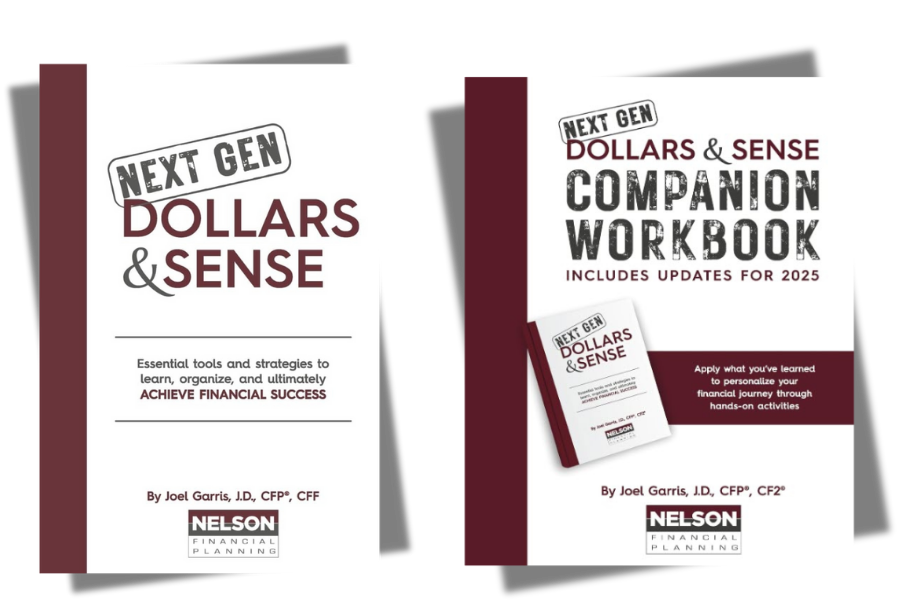
Unlock the secrets to financial success with Joel J. Garris’ insightful book, designed to equip you with the essential tools and strategies needed to take control of your financial future. Whether you’re just beginning your financial journey or approaching retirement, this book offers a comprehensive guide to help you build a solid financial plan that aligns with your goals.
- 8 Wonders1
- Bank Investments3
- Beating Inflation1
- Budget for Retirement5
- Corporate Transparency Act2
- Digital Currency1
- Energy Tax Credits1
- ESG Funds1
- Featured Blog0
- Financial Planning13
- Financial Success4
- Importance of Dividends2
- Investment Portfolio5
- Investment Strategy3
- IRA1
- Joel Garris1
- Nelson Financial Planning7
- Net Worth Improvement1
- Next Gen Dollars and Sense1
- One Big Beautiful Bill Act (OBBBA)1
- Pension Plans1
- Podcast Transcripts12
- Retirement “Secure” Act2
- Retirement Income Planning3
- Retirement Planning7
- Retirement Regrets5
- Social Security4
- Tax Liability3
- Tax Planning7
- Year-End Tax Changes3