




What This Tax Season Really Revealed About Refunds, Overtime Pay & Investing

Joel Garris and Kristin Castello break down the biggest tax season surprises, new deductions, market volatility, and why most people pay less in taxes than they think.
Dollars & Sense Episode Summary
Tax season is over, but the lessons from this year’s returns are just beginning. In this episode of Dollars & Sense, Joel Garris and Kristin Castello unpack the biggest takeaways from the 2026 tax filing season and explain what the latest IRS and Treasury statistics reveal about American households.
The conversation covers the tax changes introduced through the One Big Beautiful Bill and how those changes impacted refunds, withholding, overtime income, tip income, senior deductions, child tax credits, itemized deductions, and even interest deductions on American-made vehicle loans. Joel and Kristin explain why the average tax refund increased this year, why a bigger refund is not always a good thing, and how many taxpayers may want to revisit their withholding for the future.
“That ain’t their money, that is your money that’s coming back to you when it comes to the refund.”
One of the biggest themes throughout the episode is the gap between expectations and reality. Many people expected “no tax on overtime” or “no tax on Social Security” to work differently than they actually did. Joel and Kristin walk through who qualified, how those deductions were calculated, what income limits applied, and why some taxpayers were disappointed when they discovered they earned too much or misunderstood the rules.
“Volatility is the price of long-term growth at the end of the day.”
The episode also shifts into market commentary, highlighting how quickly investor sentiment can change. After a roughly 10% market correction tied to geopolitical fears surrounding Iran, the market recovered rapidly and moved back to record highs. Joel and Kristin discuss why long-term investors should focus less on headlines and more on fundamentals like earnings, consumer spending, and diversification.
“Usually it’s not as bad as it sounds when you’re talking about the tax brackets.”
Finally, they tackle one of the most misunderstood topics in tax planning: the difference between your marginal tax rate and your effective tax rate. For retirees, investors, and anyone worried about “moving into a higher bracket,” this section provides important clarity on how the tax system really works and why most people pay less in taxes than they think.
10 Key Takeaways
- The S&P 500 recovered from a 10% correction and reached new record highs after geopolitical fears eased.
- Corporate earnings remained strong despite market volatility and uncertainty around Iran, Venezuela, and artificial intelligence.
- Average tax refunds increased by roughly 11% this year due to new tax cuts and deductions.
- More than 25 million taxpayers claimed the new “no tax on overtime” deduction.
- The overtime deduction only applies to the “half” portion of time-and-a-half pay, not the full overtime amount.
- “No tax on tips” produced even larger deductions than overtime for many workers in hospitality and service industries.
- The enhanced senior deduction was not truly “no tax on Social Security” and was based on age and income limits.
- Higher SALT deduction caps could lead to more taxpayers itemizing deductions instead of taking the standard deduction.
- Many taxpayers still misunderstand the difference between marginal tax rates and effective tax rates.
- Reviewing your withholding and tax return throughout the year can help prevent surprises and improve long-term planning.
Episode Chapters
- 0:00 – Tax Season Is Over: What Did We Learn?
- 2:15 – Why Tax Refunds Are Bigger in 2026
- 4:10 – Market Recovery: From Iran Correction to Record Highs
- 7:15 – Why Bigger Refunds Aren’t Always Good News
- 9:20 – The Truth About “No Tax on Overtime”
- 3:10 – How the “No Tax on Tips” Deduction Works
- 17:30 – Enhanced Senior Deduction Explained
- 20:45 – Standard Deduction vs. Itemized Deductions
- 24:10 – Car Loan Interest Deduction Rules
- 26:40 – Child Tax Credits and Trump Accounts
- 29:15 – The Tax Bracket Myth Explained
- 33:00 – Marginal Tax Rate vs. Effective Tax Rate
- 36:30 – Why Staying Consistent Matters During Market Volatility
- 40:00 – Key Takeaways for Investors and Retirees
Podcast Transcript
Podcast: Dollars & Sense
Episode Date: April 19, 2026
Speakers: Joel Garris, CERTIFIED FINANCIAL PLANNER® Professional, Certified Financial Fiduciary™ and Kristin Castello, CPA, CFP® is a Certified Financial Planner® professional, a Certified Public Accountant, and a Certified Financial Fiduciary®
0:00 – Tax Season Is Over: What Did We Learn?
00:00
Joel Garris, CF2™: April 15th has come and gone. Hopefully it was a successful season for you, or at least the filing of your tax return was a somewhat successful exercise.
Joining me this week on the program, Kristin Castello, we’re going to go through the process of talking about what we learned this past tax season. We learned a lot this past tax season, didn’t we, Kristin?
Kristin Castello, CPA, CFP®: Oh yes, there were certainly a lot of changes, as there always are, but there are different forms on the tax return.
So we learned some lessons. We had some expectations going into tax season, and reality was a little bit different.
Joel Garris, CF2™: Indeed.
So we’re going to share with you what those differences were and why it’s important to you to know those differences to maybe help save money on your future tax return.
And then we’re going to talk a little bit about, I think this is a common misunderstanding, Kristin, when it comes to taxes. And that’s the difference between your marginal rate versus your effective rate?
Kristin Castello, CPA, CFP®: Yes, and usually it ends up being that you’re not paying as much in taxes as you think you are.
So we’ll kind of go through the differences between those two and how the graduated system works with the tax brackets.
Joel Garris, CF2™: No, absolutely. Key point there.
So we’ll talk about all of that on this week’s edition of Dollars & Sense, where we help you make sense out of all of life’s decisions involving your dollars.
One of Central Florida’s longest running radio programs, also a top 25 financial planning podcast out there on the world wide web.
If you have any trouble finding us on your favorite platform, go to our website at nelsonfinancialplanning.com. There you will see the icons. Click on them. They’ll get you immediately connected.
My name, of course, is Joel Garris. I am a CERTIFIED FINANCIAL PLANNER®, Certified Financial Fiduciary™ at Nelson Financial Planning, where I’ve got the pleasure of one of our fellow Certified Financial Fiduciaries™, also a CERTIFIED FINANCIAL PLANNER®, and most importantly, particularly during tax season, a CPA as well.
Welcome as always, Kristin, to the program.
Big, big past week.
Kristin Castello, CPA, CFP®: Yes, we made it to the finish line. We made it past April 15th.
Joel Garris, CF2™: Indeed.
One of the unique things of our firm at Nelson Financial Planning is for probably 25 years now, we’ve actually been doing tax preparation for our clients.
Really a value add that we reserve exclusively for the clients of the firm.
And a lot of value behind doing an actual tax return to kind of see where the real issues are.
Kristin Castello, CPA, CFP®: Definitely, yes.
And we find it helps out a lot with retirement income planning because we can really help our clients stay within certain tax brackets and figure out their tax withholding so they’re not paying in too much to the tax man, as well as not paying in too little as well.
2:15 – Why Tax Refunds Are Bigger in 2026
02:15
Joel Garris, CF2™: So let’s talk about these numbers. Some very interesting stuff as we were preparing for the show this past week.
Kristin Castello, CPA, CFP®: Yeah, so the biggest kind of headline coming out of the IRS is there were increased refunds for everyone.
So it was kind of saying that over 53 million filers claimed at least one of the new tax cuts this season, helped kind of boost refunds.
So they were saying that tax refunds are up about 11% from last year.
Joel Garris, CF2™: Wow, that’s amazing.
And all of that, of course, as a result of the one big, beautiful bill that passed last July.
So really, because of the timing of that bill, you haven’t really seen the impact until you got to this tax season.
And now we see the impact, that’s for sure.
Kristin Castello, CPA, CFP®: Exactly, yes.
So between the refunds, we also saw a difference in filing behavior.
So how folks are filing their tax returns and how people are using these new deductions and credits.
So there’s a lot going on here, more so than just bigger refunds for most folks.
Joel Garris, CF2™: One of the things that, you know, that sort of the headline number is this notion of refunds.
Now, the Treasury is reporting an average refund of just over 4,300.
So that is an increase of about 11% over the previous year refund.
So refunds went from about 3,100 last year to about 3,400 this year.
Kristin Castello, CPA, CFP®: Yep.
And the average tax cut for filers benefiting from one of these tax cuts was roughly about $800 a person.
So it did have some monetary changes for a lot of folks out there.
Which actually leads us into our next statistics here.
The IRS has actually sent out over $240 billion in refunds.
And that is up 15% from last year.
4:10 – Market Recovery: From Iran Correction to Record Highs
04:10
Joel Garris, CF2™: Beyond April 15th, this past week, of course, it was once again another busy week for the markets.
I’ll tell you, once again, what we’ve seen in the markets, just really almost since the beginning of April, just this past two, three weeks, is a great reminder of how quickly headlines and sentiment can change.
When you think of what the markets were doing throughout the course of March, responding to the war in Iran, and had that technical, met the technical definition of a correction in the form of a 10% decline, here we are, and markets have fully recovered.
Kristin Castello, CPA, CFP®: Yeah, I mean, not only recovered, we’re talking about setting all-time highs here, a new record.
S&P topping 7,000 and its highest closing since January.
So that’s pretty remarkable.
Joel Garris, CF2™: Yeah, I mean, talk about a full quarter of headlines.
And you think about when the market kind of hit that prior high, which was all the way back in January, so it wasn’t that long ago.
But in the subsequent sort of 53 trading days, that’s a little under 11 weeks.
And so a very short period of time that had a lot of concerns about artificial intelligence and replacing big chunks of the economy.
And then, of course, the quarter started with Venezuela and then Iran and a lot going on.
Kristin Castello, CPA, CFP®: During that stretch of time, the markets weren’t imploding.
They were kind of moving pretty slowly and cautiously.
So it’s just showing that the investors were processing a lot of these unknowns and that the markets tend to do okay during periods of uncertainty.
7:15 – Why Bigger Refunds Aren’t Always Good News
07:15
Joel Garris, CF2™: That is a lot of money.
Of course, if getting that big of a refund, so let’s stop here for just a second.
So if I’m getting an average refund of $3,500, perhaps there’s some thoughts that you could put behind that in terms of some planning.
This $3,500 refund basically translates to, instead, you could have $250 more each and every month to maybe spend, better yet, to save.
And so folks need to be thinking about if they’re getting that big of a refund, that there may be some planning opportunities to be thinking about.
Kristin Castello, CPA, CFP®: Yeah, so you can adjust your withholding with your employer to get a little bit more along the way.
That would mean you wouldn’t get a big refund at the end, but that means the IRS wasn’t holding your money longer than it needed to.
Joel Garris, CF2™: Key piece there is, that ain’t their money, that is your money that’s coming back to you when it comes to the refund.
One of the more interesting ones that we saw was something that was really brand new.
And conceptually, we hadn’t seen anything like this in the past, where the number of people that were claiming the no tax on overtime wound up being over 25 million folks claimed that no tax on overtime.
And that was certainly a very new concept for this past tax season.
9:20 – The Truth About “No Tax on Overtime”
09:20
Kristin Castello, CPA, CFP®: Yes, and I know when some of the earlier shows that we did, we were kind of figuring out how are we going to calculate this overtime?
Because the way that it works is it’s not the full amount of overtime you’re paid.
So if you’re paid time and a half, it’s a half that’s above your base pay.
So the question was, how are we going to calculate this?
So what we ultimately came up with is we just have to request the year-end pay stubs.
We got to see kind of what the payout or the overtime payout was throughout the year, and then from there determine what that time and a half, the half part of it was.
But what was actually a pretty pleasant surprise is a lot of the form W-2s had that amount calculated for us.
So I’d say about a third of them had it already calculated.
So they were kind of planning ahead for the specific deduction.
And that really did help a lot of our tax clients.
Joel Garris, CF2™: Because next year, that is going to be a mandatory part of the W-2.
Right.
The bill passed.
They didn’t have enough time to kind of update the forms and all of that.
So it was kind of a little bit of a question mark as to how we were going to ultimately arrive at that number.
But next year, the W-2 should all be properly reporting that.
And the other thing about that, which I think is a little bit of a confusion part, is the no tax piece only applies to the half piece.
It doesn’t apply to the whole amount that you make working overtime.
It’s just the extra half piece that you earn when you’re doing overtime.
Kristin Castello, CPA, CFP®: Right.
So we actually did see some folks that had just straight overtime.
There was not that time and a half.
And so that unfortunately didn’t qualify, even though it did show up as overtime on their pay stubs.
Joel Garris, CF2™: I remember seeing a couple of those.
Yeah, that’s a good point.
So you actually had to get paid the time and a half and not just flat rate overtime, because otherwise it was nothing to deduct.
Average overtime deduction I think was at least nationally about $3,100.
Pretty on par with kind of what we saw as we think back to the tax returns we looked at this year.
Kristin Castello, CPA, CFP®: Yes.
So the maximum that you could claim for this deduction is $12,500 per person.
So if you’re married, that’s $25,000.
But we didn’t really see anybody pushing that limit.
And ironically, the few that we did see that were pretty high in overtime, they weren’t able to take the deduction because their income was over the AGI limits.
So that’s pretty unfortunate.
The way that there is an AGI limit on it, that’s $150,000 for single, $300,000 for married.
So if you’re making that much overtime, you may be pushing the higher end of those AGI limits.
Joel Garris, CF2™: Great point, because all of that is based upon income.
And if you’ve got $25,000, if a couple has $25,000 of overtime, and again, that’s just the half piece, then you probably got a pretty good level of income, that’s for sure.
Kristin Castello, CPA, CFP®: Right.
So we kind of saw that too.
So if you do have a lot of overtime and your income is kind of pushing those levels, just kind of keep that in mind.
You might not be able to take the deduction.
But we did see, this was probably the most widely seen deduction of the one big beautiful bill deductions that we saw with our personal clients.
Joel Garris, CF2™: Yeah, 25 million, as we said earlier, took the no tax on overtime.
A smaller group, but perhaps this was even more valuable, at least some of the examples that we saw.
Smaller group, about 6 million filers claimed the no tax on tips, with that actually averaging about a $7,000 deduction because that was pure tip income.
There wasn’t even like a partial thing.
If it was tip income, you got to take 100% of it and get no taxes on that.
13:10 – How the “No Tax on Tips” Deduction Works
13:10
Kristin Castello, CPA, CFP®: Yes, and similar to the overtime, there were some income limitations on it.
So your adjusted gross income had to be at those same levels, $150,000 for single, $300,000 for married.
But it was easier to get these figures.
So with the overtime, we had to request pay stubs to kind of calculate that amount.
But for tips, usually that is reported on the form W-2 on box 7, Social Security tips.
So that number was given to us on the W-2.
We just kind of put it in the tax return.
The only kind of thing we had to do a little bit of analysis on would be figuring out if they are in the qualified occupation for the tips.
So you have to be in occupation like hospitality or service workers to claim that deduction.
Joel Garris, CF2™: And this one was pretty significant because it was $25,000 per return.
And we really saw some interesting things on this one in terms of how we played out.
And we want to dig a little bit more into that.
But we’re going to take a break first here on Dollars & Sense with Joel Garris and Kristin Castello of Nelson Financial Planning.
Being a CPA makes you certainly an expert on our topic today, which is working through some of these numbers, both what we saw at the office in terms of the hundreds of returns that we prepare, but also what we saw nationally for the American population as a whole.
Kristin Castello, CPA, CFP®: And what we’ve found so far is our numbers are pretty similar to what we see or what the IRS has seen on the national level.
So we previously talked about the no tax on overtime, and that was pretty on par with what we saw in the office here is that average deduction was about $3,100 per return where it qualified.
And then we were just talking about the no tax on tips before the break here.
And we also found that to be pretty on par with the national level.
So that average deduction was about $7,000 per return.
Joel Garris, CF2™: Bigger deduction for the no tax on tips versus the no tax on overtime.
And because the tips, it’s 100% of that you could write off versus the overtime where it was just the half piece of the overtime.
So that led to a big difference in terms of the amount of the deduction.
The other thing was just how it played out.
And this, I remember a tax return early in season, where I was reviewing it and I came and I talked to you and I said, is this right?
I can’t believe how big of a difference that it made on that particular tax return.
Kristin Castello, CPA, CFP®: So with the no tax on tips, there is actually a $25,000 cap per return.
So different from the no tax on overtime, where it was a $12,500 deduction per person, the no tax on tips was $25,000 per return.
So that’s for a single person or a married person.
Joel Garris, CF2™: Yeah, and only in the particular case that I’m thinking about, it was just one person that had tip income.
But that’s what they do.
I mean, that is their career.
They’ve had a very successful career in the restaurant business as a waiter.
And yeah, it was a huge write-off on the no tax on tips.
Kristin Castello, CPA, CFP®: Right, because tips are a significant part of their W-2s.
So if they’re able to take the full $25,000 on a single return, that is a big deduction.
Joel Garris, CF2™: Significant, really.
And I guess that gets us to another one that was significant in conversation, maybe not in impact.
And this is the new senior deduction that was often referred to as the no tax on Social Security.
It didn’t exactly work out like that.
17:30 – Enhanced Senior Deduction Explained
17:30
Joel Garris, CF2™: Across the country, about 30 million seniors claimed that enhanced senior deduction that was basically $6,000 per person, but you had to be over age 65.
And of course, there were those income limits that applied as well.
Kristin Castello, CPA, CFP®: So those income limits were $75,000 for single filers and $150,000 for joint filers or married filers.
And there was a little bit of a threshold.
So if you did trigger that and went a dollar over, you still got the majority of the deduction and then it phased out as your income went up above those levels.
Joel Garris, CF2™: It seemed like that was the case on the majority returns that we looked at this season as we prepared those for our clients.
Some people certainly got the full amount, six and six, or the full 12, but more often than not, it was just a partial part of that.
Kristin Castello, CPA, CFP®: Right.
So that’s kind of why the average enhanced senior deduction per return came out to be $7,500 because of those phase outs and whatnot.
Joel Garris, CF2™: Versus the full 12 that in theory you could get.
Billed as no tax on Social Security, that was certainly not the case.
I found myself, as I’m sure you did, Kristin, this past tax season, explaining that.
I thought my Social Security was not going to be taxed.
No, it’s not really how that works.
It’s the same as it’s always been, except you get this little extra kicker.
Kristin Castello, CPA, CFP®: Yeah, I mean, it worked in favor for a good amount of clients, but unfortunately, it didn’t play out as it seemed.
Joel Garris, CF2™: Interestingly, not based on whether you take Social Security.
It’s solely on whether you were age 65.
So some interesting things on all of that.
That is for, of course, the larger standard deduction that was implemented back in 2017, that also became permanent.
So we certainly saw a lot of people kind of doing the standard deduction once again.
20:45 – Standard Deduction vs. Itemized Deductions
20:45
Kristin Castello, CPA, CFP®: Yep.
So the numbers on that are over 105 million filers took the standard deduction.
But I expect that we’re going to see a decrease in those that did take the standard deduction from year to year from 2024 to 2025 filing, because there were some changes to the itemized deductions where I think we will see an uptick in the amount of returns that itemized now.
So we did see a change and the big one was increasing the state and local tax cap from $10,000 a return to $40,000 a return.
Joel Garris, CF2™: Yeah, I think that’s income limited, of course.
The common theme here is that any of these deductions are always limited.
If you make too much money, you don’t get them.
But we certainly saw maybe that one doesn’t have as big of an impact here in Florida because you don’t have a state income tax.
But we certainly saw some examples where folks had maybe a second home or something like that.
They were able to then write off the real estate taxes not just on their primary, but also on their secondary.
I’d be curious to see what those numbers ultimately play out as, because certainly it does open up an opportunity where people could have a little bit more opportunity to itemize.
We’ll see kind of how that skewed the numbers in terms of filers.
Kristin Castello, CPA, CFP®: Right.
So once the IRS publishes those numbers, I mean, I can’t really see the future, but I would almost guarantee there’s going to be an uptick in the amount of Schedule A.
That’s the itemized deductions.
Joel Garris, CF2™: Yeah.
So we’re talking about takeaways from taxes, not just what we saw in the office at Nelson Financial Planning, but also sort of what these average numbers were across the country.
Thirty-four million families, for example, claimed the enhanced child tax credit, an extra amount of money for children under a certain age that wound up being $2,200.
So a larger amount for that child tax credit.
What else did we see?
24:10 – Car Loan Interest Deduction Rules
24:10
Joel Garris, CF2™: Yeah. So we’re talking about takeaways from taxes, not just what we saw in the office at Nelson Financial Planning, but also sort of what these average numbers were across the country. Thirty-four million families, for example, claimed the enhanced child tax credit, an extra amount of money for children under a certain age that wound up being $2,200. So a larger amount for that child tax credit. What else did we see?
Kristin Castello, CPA, CFP®: We saw that there’s also been an uptick with the Trump accounts. So that is the first year that these have been kind of attached to the tax return. So what we saw is about 5 million of these accounts have been opened, with about 1.2 million qualifying for the $1,000 pilot program. So what we saw this year is, if you had a child last year in 2025, it’s a separate form. It’s a Form 4547, and it was attached to the tax return. You had to check a couple boxes saying you qualified for the pilot program, and then it got its own specific e-filing authorization form. So it’s almost like it was its own separate return attached with your personal tax return.
Joel Garris, CF2™: Those accounts obviously not yet set up, we expect to start to see those roll out sometime during the course of the summer. So to be determined on that, but important to file that form with your tax return, particularly to get that $1,000 pilot contribution program for a kid that had to have been born in the year 2025.
Kristin Castello, CPA, CFP®: Right. And what we also saw is for folks that bought a new automobile in 2025, about 1 million filers deducted the interest on loans for newly purchased American vehicles. And the average deduction came out to be about $1,800 per return.
Joel Garris, CF2™: This one was very frustrating. I think this was one of the more frustrating conversations we had to have with folks while during the course of tax season, because it seemed like most lenders were issuing these letters or these statements that said, well, here’s how much you paid in interest just on sort of a blanket basis, which then gave people the impression, well, I must have qualified for this deduction, but we found ourselves explaining to folks often that they actually didn’t.
Kristin Castello, CPA, CFP®: Yeah, so there were two main factors to be able to take this deduction. It was that your car must be new. So it could be a 2024 model, but as long as you are the first owner of it and the first driver of it, that would be considered new. And it had to be manufactured in the US. So we found folks meeting one of the two requirements pretty frequently, or they might have had a car loan for years and then they just get this letter and they’re wanting to deduct it on their tax return. So unfortunately, we were able to figure out these things based upon the vehicle identification number, which also had to be reported on the return.
Joel Garris, CF2™: Well, and slightly fewer total returns overall, much more of a reliance on e-filing as well.
Kristin Castello, CPA, CFP®: Yes.
Joel Garris, CF2™: We’ll wrap that up when we continue here on Dollars & Sense with Joel Garris and Kristin Castello of Nelson Financial Planning.
26:40 – Child Tax Credits and Trump Accounts
26:40
Joel Garris, CF2™: As we wrap up this conversation, Kristin, about sort of what we saw at Nelson Financial Planning in terms of as we were preparing tax returns for our clients, as we do each and every year, we prepare hundreds of tax returns for our clients. And kind of thinking about what the trends were that we saw nationally, any other sort of takeaways in terms of kind of the more the bigger picture, if you will, on this.
Kristin Castello, CPA, CFP®: Yeah, so some of the numbers are showing that there have been slightly fewer total returns filed overall compared to last year. So it seems that either tax filers are realizing maybe they don’t have to file, so if they’re below the income levels. Also that tax professionals, the e-filing has dropped a little bit too, which means that people are preparing their own tax returns, a lot more self-prepared, which just means people are using TurboTax, H&R Block, those tax filing softwares to kind of do it on their own too.
Joel Garris, CF2™: Right. Returns filed by tax professionals kind of dropping a little bit. Obviously, the software and the technology getting more stronger, more user-friendly. IRS.gov, their website also saw a significant increase in traffic, a 60% increase in traffic they were reporting compared to last year. And I guess that’s because of the impact of the one big beautiful bill. A lot of changes, which I’m sure drove a lot of people to try and kind of do some additional research on their own.
Kristin Castello, CPA, CFP®: Yes, double checking the rules, making sure that they follow all the qualifications and kind of just being able to make sure they can take these new deductions that we really haven’t seen before.
Joel Garris, CF2™: Yeah, so overall, big takeaways from your perspective, Kristin, as you navigated through yet another tax season.
Kristin Castello, CPA, CFP®: So, I mean, we did see the bigger refunds for a lot of these new deductions that we saw. Well, most widely seen was the no tax on overtime, but the biggest benefit we did see from the new deductions was the no tax on tips. So big refunds feel good, but what we want to just kind of put on your mind is maybe think about tax withholding. So maybe update your tax withholding along the way so that maybe if you are getting that bigger refund, you can kind of plan a little bit better and have extra money throughout the year.
Joel Garris, CF2™: Point of the timing of the One Big Beautiful Bill and what it was designed to accomplish was really to kind of have an influx or a push of dollars into the economy right at this point in time for very political reasons. Because let’s not forget, this is a midterm year, and my goodness, we’re going to start to hear a lot about those as the next few weeks roll by, that’s for sure.
Kristin Castello, CPA, CFP®: That makes sense.
Joel Garris, CF2™: Definitely designed to get those dollars in the economy during the course of the second quarter, the third quarter. And certainly when we look at the numbers, it certainly does appear larger refunds, certainly more numbers that are all part of it. You know, one of the numbers that always gets, people always get confused about is sort of what they are paying on taxes in terms of a tax rate. And this one, I think, sometimes when we talk to people, I almost kind of feel the stress that they’re having over this issue.
29:15 – The Tax Bracket Myth Explained
29:15
Joel Garris, CF2™: Point of the timing of the One Big Beautiful Bill and what it was designed to accomplish was really to kind of have an influx or a push of dollars into the economy right at this point in time for very political reasons. Because let’s not forget, this is a midterm year, and my goodness, we’re going to start to hear a lot about those as the next few weeks roll by, that’s for sure.
Kristin Castello, CPA, CFP®: That makes sense.
Joel Garris, CF2™: Definitely designed to get those dollars in the economy during the course of the second quarter, the third quarter. And certainly when we look at the numbers, it certainly does appear larger refunds, certainly more numbers that are all part of it.
You know, one of the numbers that always gets, people always get confused about is sort of what they are paying on taxes in terms of a tax rate. And this one, I think sometimes when we talk to people, I almost kind of feel the stress that they’re having over this issue.
Kristin Castello, CPA, CFP®: It’s triggering another tax bracket. That is a very scary conversation for a lot of folks, because the way that it’s kind of, the way that it seems is, so if I’m in the 24% bracket, does that mean I’m paying 24% on all of my income? And that is a common misconception.
That is typically not how it works out.
Joel Garris, CF2™: One of those things really, I was just going to push me into the 24% bracket, and the answer might be, well, yeah, but be careful on what you conclude is the implications, which really gets us into a couple of technical concepts here towards the end of the program, but I think they’re important.
And that’s this notion of marginal tax rate versus your effective tax rate.
Kristin, help us kind of understand the difference between those two.
33:00 – Marginal Tax Rate vs. Effective Tax Rate
33:00
Kristin Castello, CPA, CFP®: So the marginal tax rate is your top tax bracket. So it’s the rate that you pay on your last dollar of income. So the way that the US tax system works is it’s a progressive tax system, so it’s kind of graduated rates. So as you fill up one tax bracket, so the first one is 0 to 10%, then you graduate to the next bracket, which is 12%. So your first chunk of income is taxed at that 0 to 10% level. And then once you trigger that next bracket, that’s when the 12% tax kicks in.
Joel Garris, CF2™: Yeah, so if your marginal rate is, say, 24%, certainly not all of your income is taxed at that 24% level. It’s important to know sort of where you fall in the bracket. That is always the case to see how much of your income is taxed at that marginal tax bracket, but it’s just that portion of income.
Very different concept when we start to talk about the effective tax rate.
Kristin Castello, CPA, CFP®: So the effective tax rate is, it’s a calculation. So it’s just your total tax bill divided by your total taxable income.
Joel Garris, CF2™: Yeah, in essence, it’s kind of like the average. Like on any dollar that I make, indiscriminately, pick a dollar, the average tax rate that I’m going to wind up paying on that becomes your effective tax rate.
Kristin Castello, CPA, CFP®: Right, and that is almost more of a better number to use when it comes to calculating your tax bills, because there’s a lot of other factors that go into your total tax besides just your tax bracket. So you might have different tax rates depending on if you have investment income, because capital gain rates and qualified dividend rates are lower than your typical tax bracket. And then there’s also other taxes that could come into play. So things like credits. So the child tax credit that we were talking about a little bit earlier on the program, that can help reduce your total tax bill, but that’s not necessarily factored into your marginal tax bracket.
Joel Garris, CF2™: Well, and then overlay all of this with sort of, there’s like a dual tax rate structure, right? So there’s a tax rate structure that applies on income and then there’s a different one that’s generally lower rates that applies on things like qualified dividends, long-term capital gains, those kinds of things. So it does kind of make the question of, okay, well what’s my marginal tax bracket?
Well, if maybe capital gains or dividends are driving you into that next, quote unquote, income tax bracket, it doesn’t mean that that’s actually what you’re paying.
Right, because there’s a different tax rate that would apply to those long-term capital gains.
So if you’re in like the 24, maybe you’re at 15 or maybe you’re at 15% and then plus the Medicare tax of the 3.8. I mean, so there’s all kinds of, there’s no easy answer, I guess.
Shockingly, when it comes to answering questions about your taxes, there’s no easy answer. It’s always a little more complicated, isn’t it?
Kristin Castello, CPA, CFP®: But kind of the key takeaway is usually it’s not as bad as it sounds when you’re talking about the tax brackets. Generally, what we see is that if your tax bracket is, say, the 22%, then your average or your effective tax rate is probably closer to 15%.
Joel Garris, CF2™: Well, and that’s so important. And why this is important to kind of understand that is that is huge for kind of the planning decisions, the financial planning decisions, the retirement planning decisions, the income planning decisions that we do every day with our clients at Nelson Financial Planning.
One of the biggest reasons why we actually started a tax preparation service. This isn’t just an estimate. This is actually filing, signing and completing tax returns for our clients. And it really does, we see where there’s a lot of opportunity to add a lot of value to exactly how best to be as tax efficient as possible, particularly in retirement.
Kristin Castello, CPA, CFP®: Yes, and we actually see a lot of this planning come out with Roth conversions or retirement planning where we want to keep people below, you know, a filing threshold. So it really does have a lot of benefit.
Joel Garris, CF2™: That’s one of the things why, in particular, we’ve been saying, don’t just take that tax return and throw it in the file cabinet, or in today’s world, you’re probably throwing it up in a cloud somewhere.
But take a moment and really, really take a look at it and try and see, okay, if I got a refund, what does that really mean? Or if I owe money similarly, what does that really mean?
Kristin Castello, CPA, CFP®: Right, and kind of making those changes throughout the year so that it’s not a surprise on tax day, whether it’s a pleasant surprise or an unpleasant one, but kind of making those changes throughout the year.
Joel Garris, CF2™: Yeah, no, so important, so important. So as you reflect on your own tax season, if you’re listening to our program, either here on Terrestrial Radio or on one of our podcast channels or YouTube channels. So important to make sure that you are getting that all-inclusive, more holistic approach to your finances.
So if folks think that that’s something that they might need more help on, how can they reach us?
36:30 – Why Staying Consistent Matters During Market Volatility
36:30
Joel Garris, CF2™: Well, and that’s so important. And why this is important to kind of understand that is that is huge for kind of the planning decisions, the financial planning decisions, the retirement planning decisions, the income planning decisions that we do every day with our clients at Nelson Financial Planning. One of the biggest reasons why we actually started a tax preparation service. This isn’t just an estimate. This is actually filing, signing and completing tax returns for our clients. And it really does, we see where there’s a lot of opportunity to add a lot of value to exactly how best to be as tax efficient as possible, particularly in retirement.
Kristin Castello, CPA, CFP®: Yes, and we actually see a lot of this planning come out with Roth conversions or retirement planning where we want to keep people below, you know, a filing threshold. So it really does have a lot of benefit.
Joel Garris, CF2™: That’s one of the things why, in particular, we’ve been saying, don’t just take that tax return and throw it in the file cabinet, or in today’s world, you’re probably throwing it up in a cloud somewhere.
But take a moment and really, really take a look at it and try and see, okay, if I got a refund, what does that really mean? Or if I owe money similarly, what does that really mean?
Kristin Castello, CPA, CFP®: Right, and kind of making those changes throughout the year so that it’s not a surprise on tax day, whether it’s a pleasant surprise or an unpleasant one, but kind of making those changes throughout the year.
Joel Garris, CF2™: Yeah, no, so important, so important. So as you reflect on your own tax season, if you’re listening to our program, either here on Terrestrial Radio or on one of our podcast channels or YouTube channels. So important to make sure that you are getting that all-inclusive, more holistic approach to your finances. So if folks think that that’s something that they might need more help on, how can they reach us?
40:00 – Key Takeaways for Investors and Retirees
40:00
Kristin Castello, CPA, CFP®: So give us a call, 407-629-6477, or visit our website. You can do the contact us option. Just send us a message and we will be happy to reach out and set up.
Joel Garris, CF2™: NelsonFinancialPlanning.com. While there, you can also request a free copy of our book as well, Next Gen Dollars & Sense and its companion workbook published last year. So if you’re interested in that set of documents or literature, feel free to reach out to us as well on that.
With that, we’re going to wrap it on up and get on out of here. My name is Joel Garris with Kristin Castello of Nelson Financial Planning. This has been Dollars & Sense.
Next Steps
If you’d like help reviewing your financial plan, investment strategy, or retirement readiness, explore the resources available through Nelson Financial Planning or schedule a consultation to discuss your goals.
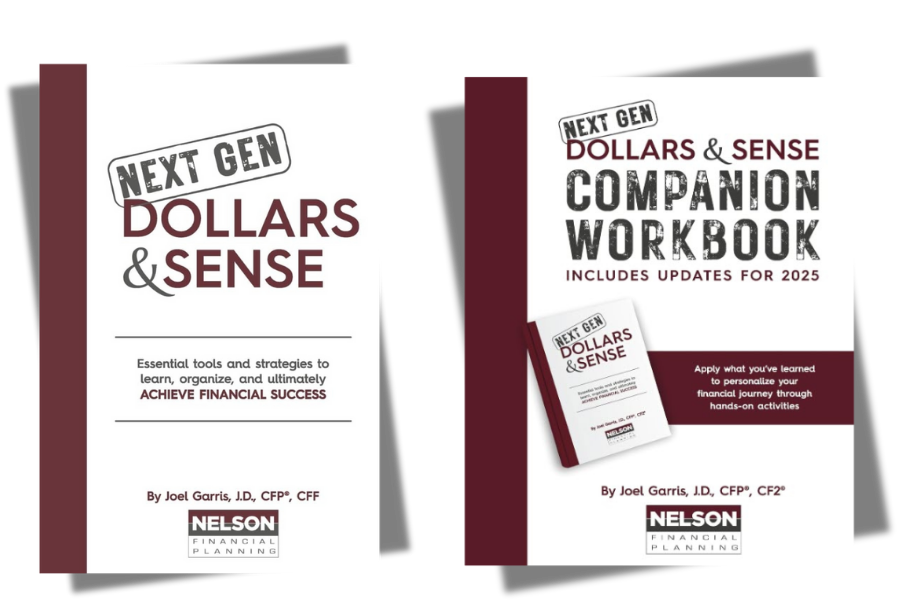
Unlock the secrets to financial success with Joel J. Garris’ insightful book, designed to equip you with the essential tools and strategies needed to take control of your financial future. Whether you’re just beginning your financial journey or approaching retirement, this book offers a comprehensive guide to help you build a solid financial plan that aligns with your goals.
REQUEST YOUR FREE COPY OF OUR BOOK & WORKBOOK!
- 8 Wonders1
- Bank Investments3
- Beating Inflation1
- Budget for Retirement5
- Corporate Transparency Act2
- Digital Currency1
- Energy Tax Credits1
- ESG Funds1
- Featured Blog0
- Financial Planning14
- Financial Success5
- Importance of Dividends1
- Investment Diversification1
- Investment Portfolio6
- Investment Strategy4
- IRA1
- Joel Garris1
- Nelson Financial Planning7
- Net Worth Improvement1
- Next Gen Dollars and Sense1
- One Big Beautiful Bill Act (OBBBA)1
- Pension Plans1
- Podcast Transcripts17
- Retirement “Secure” Act2
- Retirement Income Planning3
- Retirement Planning7
- Retirement Regrets5
- Social Security4
- Tax Liability3
- Tax Planning7
- Year-End Tax Changes3